
Kuwait doesn’t just discourage cryptocurrency-it bans it completely. Since July 2023, the Central Bank of Kuwait has enforced one of the strictest crypto prohibitions in the world. No trading. No mining. No payments. No investments. Not even a loophole. If you’re using Bitcoin, Ethereum, or any other digital asset in Kuwait, you’re breaking the law.
What Exactly Is Banned?
The ban isn’t vague. It’s detailed. It covers every possible way you might interact with cryptocurrency. The Central Bank of Kuwait issued a directive to all banks, financing companies, and exchange firms: stop all crypto-related activity. That means no accepting Bitcoin as payment, no converting USD to Ethereum, no offering crypto wallets, and no facilitating trades between customers. It doesn’t stop there. The Capital Markets Authority, the Insurance Regulatory Unit, and the Ministry of Commerce and Industry all jumped in with their own circulars. Together, they shut down four key areas:- Payments: You can’t pay for goods or services with Bitcoin or any other digital asset. No merchant in Kuwait is allowed to accept it.
- Investments: No one can sell you crypto as an investment. No trading platforms, no brokers, no crypto ETFs-none of it.
- Licensing: No business, foreign or local, can get a license to offer crypto services. And no such license has ever been issued.
- Mining: Running a Bitcoin miner in your garage, basement, or warehouse? Illegal. Period.
Why Does Kuwait Care So Much?
Kuwait isn’t just being cautious-it’s reacting to real risks. The Central Bank of Kuwait says crypto threatens financial stability, enables money laundering, and undermines its banking system. But there’s another reason, one that’s more physical: electricity. In 2022, Kuwait had the cheapest electricity in the world for Bitcoin mining. At just $1,400 per BTC, it was cheaper than mining in Texas, Germany, or Canada. With government-subsidized power, crypto miners flocked to the country. By April 2025, authorities had identified over 1,000 illegal mining operations. These aren’t small rigs. They’re industrial-scale setups, often running 24/7 in warehouses and residential buildings. The result? Massive power drain. The Ministry of Electricity, Water, and Renewable Energy reported that Bitcoin mining alone consumes 140,336 GWh per year-more than Ukraine or Malaysia. That’s enough to power hundreds of thousands of homes. When miners overload the grid, it causes blackouts. Schools, hospitals, and homes lose power. That’s not just inconvenient-it’s dangerous.What Laws Are Being Broken?
The ban isn’t just a policy-it’s backed by criminal law. The Ministry of Interior made it clear: crypto mining violates multiple existing laws, including:- Law No. (56) of 1996 (Industry Law) - unauthorized industrial activity
- Law No. (31) of 1970 (Penal Code) - illegal use of public resources
- Law No. (37) of 2014 (CITRA) - unauthorized telecommunications use
- Law No. (33) of 2016 (Kuwait Municipality) - illegal use of residential or commercial property

How Does Kuwait Compare to Other Gulf Countries?
While Kuwait shuts the door, its neighbors are opening windows. The UAE and Bahrain have full crypto licensing systems. Saudi Arabia allows regulated exchanges. Oman is testing a central bank digital currency. Even Qatar, once as strict as Kuwait, is preparing to allow digital assets in its financial free zone by mid-2025. Kuwait stands alone. It doesn’t want to regulate crypto-it wants to eliminate it. The Central Bank of Kuwait has made it clear: digital assets are incompatible with its financial system. They don’t see blockchain as innovation. They see it as a threat to control, stability, and public safety.What About Central Bank Digital Currency (CBDC)?
You might wonder: if they hate crypto, why not create their own digital currency? That’s exactly what Kuwait is considering. While private cryptocurrencies are banned, the Central Bank of Kuwait is studying a sovereign digital dinar. A CBDC would let the government control digital money without losing oversight. It would be traceable, secure, and backed by the state. This isn’t just theoretical. Kuwait has already passed the Sukuk Law to strengthen Islamic finance and authorized up to KWD30 billion ($97 billion) in sovereign debt. These moves show they’re not against financial innovation-they just want it under their control.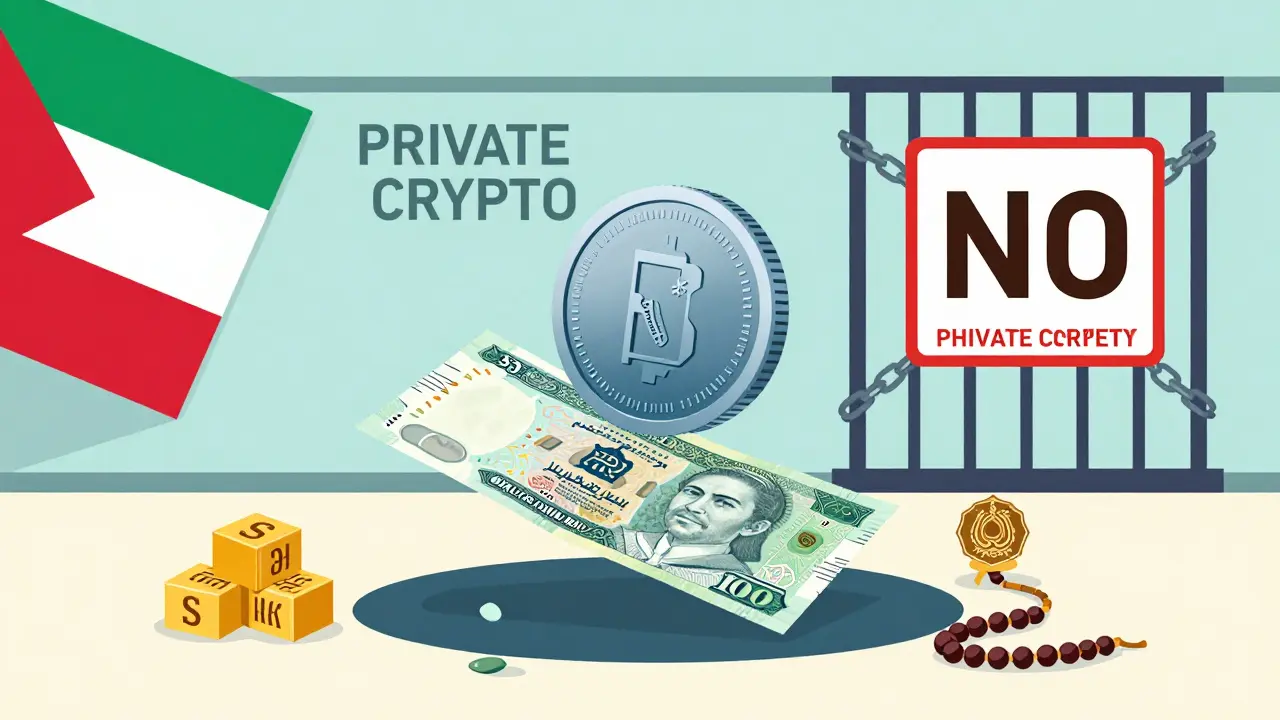
What Happens If You Ignore the Ban?
If you’re a resident or business in Kuwait and you’re still mining, trading, or accepting crypto, you’re playing with fire. The government isn’t just watching-it’s acting. Enforcement is coordinated across multiple agencies:- Ministry of Interior: Investigates and prosecutes violations
- Ministry of Electricity: Detects abnormal power usage patterns
- CITRA: Monitors network traffic for mining activity
- Kuwait Municipality: Inspects buildings for illegal setups
Jill McCollum
19 01 26 / 01:56 AMlol so kuwait just banned crypto because people were using too much electricity?? like... they literally have the cheapest power on earth and now they're mad? 😅 i mean, if you're gonna subsidize energy, maybe don't be surprised when folks turn your grid into a bitcoin farm 🤷♀️
CHISOM UCHE
19 01 26 / 14:30 PMThe energy consumption metrics cited here are non-trivial - 140,336 GWh/year is comparable to national grids of medium-sized economies. The marginal cost of mining in Kuwait was essentially negative due to zero marginal pricing of electricity, which created a classic tragedy of the commons scenario. Regulatory capture by incumbent financial institutions likely accelerated the prohibition.
Stephen Gaskell
20 01 26 / 21:53 PMGood. Let the crypto bros take their rigs to some other country. We don't need their chaos here.
Hailey Bug
21 01 26 / 03:09 AMHonestly, the power grid issue is the most compelling argument I've seen. I get that crypto fans think it's about freedom, but when your neighbor's basement miner is causing your hospital to lose power during a heatwave? That's not innovation. That's negligence. Kuwait's response isn't extreme - it's responsible.
Pat G
21 01 26 / 07:54 AMTypical middle eastern authoritarianism. They'd rather keep people poor and controlled than let them have any financial autonomy. Crypto is the people's money. They hate that.
Hannah Campbell
22 01 26 / 04:04 AMso they banned crypto but are totally fine with a government digital currency?? wow what a surprise lol guess its only illegal if its not controlled by the state 🤡
Bryan Muñoz
23 01 26 / 01:03 AMthis is all a distraction. the real reason? the central bank knows crypto exposes how corrupt and inefficient their whole financial system is. they're terrified of transparency. this isn't about power grids - it's about control. the fed and the ECB are already panic-booking CBDCs because they know what's coming. kuwait is just early to the fear.
Haley Hebert
23 01 26 / 15:53 PMI think it's actually kind of beautiful how Kuwait is choosing stability over hype. I know it sounds boring but imagine growing up in a country where your electricity doesn't randomly cut out because someone's mining Bitcoin in the apartment below you. I mean, sure, crypto is cool and all, but what's the point if you can't even charge your phone during a blackout? I get why people get mad about bans, but sometimes rules exist because someone actually cares about keeping the lights on for everyone else. It's not about being anti-tech - it's about being pro-human.
Chris Evans
24 01 26 / 00:30 AMThere's a metaphysical layer here that no one's touching. Crypto, in its purest form, is a rejection of centralized authority - a digital protest against the monopolization of value. Kuwait's ban isn't just legal - it's ontological. They're saying: 'We will not permit the existence of an alternative reality to our monetary order.' And that's terrifying. Because if a nation can outlaw a technology because it threatens its epistemological hegemony... then what's next? Will they ban dissenting thought next? Or will they just start labeling all unregulated innovation as 'electricity theft'?
myrna stovel
26 01 26 / 00:10 AMI really respect how Kuwait is prioritizing public safety over speculative markets. It's easy to get caught up in the hype of digital assets, but when your neighbor’s mining rig is causing your child’s school to lose AC during 50°C weather, it stops being a debate about finance and becomes a question of basic welfare. Not everyone can opt out of the grid - and that’s why some rules need to be firm.
Rod Petrik
27 01 26 / 11:37 AMthey're lying. this isn't about power. it's about the fed. the usa is pressuring them to shut it down because they don't want other countries creating untraceable money systems. the cbdc is just a trap. they want to track every single cent you spend. you think they care about blackouts? they care about control. they already have cameras everywhere - now they want your wallet too. wake up.
Michael Jones
28 01 26 / 05:56 AMThe legal framework referenced here is actually quite robust - Laws 56/1996, 31/1970, 37/2014, and 33/2016 collectively create a clear, enforceable basis for prosecution. This isn't arbitrary enforcement. It's a coordinated application of existing statutes to a novel threat. The fact that multiple agencies are involved shows institutional cohesion, not overreach.
Alexis Dummar
29 01 26 / 05:24 AMi mean... if you have free electricity and no one's stoppin you... why not mine? but then again... if you're using up enough power to run a small country and people start losing power at the hospital... yeah that's just not cool. i get why they banned it. but i also get why people are mad. it's like... you let the door open and then slam it shut when someone walks through. kinda unfair. still... power grid first. always.
Ashlea Zirk
30 01 26 / 16:23 PMThe regulatory clarity demonstrated by Kuwait’s multi-agency coordination is commendable. The absence of ambiguity in the prohibition minimizes legal gray zones, thereby enhancing compliance. Furthermore, the emphasis on sovereign digital currency development reflects a strategic alignment with both financial sovereignty and technological modernization - a model worth examining in other jurisdictions seeking to preserve monetary integrity without embracing decentralized alternatives.
Christina Shrader
31 01 26 / 03:08 AMI'm not into crypto but I get it - if your country's power is so cheap that people are turning homes into data centers, you have to act. It's not about hating tech. It's about not letting a few people burn through the public commons. I'd rather see Kuwait invest in solar than let miners drain the grid.
Lauren Bontje
31 01 26 / 13:28 PMThis is just the beginning. They're going to ban VPNs next. Then private messaging apps. Then offline cash. Once you let the government control your money, they control everything. This isn't about electricity - it's about total domination. Welcome to the new world order.
Alexandra Heller
31 01 26 / 17:22 PMPeople call this a ban, but really - it’s a moral choice. You can’t claim to value freedom while using energy that belongs to every citizen to fuel speculative gambling. Crypto isn’t innovation - it’s a luxury for the reckless. Kuwait chose to protect its people over the fantasies of tech bros. And honestly? I respect that more than any blockchain.
Josh V
2 02 26 / 00:47 AMstop crying about the ban and go mine somewhere else the grid is not yours to burn