
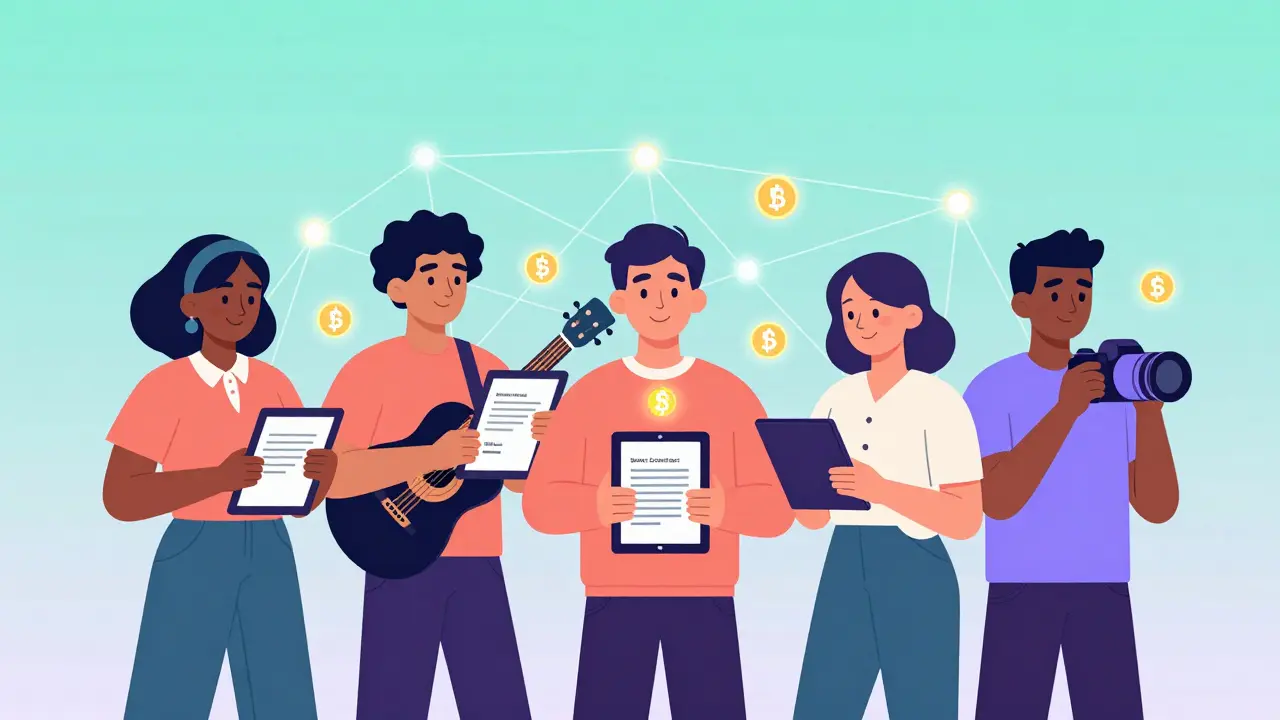
Imagine posting a video, song, or article and getting paid instantly-no middlemen, no delays, no hidden fees. That’s what content monetization smart contracts do. They’re self-executing agreements on the blockchain that pay creators the moment someone accesses or buys their work. No invoices. No PayPal holds. No platform taking 30%. Just code that enforces fairness, automatically.
How Smart Contracts Turn Content Into Cash
Smart contracts aren’t magic. They’re lines of code-written in languages like Solidity or Rust-that run on blockchains like Ethereum or Polygon. You set the rules: if a user pays 0.05 ETH to read your essay, then they get access, and 95% of that goes straight to your wallet. The rest? A tiny fee to the network. That’s it.
Traditional platforms like YouTube or Medium take a cut, delay payouts, and control what gets seen. Smart contracts remove all that. Your content lives on the blockchain. Payments happen in crypto. You own the distribution. And because every transaction is recorded permanently, there’s no dispute over who paid what or when.
Take a photographer selling limited-edition digital prints. Instead of uploading to Shutterstock and waiting 45 days for a $2 payout, they deploy a smart contract. Each print is a unique NFT. When someone buys it, the contract instantly sends 85% to the artist, 10% to the marketplace, and 5% to a royalty pool for future collaborations. All in under a minute. No bank involved.
Revenue Models That Actually Work
There’s no one-size-fits-all way to monetize content. But smart contracts make it easy to mix and match models-without locking you into a platform’s terms.
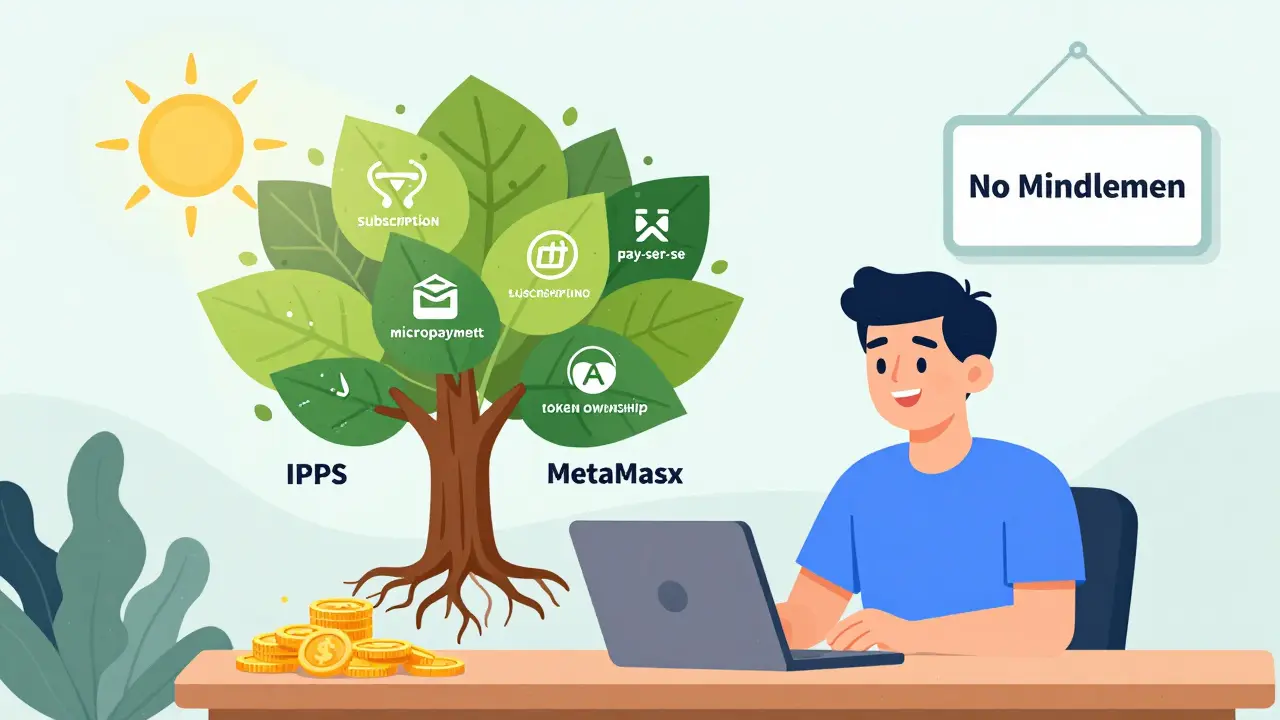
- Subscription access: Fans pay monthly in ETH or USDC for exclusive posts, early releases, or private Discord access. The contract auto-renews. If they cancel, access cuts off. No manual tracking.
- Micropayments: A journalist charges 0.002 ETH per article. Someone reads five pieces in a week? That’s 0.01 ETH-less than 50 cents. Tools like Supertab handle the checkout in one click. No credit card needed. Just a wallet.
- Pay-per-use: A musician lets you stream a track once for 0.01 ETH. Want to download it? Another 0.01. The contract tracks usage and splits revenue instantly.
- Tokenized ownership: You sell 1,000 tokens representing shares in your next album. Holders get 10% of all future streaming revenue. It’s like crowdfunding, but automated and tradable.
- Freemium + upsell: Free articles with ads. Premium content? Unlock with a one-time payment. The smart contract handles both the ad revenue split and the premium access gate.
These aren’t theoretical. Independent creators on platforms like Mirror.xyz and Zora are already using them. One writer made $12,000 in three months selling serialized fiction via micropayments. Another musician earned more from 500 token holders than they ever did from Spotify.
Why Crypto Payments Are the Real Game-Changer
It’s not just about skipping PayPal. Crypto payments work globally, 24/7, with near-zero fees for small transactions. A creator in Nairobi can sell a digital painting to a collector in Tokyo, and both get paid in minutes-no currency conversion, no wire fees, no bank approval.
Traditional payment processors charge 2.9% + $0.30 per transaction. On-chain, a micropayment of $0.10 might cost $0.001 in gas. That’s 99% less in fees. For creators who rely on small, frequent sales, that’s life-changing.
And because crypto wallets are pseudonymous, creators can protect their privacy. No need to link your bank account or SSN to every platform. You control your money. You control your identity.
The Hidden Tech Behind the Magic
Smart contracts don’t run in a vacuum. They need infrastructure:
- Blockchains: Ethereum is the most common, but gas fees can be high. Polygon and Arbitrum offer cheaper alternatives with Ethereum-level security.
- Wallets: Users need MetaMask, Phantom, or Rainbow to pay. Creators need one too-preferably non-custodial.
- Oracles: These connect smart contracts to real-world data. If you’re paying royalties based on Spotify streams, an oracle fetches that data and triggers the payout.
- Decentralized storage: Your content can’t live on a server that gets taken down. IPFS or Arweave store files permanently. The smart contract holds the link.
Most creators don’t write code themselves. Tools like Rarible, Foundation, and Zora let you mint and monetize content with a few clicks. But understanding the stack helps you avoid scams and choose the right platform.
Where It Falls Short (And How to Work Around It)
It’s not all smooth sailing. Three big hurdles still exist:
- Gas fees: Even on cheaper chains, a single micropayment can cost more than the payment itself if the network is busy. Solution? Batch payments. Use platforms that aggregate small transactions and settle them in one go.
- Usability: Most people don’t know what a wallet is. Solution? Use custodial gateways like Coinbase Commerce or Stripe Crypto. They let users pay with credit cards while the backend handles crypto on-chain.
- Regulation: Some countries treat crypto tokens as securities. Solution? Structure your token as a utility token (access pass, not investment). Consult legal advice if scaling beyond a few hundred fans.
These aren’t dealbreakers-they’re growing pains. The tools are improving fast. Wallets now have fiat on-ramps. Gas fees are dropping. And more platforms are building user-friendly interfaces.
What’s Next? AI, VR, and the Future of Ownership
Smart contracts are getting smarter. Now they’re being paired with AI:
- AI analyzes your audience and suggests optimal pricing for your content.
- It auto-generates personalized offers-like a discount on your next video if someone watched 80% of the last one.
- Virtual reality experiences are being tokenized. Buy a ticket to a live concert in VR? You get a token proving you were there. That token can be resold, traded, or used to unlock future events.
Imagine a writer who sells a novel. Each chapter unlocks based on how many people read the previous one. The smart contract adjusts pricing dynamically. The more popular it gets, the higher the price-and the more the creator earns.
DeFi is also creeping in. Creators can stake their earned tokens on platforms like Aave to earn interest. Or lend out their NFTs to others for a fee. Your content doesn’t just make money-it works for you while you sleep.
Getting Started: Your First Step
You don’t need to be a coder to begin. Here’s how to start today:
- Choose a platform: Zora (for writers, artists), Mirror (for long-form), or Audius (for music).
- Create a wallet: MetaMask or Phantom. Fund it with a small amount of ETH or SOL.
- Pick a monetization model: Start with micropayments or a single NFT release.
- Upload your content to IPFS via the platform.
- Deploy the smart contract. Set your price and royalty percentage.
- Share the link. That’s it.
Test it with friends first. See how it feels. Then scale. The barrier to entry is lower than ever.
Why This Matters More Than Ever
In 2025, attention is the new currency. But platforms are squeezing creators harder than ever. Algorithms change. Revenue drops. Policies shift. You lose control.
Smart contracts give it back. They’re not just a payment tool-they’re a rebellion against extractive platforms. They let creators build direct relationships with their audience. No gatekeepers. No middlemen. Just value exchanged fairly, instantly, and transparently.
This isn’t the future. It’s already here. The question isn’t whether you should use it. It’s whether you’ll be early-or left behind.
Can I use smart contracts to monetize my YouTube videos?
Not directly on YouTube, but you can link to a smart contract on your channel that lets viewers pay for exclusive behind-the-scenes content, early access, or ad-free versions. Platforms like Zora or Mirror let you embed paywalls on your website that connect to blockchain payments. YouTube still takes its cut on ads, but you can bypass it for premium content.
Do I need to know how to code to use smart contracts?
No. Most creators use no-code platforms like Zora, Mirror, or Foundation. These handle the coding for you. You just set the price, upload your file, and click deploy. If you want to customize the contract or build your own, then yes-learning Solidity helps. But it’s not required to get started.
Are smart contract payments taxable?
Yes. In most countries, crypto received as income is treated as taxable property. If you sell an NFT for ETH and later convert it to USD, you may owe capital gains tax. Keep records of every transaction-when you received it, its value at the time, and when you sold it. Tax software like Koinly or CoinTracker helps automate this.
What’s the difference between NFTs and smart contracts for content?
NFTs are digital certificates of ownership. Smart contracts are the rules that govern how those NFTs are bought, sold, or accessed. You can have an NFT without a smart contract (just a picture with a link). But if you want automatic royalties, paywalls, or subscriptions, you need a smart contract to enforce those rules.
Can I use smart contracts to monetize podcasts?
Absolutely. Platforms like Audius and Castaway let podcasters tokenize episodes. Fans can pay a small fee to unlock bonus content, ad-free versions, or exclusive Q&As. You can even set up a subscription where listeners pay monthly for a feed of premium episodes. The smart contract handles access and payouts automatically.
What happens if the blockchain fails or gets hacked?
Blockchains like Ethereum are among the most secure networks ever built. The code on-chain can’t be altered. But if your wallet is compromised, your funds are gone. That’s why you must use strong passwords, hardware wallets, and never share your seed phrase. The blockchain doesn’t fail-users do. Protect your keys like you would your passport.
How do I get paid in fiat if I earn crypto?
Use a crypto exchange like Coinbase or Kraken. Connect your wallet, send your ETH or SOL to the exchange, and cash out to your bank account. Some platforms, like Zora, even let you withdraw directly to your debit card. The process takes minutes to a few days, depending on the network and your bank.
Janet Combs
19 12 25 / 22:23 PMso like... you just upload your art and boom, money shows up? no cap, this feels like a dream. i tried selling digital stuff on etsy and got ghosted for 3 months. this is wild.
Sheila Ayu
20 12 25 / 14:22 PMWait-so you’re saying we don’t need YouTube? No ads? No demonetization? No “community guidelines” that randomly delete your life’s work? That’s not innovation-that’s a revolution. And you’re telling me it’s already happening??
vaibhav pushilkar
21 12 25 / 13:47 PMGas fees still kill micropayments. But batching? Yes. Use Polygon. Done.
Dan Dellechiaie
22 12 25 / 13:22 PMLet me break this down for the folks still using PayPal: You’re not just avoiding fees-you’re bypassing colonial financial infrastructure. A Nigerian poet selling to a Japanese student via ETH? That’s not fintech. That’s decolonization with a wallet.
And yes, the gas is still annoying-but so was waiting 45 days for a $2 royalty check from Shutterstock. Pick your poison.
Lloyd Yang
23 12 25 / 03:40 AMOkay, imagine this: You write a poem. Someone reads it. Pays 0.003 ETH. You get 0.00285. The network gets its tiny slice. But here’s the magic-every single time someone shares it, the contract tracks it. And if that person buys your next piece? You get a slice of that too. It’s like a ripple effect of respect. No algorithm deciding who’s ‘trending.’ Just real people valuing real work. I cried the first time I got paid this way. Not because it was a lot-but because it was fair.
And the best part? You don’t need to be rich to start. Just need a wallet, a story, and the guts to say: ‘I matter.’
Cathy Bounchareune
23 12 25 / 04:30 AMY’all are acting like this is brand new, but I’ve been doing this since 2021. I sold a series of zines on Mirror and made more than I ever did on Substack. The real win? My fans feel like they’re part of the journey-not just ad-clickers.
Also, if you’re scared of crypto? Use Coinbase Commerce. Pay with Visa. Behind the scenes? Still blockchain. You get the benefits. No headache.
Jordan Renaud
23 12 25 / 12:21 PMIt’s not about the tech. It’s about trust. We’ve spent decades trusting corporations to be fair. But they’re not built for fairness. They’re built for growth. Smart contracts? They’re built for integrity. Code doesn’t lie. It doesn’t change its mind. It doesn’t favor the influencer with 10M followers. It just does what it’s told. And that? That’s the quiet rebellion we didn’t know we needed.
Luke Steven
24 12 25 / 16:22 PMjust tried it. uploaded a 5-minute audio piece. sold 12 copies in 2 days. made $18. not life-changing. but... it felt like the first time someone actually paid me for my voice. not for clicks. not for views. just... for me. 🤍
Radha Reddy
26 12 25 / 01:07 AMWhile the concept is commendable, one must consider the regulatory implications in jurisdictions where digital asset taxation remains ambiguously defined. Compliance requires meticulous record-keeping and professional consultation.
Shubham Singh
27 12 25 / 07:33 AMOf course it works. Everyone who doesn’t understand blockchain is scared of it. But if you’re not coding in Solidity, you’re not a creator-you’re a consumer. And consumers get exploited too, just in different ways.
Charles Freitas
27 12 25 / 16:10 PMOh wow, another ‘crypto will save artists’ fairy tale. Let me guess-you also think NFTs are art and not just JPEGs with a URL? Congrats, you’ve been scammed by a 16-year-old with a Discord server. The only thing being monetized here is delusion.
Ashley Lewis
27 12 25 / 23:29 PMPathetic. This is just Web3 vaporware dressed as empowerment. Real creators need platforms with reach, not wallets with 3 followers.
SHEFFIN ANTONY
29 12 25 / 03:59 AMBro, you’re talking about smart contracts like they’re magic wands. But what if someone hacks the contract? What if the IPFS link dies? What if the whole chain gets forked? This isn’t freedom-it’s fragile.
And don’t even get me started on the energy use. You think Ethereum’s clean now? LOL. Keep dreaming.
Vyas Koduvayur
30 12 25 / 13:12 PMLet’s be real: 98% of creators using this are either tech bros or people with existing audiences. The real struggle? The 99% who don’t have 500 followers. This doesn’t solve the discovery problem-it just adds another layer of complexity to an already broken system. You can’t monetize what no one sees. And most people still don’t even know what a wallet is. So… who’s this really for? The already privileged?
Don’t get me wrong-I love the idea. But until it’s as easy as clicking ‘publish’ on Medium, it’s just a luxury for the crypto-curious. And let’s be honest: most of us just want to be heard, not to become blockchain engineers.
Ellen Sales
31 12 25 / 16:45 PMso i posted a doodle and someone paid me 0.01 eth to hang it in their metaverse apartment?? like… i made a stick figure and now it’s in someone’s digital living room?? i’m crying. this is the dumbest, most beautiful thing ever.
Sarah Glaser
1 01 26 / 20:46 PMWhile the technological framework presents compelling advantages, one must not overlook the sociocultural implications. The shift from centralized curation to decentralized ownership redefines not just economics, but the very nature of artistic value. This is not merely a payment mechanism-it is a philosophical recalibration of human creativity’s relationship to ownership, access, and legacy.