
Imagine you have cash in one country and need to pay for something in another. You can’t just walk into a store abroad and use your local bills. You need to exchange them-through a bank, an ATM, or a currency exchange. Now imagine that’s what happens every time you want to move Bitcoin from the Bitcoin network to Ethereum, or use your Solana tokens on Avalanche. That’s where cross-chain bridge technology comes in. It’s the financial exchange system for blockchains.
Why Do Blockchains Need Bridges?
Blockchains were never meant to talk to each other. Bitcoin runs on its own rules. Ethereum uses different code. Solana has its own speed and consensus. Each one is its own world. That’s great for security-but terrible for usability. If you hold ETH and want to earn interest on a DeFi platform that only works on Polygon, you’re stuck. That’s where bridges step in. They let you move assets between chains without having to sell and rebuy, which saves time, reduces slippage, and cuts fees.By 2023, over 120 bridges connected more than 100 blockchains. The total value locked in these bridges hit $25 billion. That’s not small change. It means millions of people are already using them daily. Ethereum and Polygon alone handle over 4.7 million cross-chain transactions every day. DeFi power users-those who trade, lend, and stake across platforms-have a 78% adoption rate. If you’re active in crypto, you’ve probably used a bridge without even realizing it.
How Do Cross-Chain Bridges Actually Work?
There are three main ways bridges move assets. Each has trade-offs in speed, security, and cost.- Lock and Mint: You lock your ETH on Ethereum. A smart contract on the destination chain (say, Avalanche) mints an equivalent amount of “wrapped ETH” (wETH). This is the most common method. The Avalanche Bridge processes about 1.2 million transactions a month using this model. The downside? You’re not holding real ETH anymore-you’re holding a token that represents it. If the bridge fails, your wrapped asset could become worthless.
- Lock and Unlock: Your ETH gets locked on Ethereum. On the other side, an equal amount is unlocked from a liquidity pool. THORChain uses this model. It moves native assets, not wrapped ones, so you always hold the real thing. But it needs massive liquidity pools. About 30-40% of the total bridged value sits idle in these pools just to make transfers possible. That’s expensive to maintain.
- Burn and Mint: You burn your original tokens on Chain A. New tokens are minted on Chain B. No wrapped assets. No locked funds. But if something goes wrong-like a hacker triggers a faulty smart contract-you can’t undo it. The 2022 Harmony Horizon hack lost $100 million this way. Burned coins are gone forever.
Then there’s the wrapped asset model-like wBTC. Over 185,000 Bitcoin have been locked and turned into ERC-20 tokens on Ethereum. It’s popular because Bitcoin’s network is slow and expensive to interact with directly. But it also means Bitcoin’s security doesn’t protect your wBTC. If the bridge’s custodians are compromised, your Bitcoin is gone.
Trusted vs. Trust-Minimized: The Security Divide
Not all bridges are built the same. Some rely on a small group of validators. Others use decentralized networks. The difference is huge.Federated (Trusted) Bridges use a group of 5-20 trusted nodes-often controlled by the bridge’s developers-to verify transfers. The Polygon PoS Bridge uses 100 validators, all managed by Polygon Labs. It’s fast, handles 2.5 million daily transactions, and has had zero major hacks since 2020. But it’s centralized. If those validators collude-or get hacked-you lose everything. The 2022 Nomad bridge hack, which lost $190 million, happened because a single validator key was compromised.
Trust-Minimized Bridges use cryptography and decentralized oracles to reduce reliance on trusted parties. Chainlink’s CCIP, which entered alpha testing in late 2023, uses a network of 50+ independent node operators to verify state across chains. It doesn’t just trust a few servers-it cryptographically proves what’s happening on each chain. In its test phase, it processed 1.2 million transactions with zero losses. That’s the future. But most bridges today still rely on small validator sets. According to Halborn Security, 67% use fewer than 15 validators. That’s a single point of failure waiting to happen.

Why Bridges Are the #1 Target for Hackers
Cross-chain bridges have been the biggest target in crypto hacking. In 2022 alone, they accounted for 69% of all major crypto thefts-$2.4 billion lost. Why? Because they’re complex. They connect two secure systems, but become a weak link in the middle.Most hacks happen because of:
- Validator collusion or compromised signing keys
- Flawed signature verification (Nomad, Wormhole)
- Smart contract bugs that let attackers mint unlimited tokens (Stargate Finance, $1.8 million lost)
- Insufficient security budgets-on average, bridges spend only 12% of their revenue on security, while experts recommend 25-30%
Even big names aren’t safe. Wormhole lost $320 million in 2022. Nomad lost $190 million because a single line of code let users claim any amount they wanted. These aren’t theoretical risks-they’re real, repeated, and expensive.
What’s Next? The Rise of Universal Bridges
The next wave of bridges isn’t about connecting two chains-it’s about connecting any chain, anywhere. Projects like LayerZero Labs are building “universal messaging protocols” that don’t need custom connectors for each blockchain. They’re raising hundreds of millions to make this real. LayerZero raised $120 million in March 2023 alone.Polkadot’s XCMP protocol is already live, letting its own parachains talk to each other in under a second. Chainlink’s CCIP is heading to mainnet in late 2023, aiming to become the standard for secure, decentralized cross-chain communication. These aren’t just upgrades-they’re foundational shifts.
But here’s the catch: experts predict 60% of today’s bridges will vanish by 2026. Why? Because most are standalone projects with weak security and no backing. The survivors? Those built into major blockchains-like Polygon’s bridge, or Arbitrum’s native cross-chain tools. Delphi Digital estimates 90% of independent bridge protocols will fail by 2028. If you’re using a bridge that’s not tied to a major chain, you’re gambling.
Should You Use a Cross-Chain Bridge?
If you’re using DeFi, NFTs, or Web3 apps across multiple chains, bridges are unavoidable. But not all are safe.Use bridges when:
- You need to access a DeFi protocol on another chain
- You’re moving between high-liquidity chains (Ethereum → Polygon, BSC → Avalanche)
- You’re transferring small amounts (< $10,000) and understand the risks
Avoid bridges when:
- You’re moving large sums without researching the bridge’s security history
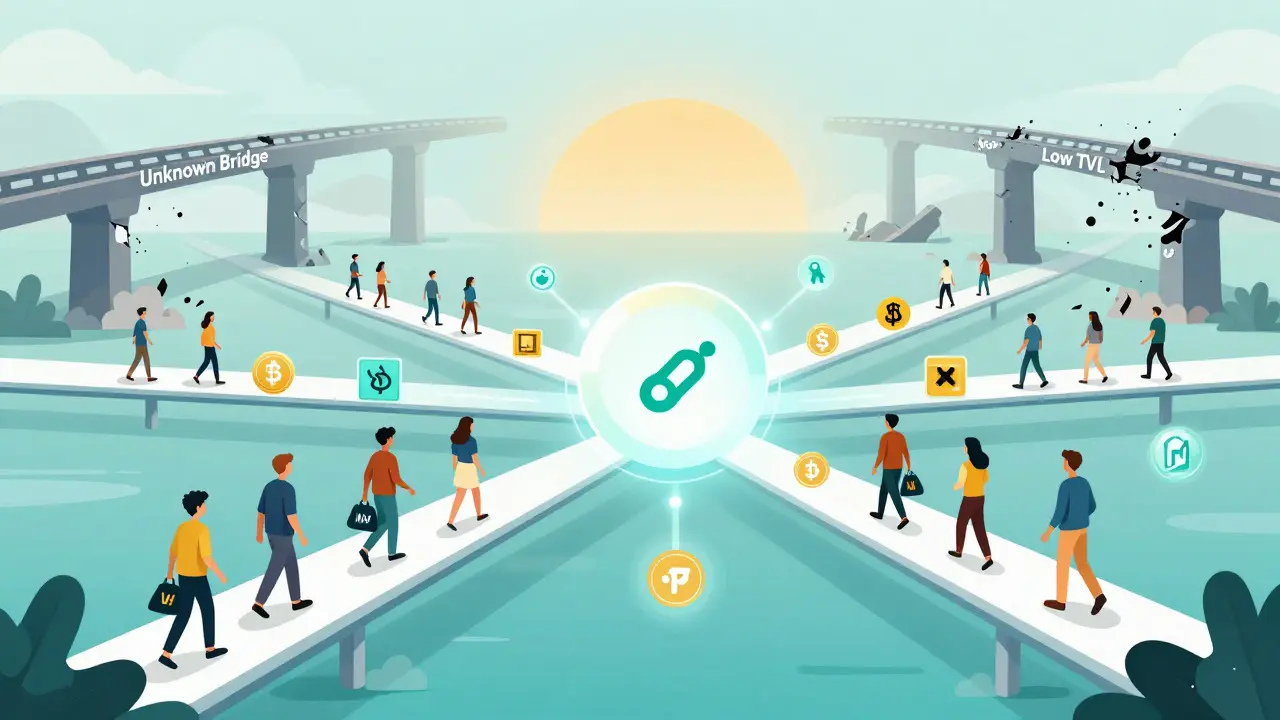
- The bridge is new, has low TVL, or no public audits
- You’re transferring assets that can’t be easily recovered if the bridge fails
Always check: Who runs the validators? Has it been hacked before? How much TVL does it hold? Is it part of a major chain’s ecosystem? Use trusted bridges like Polygon PoS, Avalanche Bridge, or THORChain for high-value transfers. Avoid unknowns.
What Happens When a Bridge Fails?
When a bridge goes down, your tokens don’t vanish-they get stuck. You might see “transaction pending” for hours, or get an error saying “insufficient liquidity.” That’s not a hack-it’s a liquidity or synchronization issue. The Bridge Watch subreddit has 28,500 members who share fixes for these problems. Common solutions: wait 24-48 hours, try a different bridge, or use a recovery tool if one exists.But if it’s a hack? You’re likely out of luck. There’s no FDIC for crypto. No refund. No customer service. That’s why security matters more than speed. A bridge that takes 10 minutes but is secure is better than one that takes 30 seconds but can be drained in a minute.
Users on Reddit and Trustpilot give bridges an average 3.8/5 rating. Positive reviews praise speed and ease. Negative ones complain about unresponsive support and lost funds. If you’ve ever lost money on a bridge, you’re not alone. But you can avoid it.
The Bigger Picture: Bridges Are the Glue of Web3
Cross-chain bridges aren’t a fad. They’re essential infrastructure. Without them, Web3 stays fragmented. No one would use DeFi on 10 different chains. NFTs wouldn’t move across marketplaces. Enterprises wouldn’t adopt blockchain for supply chains. The U.S. Office of the Comptroller of the Currency even confirmed in mid-2023 that national banks can legally use bridges-for the right reasons and with proper controls.Fortune 500 companies are already using private bridges. The market is projected to grow from $1.2 billion in 2023 to $8.7 billion by 2028. That’s a 48% annual growth rate. This isn’t just for crypto traders. It’s for banks, logistics firms, and digital identity systems.
But growth without security is just a bubble waiting to burst. The best bridges will be the ones that don’t just move tokens-they prove they’re moving them safely. Chainlink’s CCIP, Polkadot’s XCMP, and other trust-minimized systems are setting the standard. The rest? They’ll fade away.
If you’re using a bridge today, don’t just use it-understand it. Know who controls it. Know how it works. Know what happens if it fails. Because in Web3, the difference between convenience and catastrophe is just a smart contract away.
Sammy Tam
17 12 25 / 17:01 PMBeen using bridges for years and honestly? They’re the reason I can jump between DeFi chains without losing my mind. Polygon to Arbitrum to Base - it’s like a crypto subway system. Sure, some are sketchy, but if you stick to the big ones like Avalanche Bridge or THORChain, you’re golden. Just don’t throw your life savings into some new bridge that’s got 300k TVL and no audit. Been there, lost that.
Also, wrapped assets are a necessary evil. wBTC isn’t Bitcoin, but it’s the only way most DeFi apps can even touch BTC. Just know what you’re holding.
And yeah, security budgets are pathetic. 12%? Come on. If you’re building infrastructure, spend like your users’ money depends on it - because it does.
Terrance Alan
18 12 25 / 14:28 PMPeople act like bridges are some magical solution but they’re just centralized middlemen with fancy smart contracts. We were promised decentralization and ended up with a bunch of gated communities where you need to trust five guys in a server farm in Singapore. The whole thing is a farce. The fact that people still think wrapped tokens are real assets is proof we’re all just gambling with our eyes closed. And don’t get me started on how these bridges are the reason we have 90% of crypto hacks. It’s not the blockchains that are broken - it’s the bridges. And nobody wants to fix them because they’re too profitable for the devs.
Meanwhile, the real users? They’re the ones who lose everything and then get told to ‘do your own research’ like that’s some kind of magic shield.
Sally Valdez
19 12 25 / 07:52 AMUSA built the internet. USA built blockchain. And now we’re letting some anonymous dev from Ukraine run a bridge that ‘trusts’ three guys with a Discord server? No. Just no. This isn’t innovation - it’s national security risk #47. We don’t let foreign actors touch our financial infrastructure. But we let them touch our crypto? What are we, stupid? Chainlink’s CCIP is the only thing that doesn’t make me want to throw my laptop out the window. Everything else is just crypto cosplay. And if you’re using anything but Ethereum or Polygon, you’re basically handing your keys to a stranger on the street.
Also, ‘universal bridges’? That’s just a fancy way of saying ‘global financial collapse waiting to happen.’
Elvis Lam
20 12 25 / 22:09 PMJust to clarify a common misconception - lock and mint isn’t the most common method, it’s the only method most retail users interact with. Burn and mint is rare because it’s irreversible. Lock and unlock is only viable for chains with massive liquidity like THORChain, which still only handles a fraction of the volume. The real issue isn’t the model - it’s the validator set size. If a bridge uses fewer than 15 validators, it’s not trust-minimized, it’s just poorly designed. And 67% of bridges do exactly that. That’s not a bug, it’s a business model. Cheap to build, easy to fundraise, hard to audit. The only reason they still exist is because users are lazy and don’t check the docs.
Also, wBTC isn’t ‘not Bitcoin’ - it’s Bitcoin-backed. The difference matters. If the custodians are reputable and multisig’d, it’s as safe as a cold wallet. But if it’s run by a DAO with 8 members and one of them is a bot? Yeah, that’s a problem.
Jonny Cena
22 12 25 / 15:24 PMHey everyone - if you’re new to bridges, don’t panic. It’s okay to feel overwhelmed. This stuff is complex. But here’s the good news: you don’t need to understand every technical detail to use them safely. Just follow three rules: 1) Only use bridges tied to major chains (Polygon, Arbitrum, Avalanche). 2) Never move more than you can afford to lose. 3) If the bridge doesn’t have a public audit or a history of zero hacks, skip it.
And if you’ve lost funds before? You’re not alone. I’ve been there too. But you’re learning. That’s what matters. Crypto is still the Wild West, but we’re building the rules as we go. You’re part of that. Keep asking questions. Keep reading. You’ve got this.
George Cheetham
24 12 25 / 10:45 AMThere’s a deeper philosophical layer here. Bridges are the metaphysical manifestation of our desire for interconnectedness - yet we build them on fragile trust models. We crave unity in a fragmented world, but we refuse to sacrifice control. We want the freedom of multiple chains, yet we demand absolute security from systems designed for decentralization. It’s a paradox. The real innovation won’t be in cryptography - it’ll be in human behavior. When we stop treating bridges as tools and start treating them as shared infrastructure - like roads or power grids - then we’ll stop losing billions to negligence.
Until then, we’re just rearranging deck chairs on the Titanic.
Sue Bumgarner
26 12 25 / 10:08 AMOh please. You’re all acting like this is the first time someone tried to connect systems. Remember when the internet was ‘unregulated’? Same thing. Everyone panicked. Then we got standards. We got oversight. We got accountability. But no - now we’re all like ‘ooh look at the pretty tokens’ and ignore the fact that 80% of these bridges are run by guys who dropped out of college to ‘make it big.’ And you wonder why we get hacked? Because nobody’s holding them to basic standards. If this was a bank, they’d be in jail. But because it’s crypto? ‘Do your research’ - yeah right, like I have time to audit 120 different smart contracts. Someone needs to regulate this before someone loses their house.
Kayla Murphy
26 12 25 / 23:08 PMJust wanted to say - if you’re nervous about using bridges, that’s totally valid. I used to be terrified too. But I started small. Like $50. Just to see how it worked. And once I saw how smooth it was on Polygon, I felt way better. It’s okay to take your time. You don’t have to jump in headfirst. And if you’re scared? That’s your intuition telling you something. Listen to it. And if you need help, there are so many friendly communities out there. We’re all learning together. You’re not alone in this.
Tom Joyner
27 12 25 / 01:22 AMIt’s amusing how the average Reddit user treats cross-chain bridges like they’re a revelation. The concept of interoperability has existed since the 1980s - think OSI model, TCP/IP gateways. What’s novel here is not the technology, but the sheer incompetence with which it’s implemented. You’re not innovating - you’re reinventing the wheel while ignoring every lesson from 40 years of network engineering. And calling wBTC ‘Bitcoin-backed’ is a semantic sleight of hand. It’s a liability, not an asset. The entire ecosystem is a house of cards built on misplaced faith in smart contracts and the delusion that ‘decentralization’ is a buzzword that absolves you of responsibility.
Amy Copeland
28 12 25 / 07:53 AMOh sweetie, you really think THORChain is ‘safe’? Honey, that thing runs on a liquidity pool so bloated it’s basically a charity. And you’re praising Chainlink’s CCIP like it’s the Second Coming? Darling, it’s in alpha. The same team that brought you Chainlink’s oracle exploits is now your savior? I’ll stick with my cold wallet and my two-chain life, thank you very much. And no, I don’t care if you ‘don’t understand’ - I’ve lost money on bridges. You haven’t. So maybe stop pretending you’re the crypto guru.