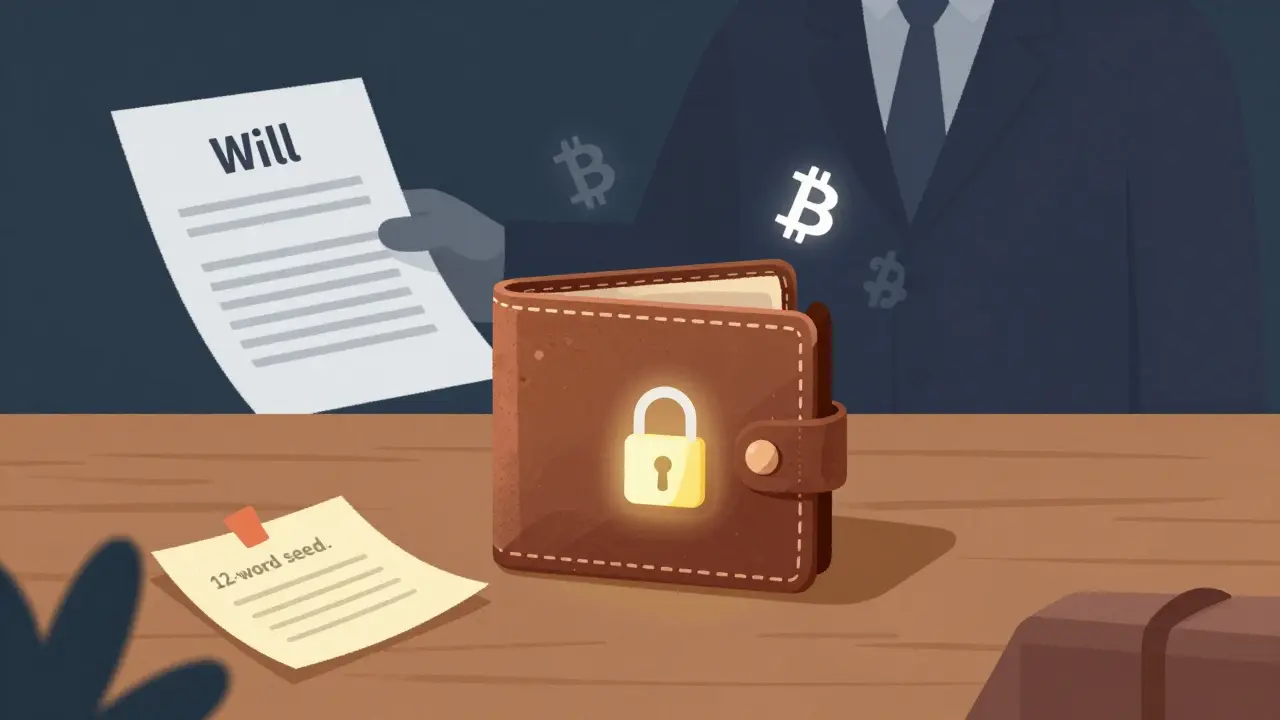
When someone dies, their bank accounts, homes, and stocks are passed on. But what happens to their Bitcoin? For millions of cryptocurrency holders, the answer is: nothing. Their wealth vanishes - not because it was stolen, but because no one knows how to unlock it. This isn’t a rare glitch. It’s a systemic failure, and it’s getting worse.
Bitcoin and other cryptocurrencies don’t exist in a bank or a brokerage account. They’re locked behind cryptographic keys - long strings of letters and numbers that only the owner knows. Lose that key, and the coins are gone forever. No court can force a wallet to open. No tech support can reset a password. No government can reverse a blockchain. The system works exactly as designed: absolute control, zero recovery. And that’s the problem.
Here’s the hard truth: about 76% of cryptocurrency owners have no plan for what happens to their digital assets after they die. They don’t tell their families. They don’t write it down. They assume someone will figure it out. But when a loved one passes, survivors don’t find a list of passwords. They find a dead phone, a locked hardware wallet, or a forgotten 12-word seed phrase scribbled on a napkin that’s now lost. In 2025, a family in California discovered a cold wallet holding $200,000 in Bitcoin. They had the device. They had the wallet address. But no one knew the password. The money is still there - visible on the blockchain - but completely inaccessible.
This isn’t just about money. It’s about legacy. Early Bitcoin adopters - people who bought Bitcoin for $10, $50, or $100 in 2010 or 2012 - are now in their 50s and 60s. Many have accumulated tens or even hundreds of thousands of dollars in holdings. As they age, health issues, accidents, and cognitive decline become more common. Yet, most still treat their crypto like a personal secret, not a family asset. They don’t talk about it. They don’t document it. And when they’re gone, the keys die with them.
Traditional estate planning doesn’t work here. A will can say, “I leave my Bitcoin to my daughter.” But if she doesn’t have the private key, the will is meaningless. Writing the seed phrase on paper and tucking it into a safe deposit box doesn’t help either. Probate courts can’t access it. Heirs can’t find it. And if someone else finds it - a janitor, a thief, a dishonest executor - the entire balance can vanish overnight. Even a revocable living trust, often recommended by lawyers, fails unless the trustee has the actual keys. Legal authority means nothing without cryptographic access.
The real danger isn’t theft. It’s neglect. People focus on securing their wallets while alive - using hardware wallets, two-factor authentication, and cold storage. But they ignore what happens after. This creates a dangerous imbalance: they solve custody risk (who controls the keys now) but completely ignore continuity risk (who controls them after death). The more someone tries to be their own bank, the more likely their heirs will inherit confusion.
Solutions exist, but they’re not mainstream. One approach is multisignature wallets. Instead of one key, you need three - and you assign each to a different person: a spouse, a child, and a lawyer. No one can move the funds alone. If the owner dies, the two surviving parties can still access the wallet. It’s not perfect, but it removes the single point of failure. Another method is using a trusted third party, like a professional custodian, to hold a copy of the key. But that reintroduces trust - and risk - into the system.
Some platforms are trying to fix this with automation. Vaulternal (vaulternal.com) addresses this by combining end-to-end encryption with smart triggers. Users encrypt their seed phrases and store them in a digital vault. They set conditions - like “if I haven’t logged in for 12 months” or “after a verified death certificate is submitted.” When the trigger activates, the system automatically sends the encrypted data to pre-designated heirs. No one, not even Vaulternal, can see the keys until the conditions are met. It’s not magic - it’s cryptography working as a silent executor.
What makes this different from writing down a password? Everything. Paper can burn. A USB drive can fail. A will can get lost. But with Vaulternal, the data is encrypted on the user’s device before it’s uploaded. It’s stored on decentralized networks like Arweave that last forever. The triggers are monitored by independent nodes that can’t access the data. And the heirs only get access after proving their identity - not through passwords, but through wallet signatures and email verification. It’s a digital will that works like a dead man’s switch: silent until it’s needed.
But technology alone won’t solve this. The bigger issue is culture. Cryptocurrency was built on the idea of autonomy - no banks, no intermediaries, no rules. That ethos clashes with inheritance, which requires coordination, trust, and planning. People don’t want to talk about death. They don’t want to admit they have crypto. They think, “I’ll get to it later.” But later might be too late.
Here’s what you can do today, no matter how much crypto you own:
- Inventory your holdings. List every wallet, exchange, and token you own.
- Document your keys. Write down your seed phrase. Store it in a fireproof safe - or better, use a secure digital legacy tool.
- Designate heirs. Tell at least one trusted person where to find it - and how to use it.
- Update regularly. Crypto changes fast. Add new wallets. Remove old ones. Review every six months.
- Don’t rely on memory. Even your spouse might not know your password. Write it down - securely.
The Gannett Trust called 2026 the year the crypto inheritance time bomb begins ticking. Millions of dollars are already lost. More will follow. This isn’t a problem for future generations. It’s happening now. Every day someone dies without leaving a key, another piece of digital wealth disappears - permanently. The blockchain records every transaction. But it can’t record who owns it if the owner never told anyone.
The solution isn’t complicated. It’s simple: treat your crypto like your house, your car, your savings. Document it. Plan for it. Pass it on. Because if you don’t, it won’t just vanish - it’ll haunt your family forever.
Leona Fowler
24 03 26 / 16:13 PMMy dad had a Ledger tucked away in a fireproof box. We found it after he passed, but no one knew the PIN. We spent months trying every possible combo-birthdays, anniversary dates, even his dog’s name. Nothing. The Bitcoin’s still there, frozen in time. I wish he’d just written it down somewhere obvious, like his will or a password manager. It’s not about trust-it’s about practicality.
Now I’ve set up a multisig with my sister and my lawyer. If I drop dead, they get access. No drama. No panic. Just a clean transfer. It’s not sexy, but it’s necessary.
Stop treating crypto like a secret club. It’s money. Treat it like money.
Neil MacLeod
25 03 26 / 01:04 AMHow utterly predictable. The same people who think ‘decentralization’ means they’re exempt from basic human logistics-like writing down a goddamn password-are now shocked their crypto vanishes into the digital ether. This isn’t a systemic failure. It’s a failure of basic adulting.
Let me guess: they also don’t update their wills, forget to name beneficiaries on retirement accounts, and leave their Netflix password scribbled on a sticky note. Pathetic. The blockchain doesn’t care about your emotional attachment to secrecy. It just records. And then it moves on.
Misty Williams
26 03 26 / 06:19 AMHow many people have died with their crypto locked away because they were too selfish to think of anyone but themselves? This isn’t a technical issue. It’s a moral one. You built wealth-then refused to let your family benefit from it. You didn’t ‘lose’ your keys-you chose to hoard them like a dragon in a cave.
There is no such thing as ‘private property’ when your death leaves others in financial ruin because you refused to be responsible. This isn’t libertarianism. It’s neglect with a blockchain.
Anand Makawana
26 03 26 / 09:41 AMFrom a governance and succession architecture standpoint, the absence of a standardized cryptographic inheritance protocol represents a critical vulnerability in the decentralized finance stack. The current paradigm relies on ad hoc, human-centric mechanisms-such as handwritten seed phrases or unsecured digital vaults-which are non-scalable and non-auditable.
Emerging solutions such as threshold signature schemes (TSS) integrated with decentralized identity frameworks (DID) offer a robust pathway toward compliant, trust-minimized inheritance workflows. Moreover, smart contract-based executors, anchored to on-chain death verification via oracle services, could automate the transfer of assets without centralized intermediaries.
Regulatory bodies must intervene to establish baseline standards for crypto estate planning, akin to fiduciary duties in traditional finance.
Mohammed Tahseen Shaikh
27 03 26 / 15:55 PMYou people are overcomplicating this. Just write the damn seed on a piece of paper. Put it in an envelope. Tell your kid where it is. Done. No apps. No trusts. No lawyers. No ‘smart triggers.’ If you can’t be bothered to write five words on a napkin, you didn’t deserve the crypto in the first place.
And stop pretending this is a ‘systemic failure.’ It’s just lazy people. Plain and simple.
kavya barikar
27 03 26 / 16:20 PMDeath is inevitable. Planning for it isn’t morbid. It’s kind.
Some of us never talk about it. But that silence costs more than money.
Andrea Zaszczynski
28 03 26 / 06:52 AMI don’t get why everyone’s so shocked. My sister told me she had $80K in Bitcoin. Said she’d ‘tell me when the time was right.’ She died last year. I found her laptop. Opened it. Password was ‘password123.’ But the wallet? Locked. No seed. No clue.
Now I’m stuck with her dog, her cat, and a dead hard drive. And I’m supposed to be grateful she ‘trusted’ me?
Trust doesn’t work if you’re dead. Write it down. Please.
Cordany Harper
29 03 26 / 00:03 AMBeen there. My uncle was one of the first Bitcoin miners. Bought his first 100 BTC for $200 in 2011. Left behind a USB stick labeled ‘BTC’ and a note that said ‘Ask Dave.’ Dave didn’t know what it was. Thought it was a virus.
Turns out the USB had the wallet file. But no password. We tried every password he ever used-his old phone number, his ex-wife’s name, his favorite beer. Nothing.
Now it’s just a brick. Sitting there. Worth $3M. And we can’t touch it.
Don’t be him. Write it down. Even if it’s stupid. Even if you think it’s embarrassing. Do it.
DarShawn Owens
30 03 26 / 17:40 PMI love how this post says ‘don’t rely on memory’-because I’ve done that before. I forgot my own crypto wallet password. Took me six months to recover it. Imagine if I’d died then.
My wife doesn’t even know I have crypto. I’m gonna fix that this weekend. I’m writing it all down. I’m putting it in my drawer with my will. I’m telling her. No more ‘I’ll get to it later.’
Thanks for the kick in the pants.
Andy Green
1 04 26 / 02:28 AMOf course this is happening. The system is designed to be anarchic. No government, no banks, no rules. So why would you expect it to have inheritance protocols? This isn’t a bug-it’s a feature.
You want your crypto to survive death? Then you need to surrender control. You need to trust someone. And that’s the opposite of what crypto stands for.
So yeah. Let it die with you. That’s the purity of the system. No one owns it. No one inherits it. It’s just… gone.
And that’s beautiful.
Zion Banks
1 04 26 / 22:42 PMThey’re not losing crypto. They’re being erased by the deep state. The Fed, the IMF, the global elite-they want your crypto to vanish so they can seize it under ‘unclaimed property’ laws. This isn’t about death. It’s about control.
They’ve been quietly passing laws since 2020 to claim unclaimed digital assets. If you don’t document your keys, they take it. And they’ll say it was ‘your fault.’
Don’t fall for it. Write your seed phrase. Hide it. Burn it. Bury it. But don’t let them have it.
They’re coming for your Bitcoin. Don’t make it easy for them.
Annette Gilbert
2 04 26 / 09:58 AMOh wow, what a shocker. People who think Bitcoin is ‘digital gold’ suddenly realize gold doesn’t vanish when you die?
Maybe if they didn’t treat crypto like a cult ritual-whispering seed phrases like sacred mantras and hiding wallets like the Holy Grail-they wouldn’t be in this mess.
It’s not a mystery. It’s just dumb people being dramatic about money they didn’t earn.
Next up: ‘The Problem Nobody Talks About: People Forget Their Netflix Passwords.’
John Alde
4 04 26 / 07:37 AMI’ve been advising families on digital asset succession for over a decade. The issue isn’t technology-it’s psychology.
People who hold crypto are often the same ones who avoid talking about death, finances, or vulnerability. They see crypto as a personal achievement, not a family resource. That mindset is toxic.
The solution isn’t more tools. It’s more conversations. Sit down. Talk. Write it down. Show them how to use it. Don’t wait until you’re gone to realize you never taught them how to live with what you built.
It’s not about keys. It’s about legacy.
manoj kumar
5 04 26 / 21:46 PMThis is why I told my kids to stay away from crypto. You think you’re smart buying Bitcoin. But you’re just creating a mess for your family. They don’t know what a private key is. They don’t care. They just want to pay the funeral bill.
And now you’ve made them suffer because you were too cool to use a bank.
Sorry, but this isn’t revolutionary. It’s just irresponsible.
Jenni Moss
7 04 26 / 16:18 PMYou’re not alone. I just helped a friend recover her dad’s crypto. He had 12 wallets. She had no idea. We spent three weeks going through old emails, notebooks, even his Google Photos. Found it on a screenshot labeled ‘random stuff.’
It took forever. But we did it. And now she’s got $400K to pay off his medical bills.
So please. Just write it down. Even if it’s ugly. Even if it’s messy. Just do it.
You’re not helping anyone by being mysterious.
vu phung
8 04 26 / 21:17 PMFrom a systems design perspective, the inheritance gap stems from a misalignment between cryptographic immutability and human lifecycle dynamics. The blockchain is immutable, but human memory is not.
What’s needed is a hybrid architecture: on-chain metadata tagging (e.g., a death flag via a trusted oracle) that triggers a time-locked multi-sig release. The keys remain decentralized, but the access logic becomes adaptive to real-world events.
It’s not magic. It’s just good engineering.
Joshua T Berglan
9 04 26 / 10:47 AMI just set up my Vaulternal vault today 😊
Told my wife, my sister, and my best friend. Set the trigger to 12 months of inactivity. If I disappear, they get the keys.
It feels weird saying it out loud. But I’m glad I did.
Thanks for the nudge, OP. You’re right. This isn’t scary. It’s just smart.
Kevin Da silva
11 04 26 / 01:54 AMWrite it down. Tell someone. Done.
Andrew Midwood
11 04 26 / 05:09 AMMy bro had a cold wallet with 300 BTC. He died in a car crash. We found the USB in his glovebox. No password. No backup. No clue.
Went to a crypto recovery service. They said it’d cost $50K and take 18 months. No guarantee.
So we gave up.
Now I use a multisig. My wife, my lawyer, and me. All three need to sign. Simple. No drama.
Stop overthinking it. Just do it.
Kayla Thompson
11 04 26 / 11:22 AMOh look, another article about how ‘people are dumb.’
Newsflash: if you can’t figure out how to leave your crypto to your kids, you shouldn’t have any.
And if you think Vaulternal is the answer, you’ve been watching too many crypto bro YouTube videos.
Real people don’t use apps to die. They use pens and paper.
And if your family can’t handle that? Then they weren’t ready to inherit anyway.
Leona Fowler
12 04 26 / 17:54 PMJust saw someone say ‘write it on paper.’
What if the paper burns? What if the house floods? What if your executor is a thief?
That’s why I use a multisig. Two out of three keys. One with my wife. One with my lawyer. One with me.
If I die, they both have to sign. No single point of failure.
It’s not perfect. But it’s better than a napkin.