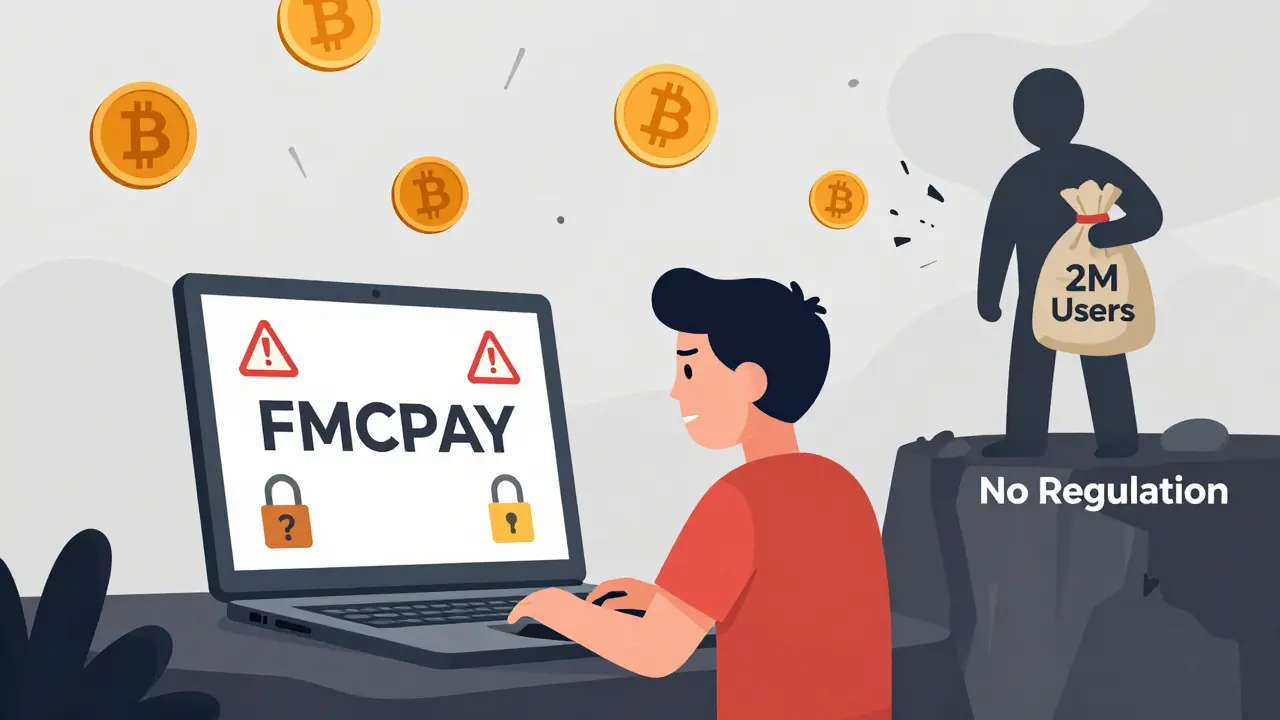
When you're looking for a crypto exchange, you want three things: security, transparency, and trust. FMCPAY claims to offer all three-but the facts tell a different story. Founded in 2021 by FUINRE Inc., a U.S.-registered company, FMCPAY has grown to claim 2 million users across 65 countries as of late 2024. It supports trading for over 30 cryptocurrencies, including Bitcoin, Ethereum, and Litecoin. It also offers staking and peer-to-peer (P2P) trading. Sounds good? Not so fast.
What FMCPAY Actually Offers
FMCPAY lets you buy, sell, and hold major cryptocurrencies. You can stake your coins to earn passive income, and trade directly with other users via P2P. That’s not unusual-Binance, Kraken, and Coinbase do the same. But here’s where FMCPAY starts to stand out for the wrong reasons.There’s no public documentation on its security infrastructure. No details on whether it uses AES-256 encryption. No mention of whether two-factor authentication (2FA) supports authenticator apps like Google Authenticator or hardware keys like YubiKey. It just says it has "encryption and multi-factor authentication." That’s not enough. If you’re putting money into crypto, you need to know exactly how it’s protected-not just that it "is" protected.
It’s also unclear if FMCPAY has a dedicated mobile app. The website works on phones, but without a verified app, you’re exposed to phishing risks. Legitimate exchanges like Coinbase and Kraken publish their apps on official app stores with clear developer names. FMCPAY doesn’t.
The Big Red Flag: No Regulation
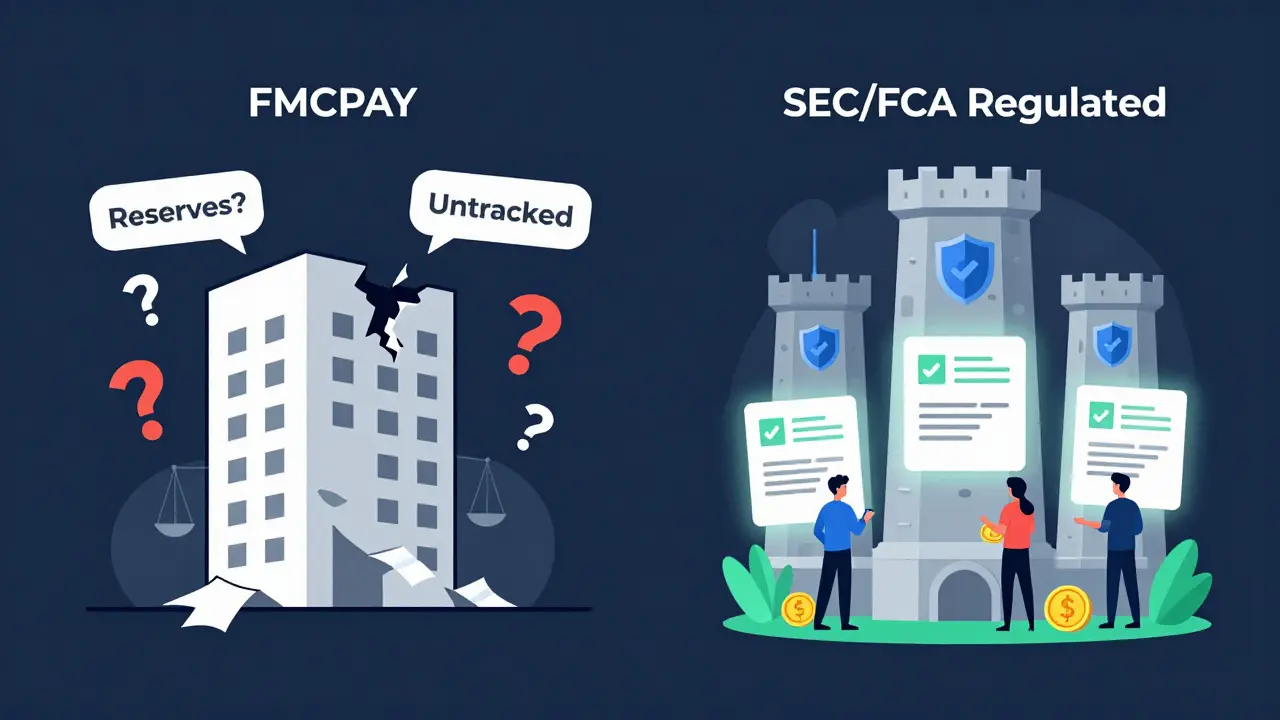
This is the most critical point. FMCPAY is not regulated by any top-tier financial authority. Not the SEC. Not the FCA. Not ASIC. Nothing. BrokerChooser, a respected brokerage verification service, explicitly states: "We wouldn’t trust FMCPAY with our own money as it is not regulated by a financial authority with strict standards."Why does this matter? Because when something goes wrong-your funds get frozen, your account gets hacked, or the platform disappears-you have zero legal recourse. Regulated exchanges are required to keep client funds separate from company money, carry insurance, and submit to regular audits. FMCPAY doesn’t have to do any of that.
Compare that to Interactive Brokers, which is regulated by the SEC, FCA, and ASIC. If you lose money there, you can file a complaint, get help from a financial ombudsman, or even claim compensation through investor protection schemes. With FMCPAY? You’re on your own. BrokerChooser warns: "If you get scammed by a broker, you have few options to get your money back."
Trading Volume? Untracked. Reserves? Unknown.
FMCPAY is listed on CoinMarketCap, but it’s labeled as an "Untracked Listing." That means the platform doesn’t provide verifiable data on trading volume, liquidity, or reserve holdings. In plain terms: no one can confirm if the platform actually has the Bitcoin or Ethereum it claims to hold.Top exchanges like Binance and Coinbase publish regular proof-of-reserves reports, often audited by third parties. FMCPAY doesn’t. And yet, it claims to serve 2 million users. That’s a huge red flag. How can you trust a platform that won’t prove it has the assets to back up its users’ deposits?
Even CoinGecko, which lists FMCPAY, doesn’t provide user reviews or volume data. That’s not a sign of growth-it’s a sign of obscurity. If a platform can’t get its numbers verified by the industry’s standard data providers, it’s not trusted by the market.
Trustpilot Rating: 4.4? Or a Mirage?
Traders Union reports a 4.4-star rating on Trustpilot as of September 2025. That sounds impressive. But here’s the catch: Forex Peace Army, another trusted review platform, reported in November 2024 that FMCPAY had zero reviews and was "not yet rated."Which one is right? The truth is, we don’t know. This contradiction suggests either unreliable data collection, fake reviews, or a platform that’s not widely used by experienced traders. Real users on Reddit, Twitter, and crypto forums rarely mention FMCPAY. If it were a legitimate, high-volume exchange, you’d see thousands of real user stories-both good and bad. You don’t.
Trustpilot ratings can be manipulated. A 4.4 rating with no context-no detailed reviews, no screenshots of trades, no proof of withdrawals-is meaningless. It’s a number without substance.
Who Is FMCPAY Really For?
There’s one group that might consider FMCPAY: people in countries where regulated exchanges are blocked or unavailable. If you’re in a region with strict capital controls and no access to Coinbase or Kraken, FMCPAY might be the only option.But even then, you’re taking a huge risk. You’re trading safety for access. And in crypto, safety is everything. A single hack, scam, or shutdown can wipe out your entire portfolio. There’s no FDIC insurance. No government backstop. Just a company with no accountability.
For everyone else-especially those in the U.S., EU, UK, Canada, Australia, or Japan-FMCPAY is not a viable option. The regulatory environment is tightening. The SEC is cracking down on unregistered platforms. In 2023, the U.S. alone fined over $1.2 billion in crypto-related violations. FMCPAY isn’t on the list of approved exchanges. That’s not an accident.
Alternatives That Actually Work
If you want security, transparency, and real protection, here are better choices:- Coinbase: Regulated in the U.S., insured custodial wallets, easy for beginners.
- Kraken: Strong security, transparent reserves, supports staking and futures.
- Binance: Highest volume globally, wide coin selection, though facing regulatory scrutiny in some regions.
- Interactive Brokers: For serious investors-regulated by SEC, FCA, ASIC, with full investor protection.
All of these platforms publish clear terms, audit reports, and contact information. They don’t hide behind vague claims. They answer questions. FMCPAY doesn’t.
The Bottom Line
FMCPAY looks tempting. It’s simple. It supports staking. It claims big numbers. But none of that matters if you can’t trust it. The lack of regulation, the unverified trading volume, the absence of security details, and the conflicting review data all point to one thing: this is a high-risk platform.There’s no evidence FMCPAY is a scam. But there’s plenty of evidence it’s not safe. And in crypto, avoiding risk isn’t optional-it’s survival.
If you’re looking for a place to trade, choose a platform that puts transparency first. Don’t gamble on a name you can’t verify. Your money deserves better.
Is FMCPAY a regulated crypto exchange?
No, FMCPAY is not regulated by any top-tier financial authority like the SEC, FCA, or ASIC. It operates without the oversight required by most major markets, making it a high-risk option for users seeking legal protection.
Can I withdraw my crypto from FMCPAY?
While FMCPAY claims to allow withdrawals, there are no verified user reports or third-party confirmations of successful withdrawals. Without transparency on reserves or trading volume, there’s no guarantee your funds will be available when you need them.
Does FMCPAY have a mobile app?
FMCPAY does not publicly list a mobile app on Google Play or the Apple App Store. The platform is accessible via web browser, but the lack of an official app increases phishing risks and reduces security.
Why is FMCPAY listed on CoinMarketCap but marked as "Untracked"?
CoinMarketCap lists FMCPAY because it meets basic technical criteria for inclusion, but it’s marked "Untracked" because the exchange doesn’t provide verifiable trading volume or reserve data. This means its activity can’t be independently confirmed.
Is FMCPAY safe for staking crypto?
Staking on FMCPAY carries the same risks as trading on it. Since the platform isn’t regulated and its security practices aren’t transparent, you’re trusting your staked assets to an unverified entity. There’s no insurance or legal recourse if something goes wrong.
What should I do if I already have funds on FMCPAY?
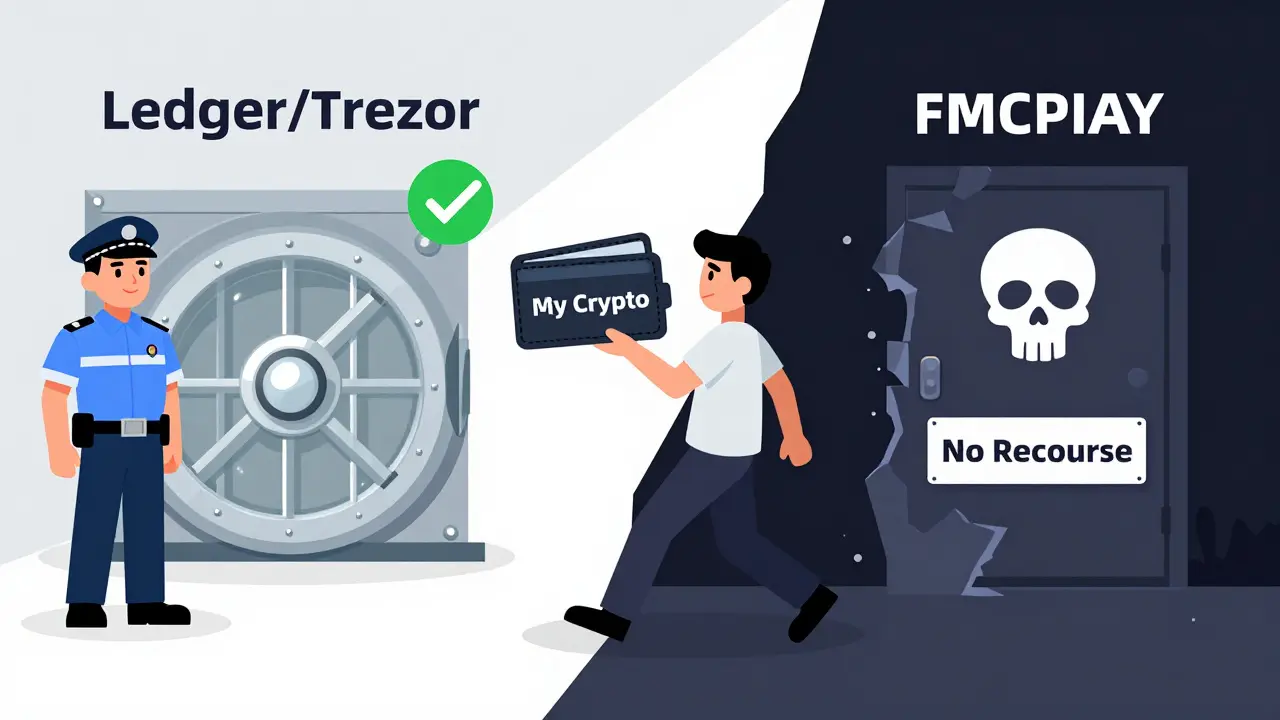
Withdraw your funds to a personal wallet you control, like Ledger or Trezor, as soon as possible. Avoid leaving crypto on any exchange you don’t fully trust. Once withdrawn, consider moving your assets to a regulated platform like Coinbase or Kraken for long-term holding.
Stephen Gaskell
16 01 26 / 17:23 PMDon't touch this with a 10-foot pole. No regulation, no app, no transparency. Just a digital snake oil pitch.
CHISOM UCHE
17 01 26 / 17:28 PMThe lack of on-chain reserve proofs and absence of regulatory licensing protocols fundamentally undermines the credibility of FMCPAY's operational architecture. In a decentralized ecosystem predicated on trust minimization, this represents a catastrophic failure of institutional due diligence.
Ashlea Zirk
18 01 26 / 04:32 AMThank you for this meticulously researched breakdown. The absence of regulatory oversight is not merely a technical gap-it's a systemic vulnerability. For users unfamiliar with crypto risk profiles, this platform presents a dangerous illusion of legitimacy. The comparison to Coinbase and Kraken’s public audit reports is particularly telling.
Shaun Beckford
20 01 26 / 02:56 AMThis isn't an exchange-it's a crypto-themed Ponzi lounge with a fancy logo and a fake Trustpilot rating. They're not hiding behind encryption-they're hiding behind silence. If your money's on FMCPAY, you're not investing, you're volunteering for a digital mugging.
Chris Evans
21 01 26 / 23:26 PMFMCPAY doesn't just lack regulation-it lacks ontology. It exists as a spectral entity in the crypto ether, a ghost in the machine of financial trust. We're told to trust the code, but what code? There's no whitepaper, no audit trail, no accountability. Just a website that whispers promises and vanishes when you reach for your keys.
Pat G
22 01 26 / 22:50 PMWhy do Americans keep falling for this garbage? If you're not on a regulated platform, you're not a trader-you're a sucker. This is why the U.S. needs to ban these offshore scams cold. No excuses. No exceptions. Just shut them down.
Alexandra Heller
23 01 26 / 11:04 AMIt's not about whether FMCPAY is a scam-it's about whether we've collectively surrendered our moral responsibility to verify before we invest. We've turned finance into a lottery and called it innovation. This platform is just the latest symptom of a culture that values speed over safety, hype over honesty.
myrna stovel
24 01 26 / 01:25 AMIf you're new to crypto and stumbled on this exchange, please don't panic-just withdraw. Move your assets to a wallet you control. It's not about fear, it's about empowerment. You have the power to choose safety. Start there. You're not alone in this journey.
Hannah Campbell
25 01 26 / 09:33 AMFMCPAY got a 4.4 on Trustpilot? LOL. That's like giving a gas station attendant a Michelin star because they smiled while pumping your gas. Who wrote those reviews? Their cousins? Their bot farm? This is comedy with a side of financial ruin
Bryan Muñoz
25 01 26 / 12:50 PMThey're working with the Fed. You think they'd let this fly if it wasn't a controlled demolition? The SEC is letting them run so they can crash it later and seize everyone's coins under 'national security'. This is phase one of the crypto wipeout. I told you all this last year. 💀
Rod Petrik
26 01 26 / 02:58 AMThey're not even trying to hide it. No app? No reserves? No audits? They're a honeypot. They want you to deposit, then vanish. The 2 million users? Fake. The staking rewards? Just accounting magic. You think your BTC is there? Nah. It's already been moved to a mixer and sold to China. They're all connected. I've seen the logs.
Sarah Baker
28 01 26 / 02:13 AMYou're not alone if you're feeling overwhelmed. Crypto is confusing, and shady platforms make it worse. But here's the good news-you already did the right thing by asking questions. Now take a deep breath, withdraw your funds, and find a platform that treats you like a person, not a number. You deserve that peace of mind.
Pramod Sharma
28 01 26 / 02:22 AMSimple truth: no regulation = no safety. Stick to the big names. Your future self will thank you.
Liza Tait-Bailey
29 01 26 / 22:49 PMugh i just checked fmcpay and it looks so slick… but then i read this and wow. yeah i'm pulling out. thanks for the wake up call 😅
nathan yeung
31 01 26 / 06:25 AMbro if you're from india and using this, just use coinbase or binance. they work fine here. no need to risk it for some random site. stay safe
Bharat Kunduri
2 02 26 / 00:35 AMthey claim 2m users? lol i bet half of em are fake accounts made by their devs. i tried to withdraw once and it took 3 weeks and then said 'server error'… yeah right
Chris O'Carroll
2 02 26 / 06:40 AMFMCPAY is the crypto equivalent of a used car salesman in a suit. Smiles too much, skips the fine print, and you’ll realize too late that the engine’s held together with duct tape and hope.