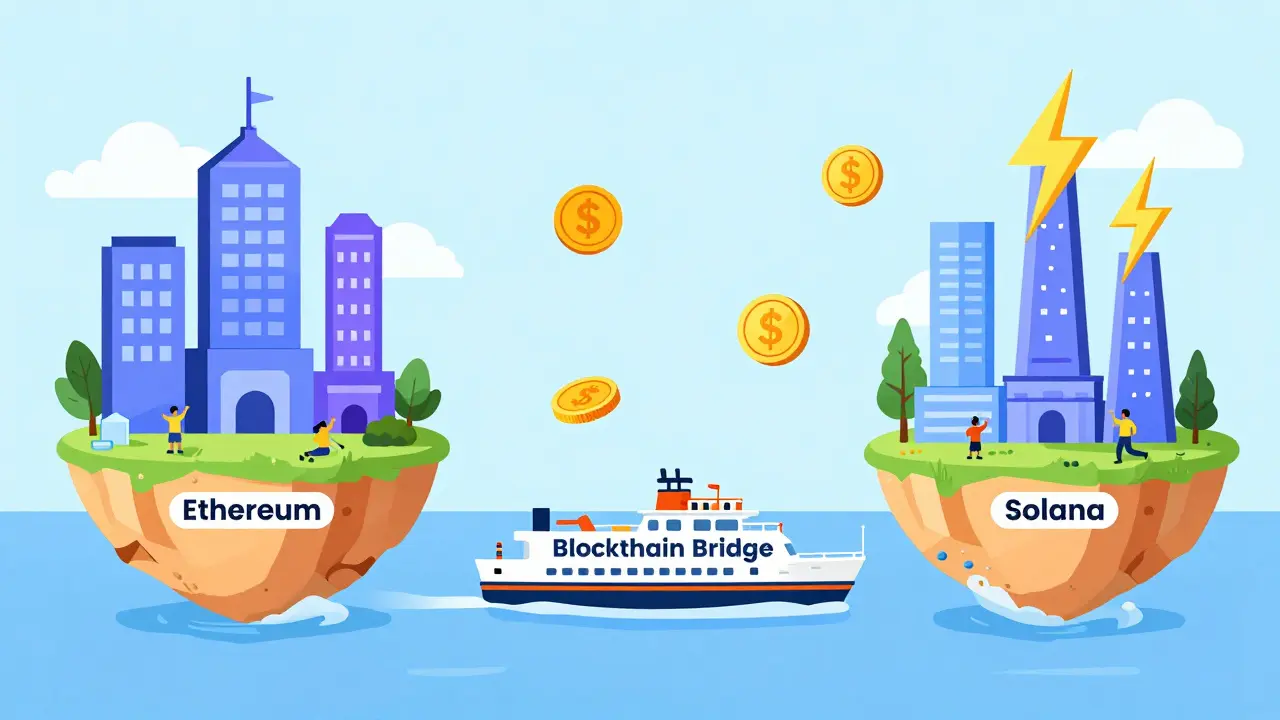
By 2026, if you're still using just one blockchain, you're missing the point. The days of isolated chains are over. Today, crypto isn't about choosing between Ethereum, Solana, or Polygon-it's about moving assets freely between them. That’s where blockchain interoperability bridges come in. They’re not a niche tool anymore. They’re the plumbing behind every DeFi trade, every stablecoin transfer, and every cross-chain wallet interaction you make.
What Blockchain Bridges Actually Do
Think of a blockchain bridge like a ferry between two islands. One island runs on Ethereum, the other on Solana. You’ve got USDC on Ethereum, but you want to use it on Solana to earn yield. A bridge lets you lock your USDC on Ethereum and mint an equivalent version on Solana. Or, in newer systems, it lets you move the actual asset without copying it. The goal? Make chains feel like one network. There are two main types: trusted and trustless. Trusted bridges rely on a central group of operators to verify transactions. Think of them like a bank telling you, "We’ll handle the transfer." Trustless bridges use smart contracts and cryptographic proofs. No middleman. Just code. In 2026, trustless is winning. Why? Because users don’t want to trust a company with their money-they want to trust math.The Market Is Exploding
In 2024, the bridge market was worth $202 million. By 2032, it’s projected to hit $911 million. That’s a 22.5% annual growth rate. Why? Because 65% of DeFi projects now depend on bridges to survive. If you’re building a yield farm, a lending protocol, or even a gaming token, you need users from multiple chains. No bridge? No users. Binance Bridge still leads in volume, moving billions between Ethereum and BSC. But it’s not the only player. Avalanche Bridge delivers near-instant transfers with sub-second finality. Symbiosis Finance lets you swap ETH on Ethereum for USDT on Bitcoin, all in one click. And LI.FI? It’s become the go-to aggregator, connecting over 60 chains and 20+ DEXs. You don’t pick a bridge anymore-you pick a platform that picks the best one for you.The Rise of Native Bridges
The old model-lock on Chain A, mint on Chain B-is outdated. Newer chains are building interoperability into their core. Plasma and Monad didn’t just launch a blockchain. They launched a blockchain with a built-in bridge. LayerZero powers Plasma. Wormhole powers Monad. These aren’t add-ons. They’re baked in from day one. This shift means assets aren’t just being copied across chains-they’re being issued natively across ecosystems. An ERC-7683 token (a new standard) can exist on Ethereum, Solana, and Polygon simultaneously, with the same address and identical behavior. No wrapped tokens. No bridge risk. Just one asset, everywhere.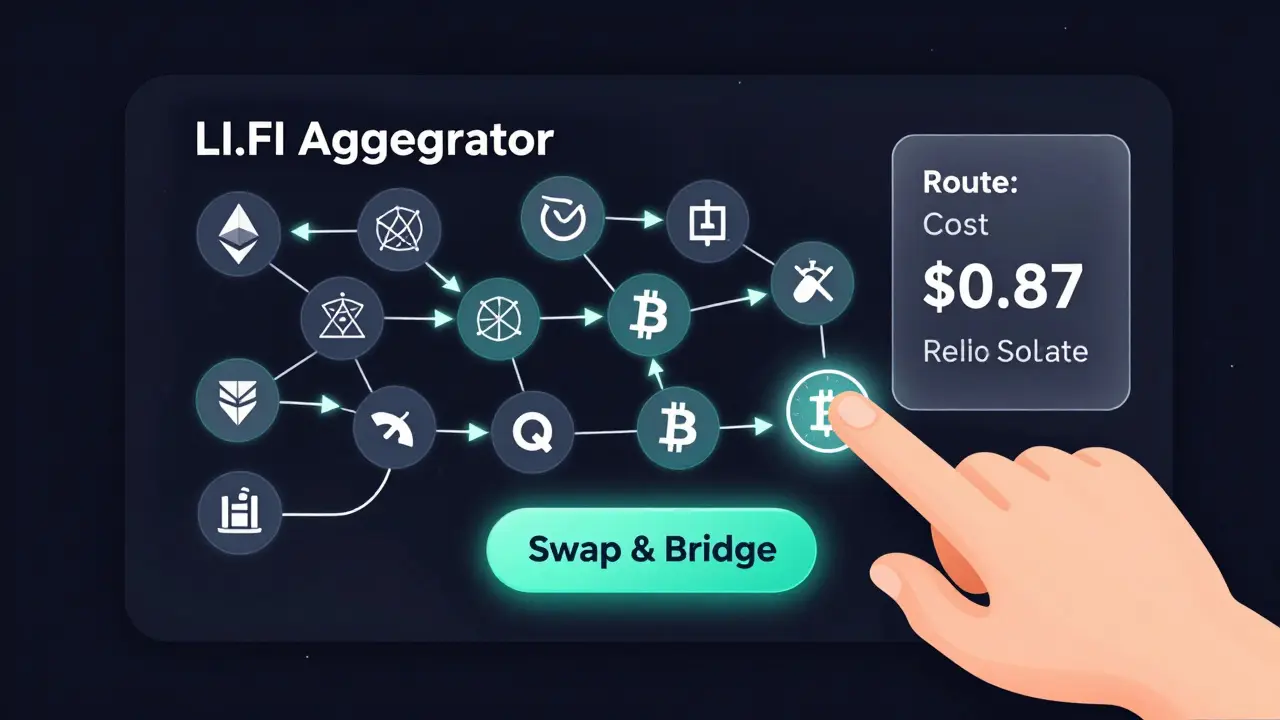
Stablecoins Are the Lifeblood
The most bridged asset? USDC. USDT. DAI. Stablecoins make up over 70% of cross-chain volume. Why? Because they’re the only digital assets that hold real-world value. Institutions use them to move treasury cash. Traders use them to chase yield. Retail users use them to avoid crypto volatility. Allbridge Core specializes in this. It moves stablecoins between EVM and non-EVM chains-like from Ethereum to Solana or from Polygon to Bitcoin. That’s huge. Bitcoin doesn’t run smart contracts. But with bridges, you can still use USDC on Bitcoin’s network. That’s not magic. It’s infrastructure.Aggregators Are Taking Over
You used to have to choose: Should I use Multichain? Or Synapse? Or Portal? Now, LI.FI and Symbiosis do the choosing for you. These platforms scan dozens of bridges and DEXs in real time. They find the cheapest route. The fastest. The one with the least slippage. And they do it all in a single transaction. LI.FI doesn’t just bridge. It swaps. You click "swap ETH for USDC on Arbitrum," and it figures out: "First, bridge ETH to Arbitrum via Wormhole. Then swap on Curve. Total cost: $0.87. Done." No manual steps. No juggling wallets. Just one click. Polygon’s AggLayer is another example. It handles swaps within the Polygon ecosystem. But for everything outside? It routes to LI.FI. This is the future: native liquidity for your ecosystem, and third-party aggregators for the rest.
precious Ncube
20 02 26 / 20:41 PMThis is what happens when you let engineers design finance. Bridges? More like glorified PayPal with blockchain buzzwords. You think people care about 'trustless' when their funds vanish because some smart contract had a typo? Wake up. We’re not building the future-we’re just repackaging the same scams.
Tracy Peterson
21 02 26 / 03:02 AMThe real beauty here is how we’re moving from ownership to access. It’s not about having USDC on five chains-it’s about letting value flow like electricity through a grid. No more silos. No more gatekeepers. Just pure, permissionless motion. This isn’t crypto-it’s the foundation of a new economic layer.
Elana Vorspan
22 02 26 / 01:37 AMI love how this is evolving 😊 It used to feel like jumping between islands with a leaky boat... now it’s like a subway system that just... works. LI.FI is a game changer. I don’t even think about bridges anymore. I just swap. And that’s the win. Seamless is sacred.
Megan Lavery
22 02 26 / 05:56 AMHonestly? I’ve been using bridges for two years now. Never had an issue. The fear-mongering around hacks is real, but so is the progress. Every time I bridge USDC to Solana to farm yield, I feel like I’m part of something bigger. No more waiting for one chain to catch up.
Mae Young
22 02 26 / 08:21 AMOh, wow. Another manifesto about 'the omnichain future.' Let me guess-you also believe in crypto winter as a 'necessary reset' and that NFTs are 'digital art'... right? Let’s not pretend this isn’t just a fancy way to move money between exchanges that all answer to the same VC group. You're not building infrastructure-you're building a casino with more layers.
Deborah Robinson
23 02 26 / 15:26 PMTo everyone scared of bridges: remember when you couldn’t send Bitcoin to Ethereum? We’ve come so far. Bridges aren’t perfect-but they’re the bridge. (Pun intended.) Keep pushing for better, but don’t throw the baby out with the bathwater. Progress is messy. And beautiful.
Ryan Burk
24 02 26 / 13:43 PMso like... bridges are just like... wallets that talk to each other? why is this even a thing? i just want to buy stuff with crypto. why do i care if its on solana or ethereum? this feels like overengineering for people who like to debug smart contracts on saturday nights
Don B.
25 02 26 / 04:10 AMLI.FI? Please. That’s just a middleman pretending to be a solution. You think you’re decentralized? Nah. You’re just paying another company to pick the best scam for you. And don’t even get me started on 'intent-based bridging.' Sounds like a sci-fi movie where the AI does your taxes. We’re not ready for this.
Arya Dev
26 02 26 / 00:32 AMThe numbers are inflated. $911 million by 2032? That’s based on projections from companies that profit from bridge usage. The real volume? Maybe 10% of that. And the hacks? They’re not bugs-they’re features. Someone’s always getting robbed. That’s the price of 'innovation.'
Leslie Cox
27 02 26 / 02:39 AMYou say 'trust math' like it’s holy scripture. But math doesn’t audit itself. Code doesn’t sleep. And humans? We still write the code. So when you say 'trustless,' you’re really saying 'I hope no one made a typo in line 287.' That’s not confidence. That’s a prayer.
Sean Logue
1 03 26 / 02:33 AMAs someone from outside the US, I can tell you-this is the first time crypto actually feels global. In Nigeria, we use bridges to send remittances faster than Western Union. No bank. No paperwork. Just a wallet and a bridge. That’s real impact. Not hype. Real life.
Robert Conmy
2 03 26 / 00:18 AMIf you’re still using Binance Bridge in 2026, you’re not crypto-native-you’re a tourist. Real users use LayerZero. Or Wormhole. Or native chains with built-in interoperability. Anything else is just a glorified API wrapper for centralized entities. Get with the program.
Lilly Markou
2 03 26 / 21:58 PMThe regulatory implications of cross-chain asset issuance are profound. If a token is issued natively across multiple jurisdictions, which sovereign authority governs its legal status? The lack of clarity here is not an oversight-it is an existential threat to the entire framework. We must proceed with extreme caution.
aaron marp
4 03 26 / 15:34 PMI’ve been watching this space since 2021. The shift from wrapped tokens to native issuance? Huge. It’s not just technical-it’s philosophical. We’re moving from 'copy-paste assets' to 'true multi-chain identity.' That’s the real revolution. And it’s quiet. Nobody’s screaming about it. But it’s happening.
Phillip Marson
5 03 26 / 03:13 AMBridges are the duct tape holding crypto together and everyone’s pretending it’s a cathedral. One day it’s gonna snap and everyone’s gonna scramble like ants after the sugar bowl falls. And then we’ll all say 'I told you so.' But by then? The damage is done.
Alyssa Herndon
6 03 26 / 14:32 PMI’m not against bridges. I just wish people would stop treating them like magic. They’re tools. Useful. Flawed. Necessary. But not holy. Let’s stop glorifying infrastructure and start demanding better audits, better incentives, and better fallbacks. That’s what real progress looks like.
Ifeanyi Uche
8 03 26 / 03:46 AMwhy do you think africans even care about solana or polygon? we just want to send money to our families without paying 20% in fees. bridges arent about innovation they are about survival. you guys are too busy talking about intent to see the real use case right in front of you
Jeff French
8 03 26 / 13:18 PMThe aggregation layer is the real innovation. LI.FI, AggLayer-they’re the OS of cross-chain. No one talks about them because they’re invisible. But that’s the point. The best infrastructure is the one you don’t notice. We’re not building bridges anymore. We’re building the highway.
Michael Rozputniy
9 03 26 / 13:00 PMAll of this is a distraction. The real power lies in the fact that bridge operators are quietly collecting user data, transaction patterns, and wallet addresses. They’re building profiles. The 'trustless' system? It’s just a front. Behind it? A surveillance network with blockchain branding. You’re not free. You’re being mapped.