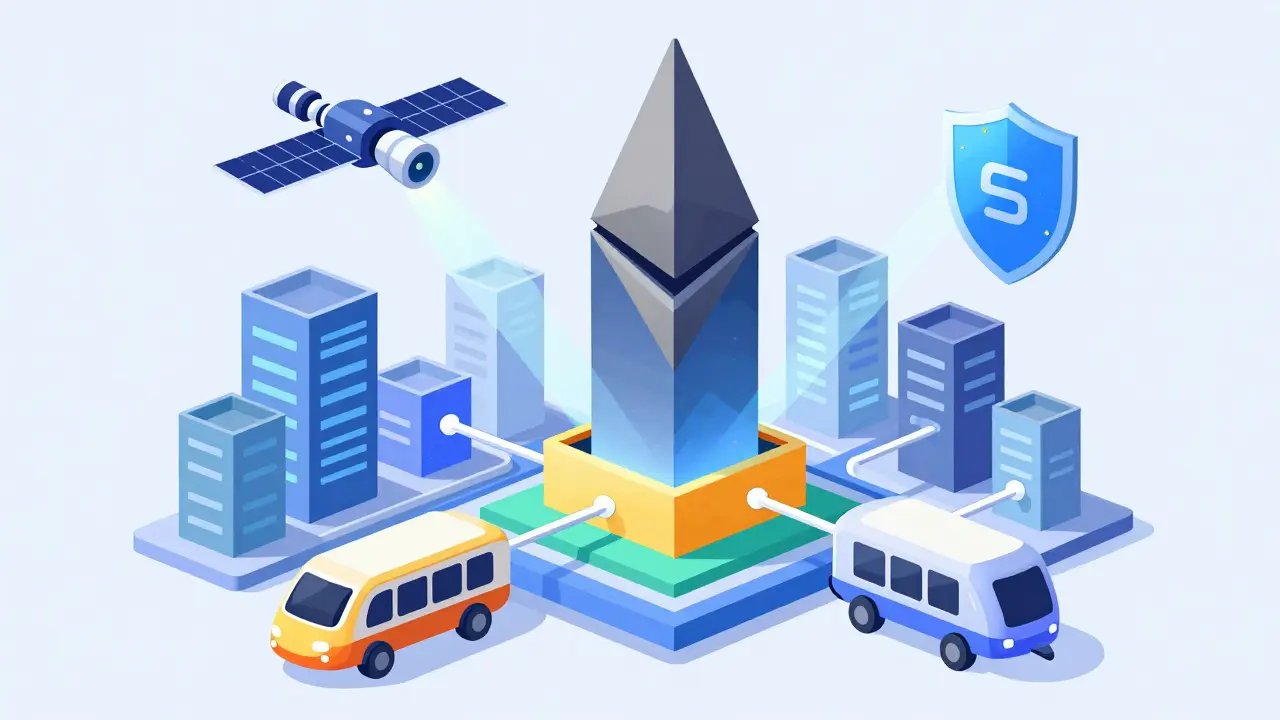
The old idea of one blockchain to rule them all is dead. By 2026, no serious project builds on just one chain. If you’re still trying to force everything onto Ethereum or Solana, you’re already behind. The future isn’t about choosing a single chain-it’s about building across many, and connecting them in ways that make sense. This is the multi-chain ecosystem, and it’s not a trend. It’s the new baseline.
Why Single Chains Can’t Cut It Anymore
Ethereum was the pioneer. It proved that smart contracts could run reliably on a decentralized network. But as usage grew, so did the costs. In late 2025, average gas fees hit $4.27 per transaction during peak times. For a simple payment, a NFT mint, or a game action-that’s unsustainable. Users left. Developers scrambled. And that’s when the industry realized: scaling one chain infinitely isn’t possible. It’s like trying to expand a single highway to handle every car in the country. Traffic jams are inevitable. The answer wasn’t to make Ethereum faster. It was to let other chains handle the low-cost, high-volume tasks. That’s where Layer 2s like Base, Optimism, and Arbitrum came in. They’re not competitors-they’re partners. Base, for example, now handles 78% of new consumer apps because it’s built on Coinbase’s infrastructure. It’s fast, cheap, and trusted. But it doesn’t replace Ethereum. It relies on it for security. That’s the core idea: specialization.How Multi-Chain Works: Modular, Not Monolithic
Modern multi-chain systems don’t just connect chains-they break them apart. Think of a blockchain like a car. In the old model, one company made the engine, the wheels, the brakes, and the radio. Now, you buy each part from the best supplier. That’s modular blockchain. Celestia, launched in late 2023, handles only one thing: data availability. It doesn’t execute transactions. It just makes sure data is stored and accessible. That’s it. Meanwhile, chains like Polygon 2.0 and Taiko handle execution. They use Celestia’s data to verify what happened. This separation cuts costs and boosts speed. Polygon 2.0 now supports 125 transactions per second across its network-over four times faster than Ethereum’s 15-30 TPS. Then there’s EigenLayer. It lets Ethereum validators earn extra income by securing other chains. Instead of each new chain needing its own set of validators (expensive and risky), EigenLayer lets them borrow security from Ethereum. By December 2025, $4.7 billion in ETH was being used this way. That’s a 63% drop in security costs for new chains. It’s like renting a security guard from the best firm in town instead of hiring your own.The Cost Advantage: From $4 to $0.03
Numbers don’t lie. In Q4 2025, Chainalysis found that multi-chain setups slashed transaction costs by 89% for everyday actions. A simple token swap on Ethereum cost $4.27. On Base or Optimism? Less than $0.03. That’s not a small improvement. That’s a revolution. Companies like WisdomTree used this to build a tokenized fund platform. Before multi-chain, transfers took days. Now, they settle intraday. Costs dropped by 89%. The catch? It took 14 months and $2.3 million to build. But that’s the trade-off: upfront investment for long-term efficiency. For startups, the cost of waiting is worse. SVB’s 2026 Crypto Outlook found that 31% of failed startups in 2025 had no multi-chain strategy. They weren’t outcompeted on features-they were outpaced on cost and speed.
Security Risks: The Bridge Problem
Multi-chain isn’t risk-free. The biggest weakness? Cross-chain bridges. These are the tunnels connecting chains. In 2025, $287 million was stolen through bridge exploits. That’s 68% of all DeFi losses-even though bridges only handle 22% of total value. Why? Because they’re complex, poorly audited, and often built by small teams with limited resources. The solution isn’t to avoid bridges. It’s to use better ones. New protocols like LayerZero and Axelar are moving toward decentralized verification using zero-knowledge proofs. These don’t rely on a few trusted parties. They use math to prove transactions happened without revealing details. By Q3 2026, institutional-grade cross-chain messaging will be standard. Until then, enterprise users stick to bridges backed by major players like Polygon or Consensys.Who’s Leading the Pack?
The market is consolidating fast. By January 2026, three models dominate:- Modular execution environments (34% market share): Chains like Taiko and zkSync that separate execution from data.
- Ecosystem-native Layer 2s (29%): Base, Optimism, Arbitrum Orbit-built to work with their parent chains.
- Specialized ZK-rollups (22%): Focused on privacy or high-throughput use cases.
Enterprise Adoption: Banks, Supply Chains, and Beyond
This isn’t just for crypto natives. In 2026, 89 of the top 100 banks are running multi-chain pilots. JPMorgan’s Kinexys platform settled institutional payments 97% faster using hybrid on-chain networks. Deloitte found 68% of Fortune 500 companies now have dedicated multi-chain teams-up from 22% in 2024. Financial services lead adoption at 47%, followed by supply chain (23%) and gaming (17%). Why? Because these industries need speed, auditability, and low cost. A shipment tracking system on a multi-chain network can update in real time, prove authenticity, and cut paperwork-all without a central database.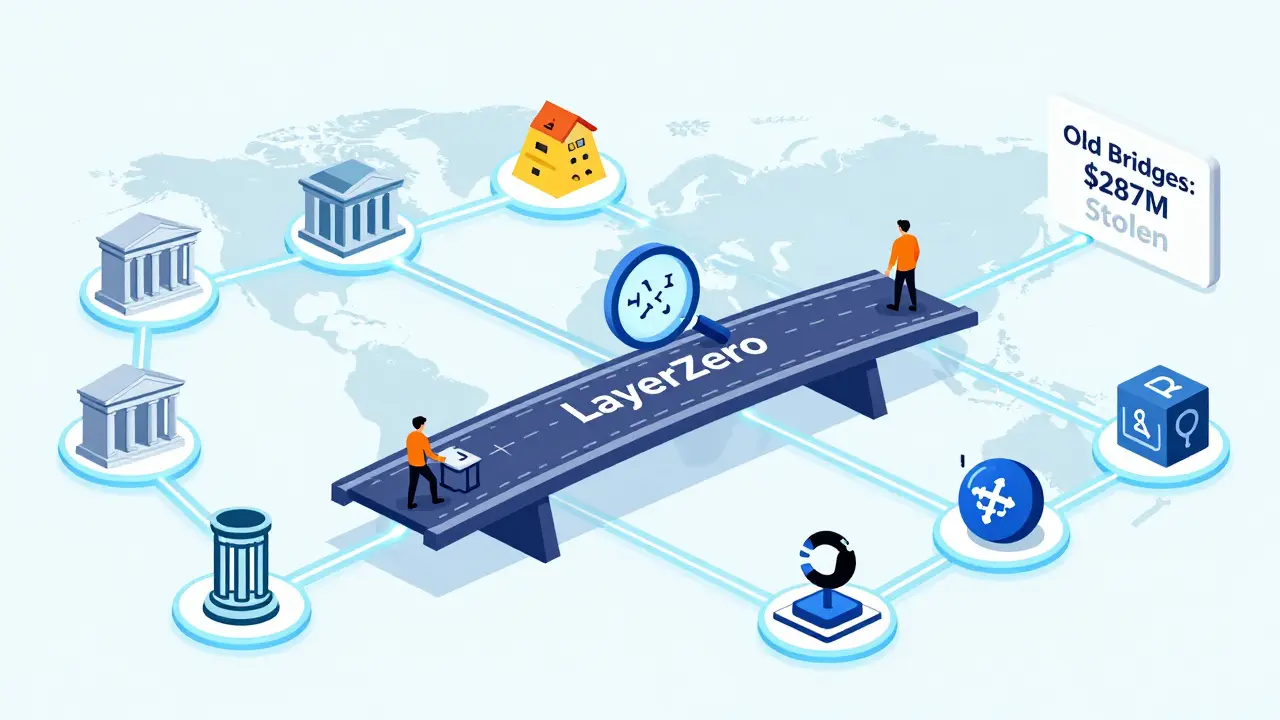
What’s Next in 2026?
The roadmap for this year is clear:- Q2 2026: Universal account abstraction. Your wallet will work the same across all chains-no more switching addresses.
- Q3 2026: Cross-chain privacy using zero-knowledge proofs. You’ll be able to send assets privately between chains.
- Q4 2026: Institutional-grade messaging protocols. Banks will use these to settle trades, not just crypto.
Bill Sloan
14 01 26 / 17:48 PMThis is actually kind of wild to see how fast this shifted. I remember when everyone was yelling about Ethereum being the only way. Now? It's like the CPU of a computer-just one part of the stack. Base and Optimism are the real MVPs for users, and Celestia? Quietly the unsung hero. 🚀
Andre Suico
15 01 26 / 07:44 AMThe modular approach is the only rational path forward. Fragmentation is inevitable, but standardization through shared security and data availability layers mitigates the risks. The real challenge isn't technical-it's organizational inertia. Enterprises still cling to monolithic architectures because they're easier to audit, even if they're inefficient.
Hannah Campbell
15 01 26 / 15:36 PMso you're telling me i need to learn 5 different blockchains just to send $5 to my friend? 🤡
Callan Burdett
15 01 26 / 17:12 PMMan, I used to think Solana was the future. Then I tried to send a transaction during peak hours and lost $12 in gas. Now I just use Base and forget about it. The future isn't flashy-it's cheap, fast, and doesn't make you cry. 💪
Pramod Sharma
15 01 26 / 17:18 PMSpecialization is the law of nature. Why should one chain do everything? The sun doesn't grow food. The soil doesn't light the sky. Each part has its role. Chains are no different.
Bryan Muñoz
15 01 26 / 19:39 PMThey're all controlled by the same 3 VC firms anyway. You think EigenLayer is decentralized? Lol. It's just a fancy way to make ETH holders richer while you pay $0.03 to swap tokens. They're building a gated garden and calling it freedom 🤫
Bharat Kunduri
15 01 26 / 20:36 PMmulti chain? more like multi headache. i tried to bridge from base to polygon and lost my nft. now i just hodl on eth and pray. also why is everyone spelling celestia wrong? its celestia not celestia
ASHISH SINGH
17 01 26 / 07:56 AMLet me guess-this is the same system that’ll collapse when the Fed hikes rates again. You think decentralization means freedom? It means 12 different wallets, 8 bridges, and 3 of them get hacked before breakfast. This isn’t evolution-it’s entropy dressed up as innovation.
Nishakar Rath
17 01 26 / 23:12 PMWho even cares about enterprise adoption? Banks don't understand crypto. They just want to tokenize your mortgage so they can charge you 17% interest on it. This isn't progress-it's financial colonialism with a blockchain sticker on it
nathan yeung
19 01 26 / 04:57 AMActually, I’ve been using Taiko for my dApp and it’s been smooth. The docs are legit. No more guessing which RPC to use. Private nodes? Totally worth it. I went from 3s delays to 180ms. Game changer.
Chidimma Okafor
20 01 26 / 04:23 AMOh my stars and garters! This is the symphony of the digital age-each chain a virtuoso, each layer a note in the grand composition! Celestia, the silent maestro holding the score; EigenLayer, the velvet cloak of security draped over the orchestra! Who knew blockchain could be poetry? 🎻✨
Jason Zhang
20 01 26 / 15:33 PMYeah, sure, multi-chain is great… until you realize half the L2s are just Ethereum with a different logo and a 10% lower gas fee. And don’t get me started on the bridge hacks. $287 million? That’s not innovation. That’s a tax on gullibility.