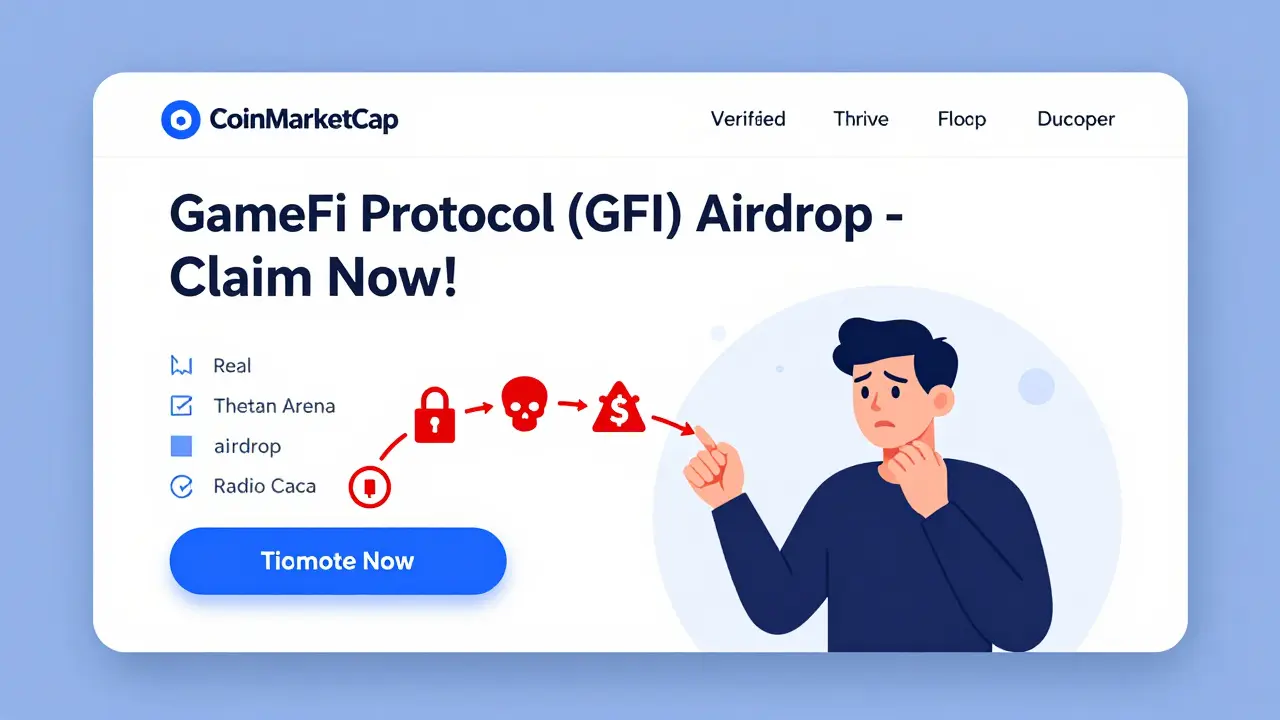
GameFi Airdrop Scam Checker
Check if a suspected GameFi Protocol (GFI) airdrop link is legitimate or a scam. Enter the URL below and we'll verify common scam red flags.
There’s no official GameFi Protocol (GFI) airdrop running right now on CoinMarketCap - and there never has been. If you’ve seen ads, Telegram groups, or YouTube videos claiming otherwise, you’re likely being targeted by scammers. The name GameFi Protocol and its token symbol GFI don’t appear in any verified CoinMarketCap announcements, partner campaigns, or blockchain records. CoinMarketCap has hosted dozens of GameFi airdrops in the past - like those with Thetan Arena, BunnyPark, and Radio Caca back in 2021 - but GameFi Protocol isn’t one of them.
Why the confusion exists
The term "GameFi" is everywhere. It’s a buzzword used by hundreds of projects trying to ride the wave of blockchain gaming. Many of them use names like "GameFi [Something]" to sound official. Some even copy-paste CoinMarketCap’s branding to look legitimate. CoinMarketCap itself never runs airdrops directly - it lists tokens and sometimes partners with projects to promote their launches. But it doesn’t issue tokens, manage wallets, or collect your private keys.GameFi Protocol (GFI) doesn’t show up on CoinMarketCap’s official list of supported tokens. It doesn’t appear on CoinGecko either. No whitepaper, no GitHub repo, no verified social media accounts under that exact name. If a project can’t be found on these platforms, it’s not something you should trust with your crypto.
How real GameFi airdrops work
Real airdrops - like the ones CoinMarketCap helped run in 2021 - had clear rules:- They were announced on CoinMarketCap’s official blog and Twitter
- They required users to complete simple tasks: follow the project, join Discord, hold a specific token
- They used verified smart contracts - no wallet connection needed until claim time
- They distributed tokens to wallets that had already interacted with the project’s ecosystem
There was no "pre-sale" or "early access" fee. No request for your seed phrase. No "instant claim" links that asked you to send ETH or BNB first. If a site asks you to deposit funds to get your airdrop, it’s a scam. Always.
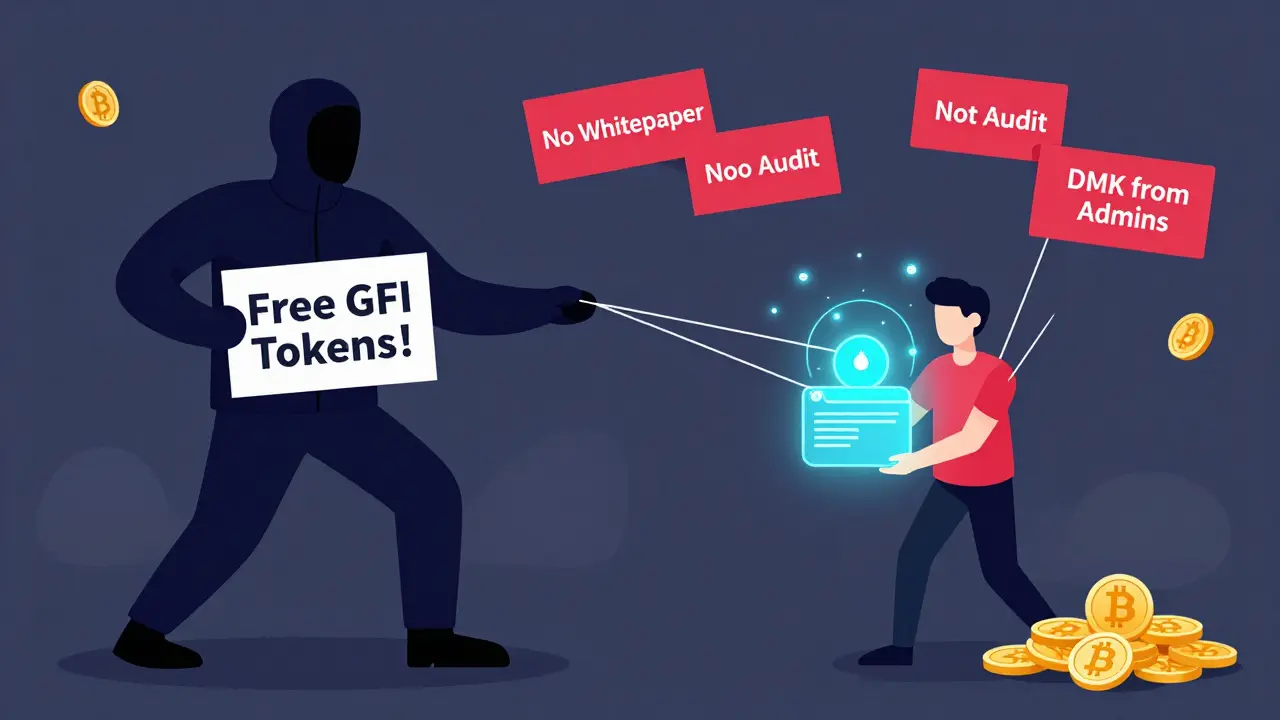
Red flags for fake GFI airdrops
Here’s what to watch out for:- Website URL doesn’t match the official project name (e.g., gamefiprotocol-airdrop[.]com instead of gamefiprotocol.io)
- Telegram or Discord admins message you first - real teams don’t DM users
- Claims of "limited spots" or "only 24 hours left" - pressure tactics are classic scam moves
- Links asking you to connect your MetaMask or Trust Wallet to claim tokens
- No verifiable team members, no LinkedIn profiles, no audit reports from CertiK or Hacken
One user lost $8,400 in October 2024 after clicking a "GFI CoinMarketCap airdrop" link that asked him to approve a transaction. He thought he was claiming free tokens. Instead, he approved a contract that drained his entire wallet. He didn’t get a single GFI token - because the token doesn’t exist.
Where to find real GameFi airdrops
If you want to participate in actual GameFi airdrops, stick to trusted sources:- CoinMarketCap’s official blog - check the "Airdrops" section
- Project websites - look for .io, .org, or .com domains with clear documentation
- Verified social accounts - blue checkmarks on Twitter/X, active Discord with community mods
- Blockchain explorers - search for the token contract on BscScan or Etherscan
Projects like DeFi Warrior, ZOO Crypto World, and Binary X ran legitimate CoinMarketCap-powered airdrops in 2021. Their tokens are still listed. Their teams are public. Their contracts are audited. That’s the standard.

What to do if you already clicked a fake link
If you connected your wallet to a suspicious site or sent any crypto:- Immediately disconnect your wallet from all dApps using a tool like WalletConnect’s revoke page
- Move any remaining funds to a new wallet - don’t reuse the compromised one
- Report the scam to CoinMarketCap’s support team using their official contact form
- Share the link in crypto scam reporting groups like r/CryptoScams on Reddit
Unfortunately, once you approve a malicious contract, there’s no way to reverse it. Blockchain transactions are irreversible. Prevention is your only defense.
Anselmo Buffet
11 12 25 / 18:07 PMThis is the kind of post that saves people thousands. Seriously, if you're new to crypto, read this twice. No exceptions.
JoAnne Geigner
11 12 25 / 20:24 PMI’ve seen so many people fall for this exact scam... it breaks my heart. The way they promise free money, then take everything... it’s predatory. We need more clear-headed people like the author putting this out there.
PRECIOUS EGWABOR
12 12 25 / 00:20 AMOh sweet mercy, another ‘educational’ post about GameFi Protocol. Because obviously, the entire blockchain ecosystem is just a kindergarten class where everyone needs to be told not to touch the hot stove. I mean, come on. If you’re that gullible, maybe don’t touch crypto at all.
amar zeid
13 12 25 / 14:41 PMThank you for this comprehensive breakdown. In India, these scams are proliferating rapidly through WhatsApp groups and fake YouTube tutorials. Many elderly users are being targeted. This should be translated and shared widely.
Claire Zapanta
14 12 25 / 09:16 AMCoinMarketCap is just a front for the SEC’s crypto suppression agenda. They don’t list GFI because they’re afraid of decentralized gaming disrupting Wall Street’s control. You think this is a scam? Wait until you see what they’re hiding behind the real projects.
Lloyd Cooke
16 12 25 / 03:15 AMThe metaphysics of trust in decentralized systems is fascinating. When one’s epistemological framework is rooted in institutional validation - CoinMarketCap, CertiK, Etherscan - one forgets that the entire architecture was built to bypass such gatekeepers. The irony is that the very tools meant to empower are now being weaponized as authority symbols. GFI may be a phantom, but the fear it exploits? That’s very real.
Kurt Chambers
17 12 25 / 05:16 AMYeah right, CoinMarketCap’s the saint of crypto. Tell that to the 2020 Binance listings that turned out to be rug pulls. This whole ‘verify through official channels’ crap is just corporate propaganda. If you’re not buying tokens from a Telegram bot, you’re not living.
Jessica Eacker
18 12 25 / 05:42 AMYou’re not alone if you got tricked. The system is designed to confuse. Just take a breath, cut your losses, and move on. You’re stronger than this moment.
Jessica Petry
18 12 25 / 07:48 AMI mean, really? You’re still using CoinMarketCap as a credibility marker? That’s like trusting the New York Times to tell you what’s happening in the dark web. The entire platform is a paid advertisement engine. GFI might not exist, but neither does your faith in centralized data aggregators.
Scot Sorenson
18 12 25 / 14:18 PMSo let me get this straight - you’re telling me that if a scammer uses the word ‘CoinMarketCap’ in their URL, it’s automatically fake? Wow. That’s like saying if someone says ‘NASA’ in their ad, the moon landing is fake. I’m shocked. Truly.
Ike McMahon
19 12 25 / 09:26 AMDisconnect your wallet. Change your seed phrase. Report the link. Do it now. Don’t wait.
Patricia Whitaker
20 12 25 / 11:41 AMUgh. Another ‘educational’ post. Can we just let people make their own mistakes? I mean, if you’re dumb enough to send ETH to a random link, you deserve to lose it. Stop coddling the masses.
Joey Cacace
22 12 25 / 11:10 AMThank you so much for this! 💙 I shared it with my crypto study group - everyone was about to join a GFI Discord. We’re all safe now because of you. You’re a real one.
Taylor Fallon
24 12 25 / 08:24 AMwe all wanna believe in the magic of web3 right? like... the dream of free tokens and easy money... but then reality hits like a brick wall made of smart contracts. gfi? nah. but the hope? that’s real. keep being kind to newbies. they’re just trying to believe in something better.
Sarah Luttrell
24 12 25 / 23:12 PMOh my god. I just lost $12k to this exact scam. I thought I was getting rich. I’m crying right now. Thank you for this post. I’m not alone. I’m not stupid. I just trusted the wrong thing.
Kathleen Sudborough
25 12 25 / 12:12 PMI’ve been in crypto since 2017 and I still get fooled sometimes. This post is exactly what the community needs - calm, clear, and kind. No yelling, no shame, just facts. If you’re reading this and you’re scared, you’re okay. We’ve all been there. You’re learning. That’s what matters.