
Security tokens aren’t just another crypto trend. They’re real assets-like shares in a company, a slice of a New York apartment, or ownership in a gold reserve-turned into digital pieces you can buy, sell, and track on a blockchain. Unlike speculative cryptocurrencies, security tokens are regulated financial instruments. That means they come with legal protections, clear ownership rights, and rules that prevent fraud. If you’re looking to get into blockchain investing without gambling on meme coins, this is where the real opportunity is.
What Exactly Are Security Tokens?
Think of a security token as a digital version of a stock certificate or a deed to a property. Instead of paper documents and brokers handling transfers, everything happens on a blockchain. The token represents a share in something tangible: real estate, equity in a startup, bonds, commodities like oil or silver, or even future revenue from a business.
These tokens follow strict rules built into their code. If you’re not an accredited investor in the U.S., the token’s smart contract won’t let you buy it. If you’re in the EU, you might be able to invest, but only in certain types of assets. The rules aren’t optional-they’re enforced automatically by the blockchain. This is called compliance-by-design. It’s what makes security tokens different from unregulated ICOs that crashed in 2018.
In 2026, security tokens are backed by real-world value. A single token might represent 0.01% of a $10 million office building in Singapore. You don’t need $1 million to own a piece of it-you need $1,000. That’s the power of fractional ownership.
Why Security Tokens Are Different From Crypto or Stocks
Most people think crypto means Bitcoin or Ethereum. But security tokens sit in a different lane. Here’s how they compare:
- Bitcoin/Ethereum: Decentralized, speculative, no underlying asset. Price moves on hype, news, or fear.
- Traditional stocks: Regulated, but slow. You trade during market hours, pay fees to brokers, and wait days for settlement.
- Security tokens: Regulated like stocks, but traded 24/7 on blockchain. Settlement happens in minutes. You own a real asset, not just a bet.
Take a company like a small tech startup in Berlin. Instead of going through a long, expensive IPO process, they issue security tokens representing equity. Investors buy them directly on a regulated platform. No underwriters. No months of paperwork. Just a smart contract that gives you voting rights and dividend payouts automatically.
Step 1: Choose a Regulated Platform
You can’t just buy security tokens on Binance or Coinbase. They’re not listed there. You need a platform that’s licensed to handle securities. These platforms are built for compliance. They handle KYC, AML, investor accreditation checks, and legal reporting.
In 2026, the most trusted platforms include:
- Securitize (U.S.-based, works with institutional investors)
- Polymarket (for tokenized derivatives and real-world assets)
- Tokeny (EU-focused, strong compliance tools)
- Bakkt (backed by the NYSE parent company, now offering tokenized real estate)
Don’t pick a platform just because it has flashy graphics or low fees. Look for these three things:
- Is it licensed by a financial regulator? (SEC, FCA, MAS, etc.)
- Does it use Ethereum or another blockchain with proven compliance infrastructure?
- Does it partner with a regulated custodian to hold your tokens safely?
Platforms like Securitize use Ethereum-based standards that allow them to block transfers if someone tries to sell to an unverified buyer. That’s not a bug-it’s the whole point.
Step 2: Complete KYC and AML Verification
This isn’t optional. It’s the law. You’ll need to upload:
- A government-issued ID (passport or driver’s license)
- A proof of address (utility bill or bank statement, less than 3 months old)
- For U.S. investors: Proof of accredited investor status (tax returns, bank statements showing $200k+ income or $1M+ net worth)
The process takes 1-5 business days. Some platforms use AI to verify documents faster. Others require manual review. Either way, don’t rush it. If your documents are blurry or outdated, your application will be rejected.
Once approved, you’re locked into your investor status. If you’re an accredited investor in the U.S., you can only buy tokens labeled for accredited investors. If you’re retail, you’re limited to offerings that qualify under Regulation A+ or Regulation CF.
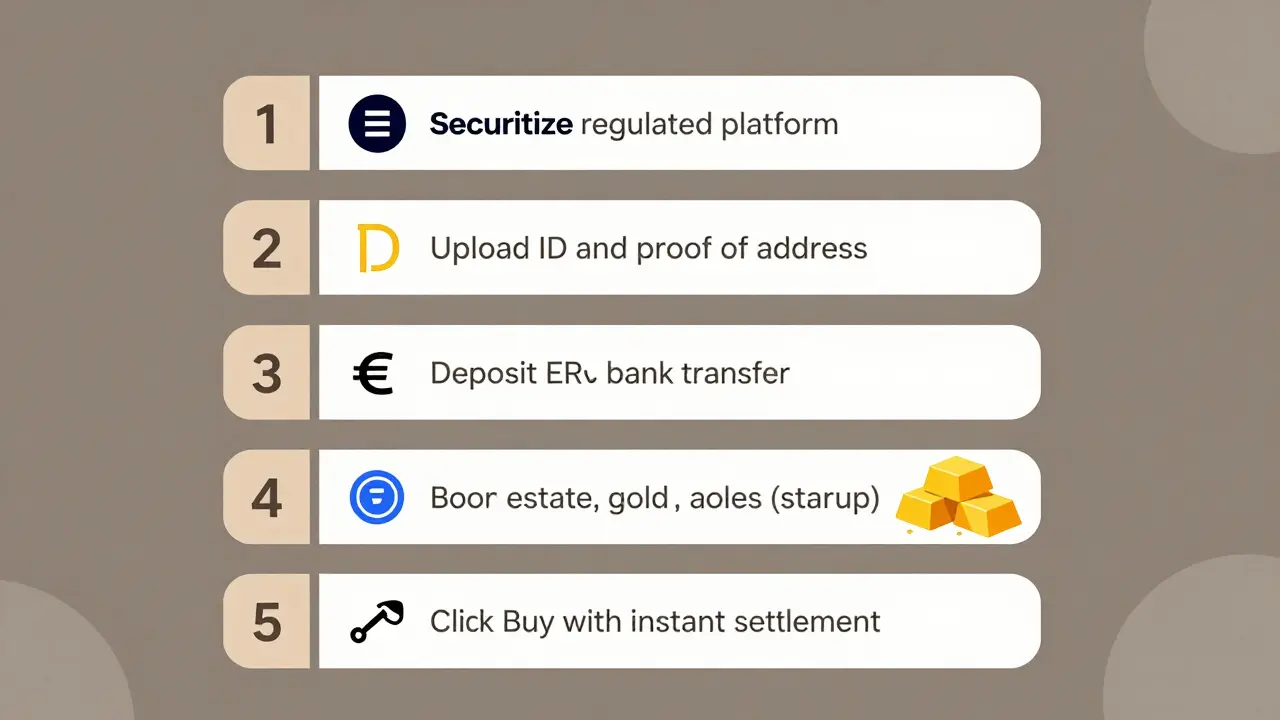
Step 3: Fund Your Account
Most platforms accept bank transfers in USD, EUR, or NZD. Some allow you to deposit stablecoins like USDC or EURC, which are pegged 1:1 to fiat and accepted by compliant platforms.
Don’t send Bitcoin or Ethereum directly unless the platform explicitly says it’s allowed. Many platforms won’t accept them because they’re harder to trace and could trigger AML flags.
Once your funds are in, you’ll see a balance in your dashboard. You’re ready to browse available tokenized assets.
Step 4: Pick Your Asset
Here’s where it gets interesting. You’re not just picking stocks-you’re picking real-world value.
- Real estate: Fractional shares of commercial buildings in London, luxury apartments in Dubai, or warehouse spaces in Auckland. Returns come from rent and appreciation.
- Equity: Shares in private companies-startups, biotech firms, or renewable energy projects. These are often pre-IPO opportunities.
- Commodities: Gold, silver, or even carbon credits. Each token might represent 1 gram of gold stored in a Swiss vault.
- Revenue-sharing: Tokens tied to future income from a film, music catalog, or SaaS business. You get paid when the business earns.
Each asset has a prospectus. Read it. Look for:
- Who’s issuing the token?
- What’s the underlying asset?
- How are profits distributed? (Monthly? Quarterly?)
- Are there lock-up periods? (Some tokens can’t be sold for 12 months.)
- What’s the exit strategy?
Don’t just chase the highest projected return. Look at the track record of the issuer. Is this a team with real experience? Or a startup with a slick website and no assets?
Step 5: Buy and Manage Your Tokens
Click “Buy,” enter the number of tokens, confirm the price, and hit submit. The transaction settles in minutes. You’ll see your tokens in your wallet on the platform.
Dividends? They’re automatic. If the building you own a share of earns rent, the platform sends your portion directly to your linked bank account. No invoices. No delays.
You can also sell your tokens on the platform’s secondary market. Unlike traditional private equity, where you wait years to exit, security tokens let you trade anytime-subject to jurisdictional rules. Some tokens have holding periods. Others are freely tradable.

Where the Risks Are (And How to Avoid Them)
Security tokens are safer than crypto, but they’re not risk-free.
- Platform risk: If the platform shuts down, you could lose access. Always use regulated, well-funded platforms with insurance.
- Liquidity risk: Just because a token can be traded doesn’t mean it will be. Low-volume assets might be hard to sell quickly.
- Regulatory risk: Laws change. A token that’s legal in Singapore might be banned in Canada. Always check jurisdiction rules.
- Asset risk: The building you invested in might sit empty. The startup might fail. This is still investing-you’re not guaranteed returns.
Only invest what you can afford to lose. Diversify. Don’t put all your money into one tokenized property or one startup. Spread it across asset types and geographies.
Real-World Example: A $5,000 Investment in Auckland Real Estate
In 2025, a Wellington-based investor bought 50 tokens representing 0.5% of a 12-unit apartment building in Auckland. The total value of the building was $10 million. Each token cost $100.
The building generates $600,000 in annual rent. The investor’s share: $3,000 per year. That’s a 6% annual return before appreciation.
After 18 months, the building’s value rose to $11 million. The investor sold their tokens for $110 each-making a $500 profit on top of the rent. Total return: 11% in 18 months.
This is what’s possible when you combine real assets with blockchain efficiency.
What’s Next for Security Tokens?
By 2027, we’ll see more traditional banks offering tokenized assets. Pension funds are already testing them. The Swiss Exchange is launching a dedicated security token trading platform. Even Wall Street firms are building internal systems to issue and trade them.
For everyday investors, this means more access. More choice. Lower barriers. The old system of high minimums, slow transfers, and opaque ownership is fading.
Security tokens aren’t the future. They’re here. And if you’re waiting for someone else to explain them to you, you’re already behind.
Are security tokens legal?
Yes, if they’re issued and traded on regulated platforms. Security tokens are legally classified as securities under U.S. SEC rules, EU MiCA regulations, and similar frameworks in Singapore, Australia, and Switzerland. They must follow the same rules as stocks or bonds-just with blockchain efficiency.
Can I invest in security tokens if I’m not an accredited investor?
Yes, but only in certain offerings. In the U.S., Regulation A+ and Regulation CF allow non-accredited investors to buy tokens with limits on how much they can invest. In the EU, Singapore, and UAE, retail investors can participate more freely, depending on the asset type and platform licensing.
Do I need a crypto wallet to hold security tokens?
No. Most platforms hold your tokens for you in a secure, custodial wallet. You don’t need to manage private keys. If you do want to transfer tokens to a personal wallet, make sure it’s compatible with the token’s blockchain (usually Ethereum) and supports the compliance rules built into the token.
How are dividends paid out?
Automatically. Smart contracts handle payouts based on the asset’s income-rent, profits, interest. The platform sends the money directly to your linked bank account. No forms. No delays. You’ll get a statement showing exactly how much you earned and from which asset.
Can I lose money investing in security tokens?
Yes. Just like buying a stock or real estate, the value can go down. The building might sit vacant. The company might fail. The market might crash. Security tokens reduce fraud and improve transparency, but they don’t eliminate market risk. Never invest more than you can afford to lose.
george haris
20 01 26 / 12:47 PMMan, I’ve been waiting for this for years. Real assets on-chain? Yes please. I bought a slice of a Brooklyn warehouse last year through Tokeny and got my first dividend last month-$47.23. Not life-changing, but it felt like owning something real for the first time. No broker breathing down my neck, no paperwork. Just code and cash.
Paru Somashekar
20 01 26 / 22:35 PMSecurity tokens represent a paradigm shift in asset ownership, particularly for emerging economies where access to capital markets remains restricted. The fractionalization of high-value real estate and private equity instruments enables inclusive participation, provided regulatory frameworks are harmonized across jurisdictions. One must exercise due diligence in platform selection, as compliance infrastructure is non-negotiable.
Heather Crane
21 01 26 / 03:40 AMI love this so much!!! 🌟 Finally, something that feels like investing instead of gambling. I’m a single mom in Ohio and I put $1,000 into a tokenized solar farm in Arizona. Last quarter, I got $28 in dividends. My kid asked why I was smiling at my phone and I told her ‘We’re owning the sun now.’ 💪☀️
David Zinger
22 01 26 / 09:21 AMUSA is falling behind. Canada has had tokenized real estate on the TSX since 2024. Why are you all still talking about Securitize like it’s the only option? We’ve got AssetChain and BlockchainCapital here. You guys are stuck in 2021. 🇨🇦🔥
Catherine Hays
22 01 26 / 16:42 PMAnother crypto cultist pushing another scam. You think blockchain makes fraud impossible? The SEC has already shut down 37 tokenized real estate platforms in 2025. This is just the new ICO. You’re all gonna lose everything. And no, I won’t send you my portfolio. You don’t deserve it.
Kevin Pivko
24 01 26 / 13:34 PMLet’s be real. 90% of these ‘tokenized assets’ are just rebranded Ponzi schemes with fancy smart contracts. That ‘$10M building in Singapore’? Probably a photo from Google Images and a PDF someone made in Canva. You think the issuer is gonna pay you rent? Nah. They’re gonna disappear after the first 500 investors.
Mathew Finch
25 01 26 / 02:07 AMAnyone who thinks security tokens are for ‘everyday investors’ is delusional. You need $1M in net worth to even get past the first gate. This isn’t democratization-it’s exclusion with a blockchain veneer. The rich get richer, the rest get KYC forms.
Margaret Roberts
26 01 26 / 20:41 PMDid you know the government is using these tokens to track your spending? Every dividend you get is logged. Every sale is flagged. Soon they’ll know what you bought, when, and how much you made. This isn’t freedom-it’s surveillance with a smiley face. The Fed is building a financial panopticon. Wake up.
Adam Lewkovitz
28 01 26 / 12:42 PMY’all act like this is magic. It’s just stocks with extra steps. If you can’t afford to buy a whole building, you shouldn’t be buying 0.01% of one. You’re paying fees to a platform that’s basically a middleman with a blockchain logo. Stick to index funds.
Clark Dilworth
28 01 26 / 18:14 PMFrom a DeFi infrastructure standpoint, the critical enabler is the ERC-1400 standard for programmable securities, which allows for dynamic compliance logic embedded within the token’s metadata. The interoperability between on-chain identity protocols like Worldcoin and on-chain asset registries is what enables true compliance-by-design at scale.
Brenda Platt
29 01 26 / 18:16 PMTHIS IS SO EXCITING!!! 🥳 I’m 52 and just started investing last year. I bought 10 tokens in a women-owned tech startup in Austin. They just hit $100M valuation! I got a little email saying I’m now a shareholder with voting rights. I cried. I’m so proud of us. You can do this too, girls!! 💜
Barbara Rousseau-Osborn
30 01 26 / 08:53 AMOf course you’re all falling for this. You don’t even know what a prospectus is. You just see ‘6% return’ and click buy. You think the blockchain makes you smart? No. It just makes your mistakes faster. You’re not an investor. You’re a gambler with a crypto wallet.
Chidimma Catherine
30 01 26 / 21:42 PMI’m from Nigeria and I can’t invest in any of these platforms because I’m not accredited. But I read everything. I study. I learn. One day, when the rules change, I’ll be ready. I’m not waiting for permission. I’m building my knowledge. This isn’t just money-it’s power. And power belongs to those who understand it first.
Nathan Drake
31 01 26 / 13:08 PMIf ownership is digitized, then what is property? If a token represents a share in a building, but the building still exists in physical space governed by municipal law-then is the token merely a symbol, or a new form of contract? The blockchain doesn’t change the nature of ownership-it just changes how we verify it. And perhaps, that’s all we ever needed.