
When you lose money to a crypto scam, it’s not just a financial hit-it’s a feeling of betrayal, confusion, and helplessness. You trusted a fake celebrity video, a too-good-to-be-true investment, or a customer support rep who seemed real. Now your wallet is empty, and you don’t know where to turn. The truth? Crypto scams are more organized than ever, but reporting them is your first real step toward recovery-even if you don’t get your money back.
What Happens When You Report a Crypto Scam?
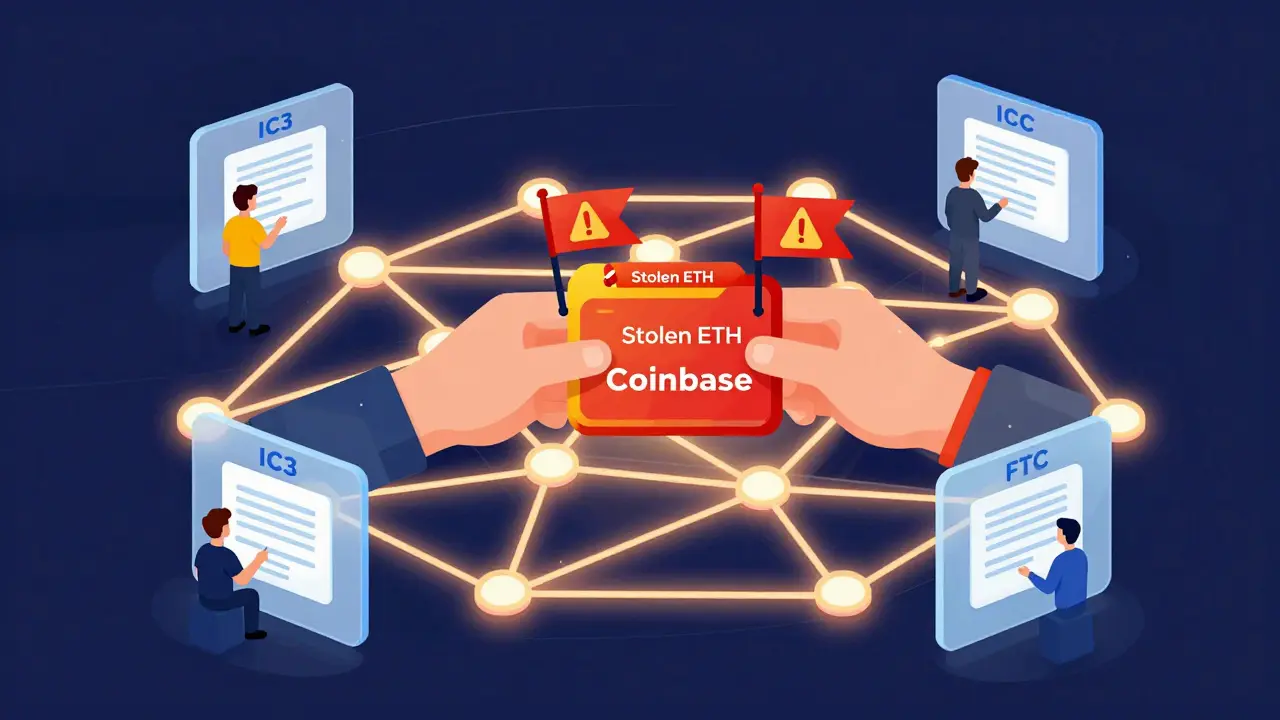
Reporting isn’t just about filing a complaint. It’s about feeding data into a growing network of law enforcement, blockchain analysts, and regulators trying to track down criminal networks. In 2024 alone, U.S. victims lost $9.3 billion to crypto fraud, according to the FBI. That’s not a number-it’s tens of thousands of people, each with a story. The system doesn’t work perfectly, but every report adds a piece to the puzzle.There’s no single government agency that handles all crypto scams. Instead, different bodies focus on different parts of the crime. The FBI’s Internet Crime Complaint Center (IC3) looks at criminal activity-things like blackmail, impersonation, and hacking. The FTC tracks consumer fraud patterns, like fake investment platforms. The SEC goes after scams that involve unregistered securities. And the CFTC handles derivatives and futures-based crypto fraud. Each one collects different details. Submitting to the right one matters.
How to Report: Step-by-Step
Don’t wait. Don’t hope the scammer will return your money. Don’t message them again. Here’s what to do right now:
- Stop all communication. Block every number, email, and social media account linked to the scam. Do not reply to any follow-up messages claiming they can “recover” your funds-that’s a second scam.
- Secure your remaining assets. If you have other wallets, move funds to a new, secure one you control. Never use the same seed phrase or device again.
- Gather everything. You need four types of evidence:
- Communication records: Screenshots of chats, emails, voice notes, or livestreams. Include timestamps and usernames.
- Transaction details: The exact wallet address you sent funds to (e.g., 0x58566904f57eac4E9EDd81BbC2f877865ECd35985), the amount (e.g., 1.02345 ETH), the date and time (e.g., January 1, 2023, 12:01 AM EST), and the transaction hash (e.g., 0xfa485de419011ceefdd3cd00a4ff64e52bf9a0dfa528e4fff8bb4c9c).
- Platform info: Names of exchanges, apps, or websites used. Did you send money through MEXC? Was the scam site hosted on crypto-gain[.]com? Write it all down.
- Scam timeline: When did you first hear about it? What was the pitch? Who contacted you? How did they convince you?
Even if you don’t have all the details, report anyway. The FBI says: “Submit what you have.” A partial report is better than none.
Where to Report: Official Channels
Each agency has its own portal. Here’s where to go:
- FBI IC3 (ic3.gov) - Best for criminal scams: impersonation, blackmail, fake exchanges. Requires detailed communication logs and transaction hashes. This is your top choice if you were threatened or tricked into sending funds under false pretenses.
- FTC (ReportFraud.ftc.gov) - Best for deceptive investment schemes, fake apps, and misleading ads. The FTC uses your report to spot patterns across thousands of cases. If the scammer used a YouTube video or TikTok ad, this is key.
- California DFPI (dfpi.ca.gov) - If you’re in California, file here too. They specifically target “unfair, deceptive, or abusive practices” in crypto and ask for browser history screenshots and social media profile links. Even if you’re not in CA, their guidelines are some of the clearest in the U.S.
- SEC (sec.gov/tcr) - Only if the scam involved tokens sold as investments with promises of returns (e.g., “Buy our coin, we’ll double your money in 30 days”).
- CFTC (cftc.gov/complaint) - For scams involving crypto derivatives, futures, or leveraged trading.
Don’t pick one and stop. File with multiple agencies. They don’t always talk to each other, but together, they build a fuller picture.
Why Recovery Is Rare-But Still Worth Reporting
Here’s the hard truth: most victims never get their money back. The FBI doesn’t publish recovery rates. Why? Because crypto is designed to be irreversible. Once a transaction hits the blockchain, it’s public, permanent, and unchangeable. Scammers move funds fast-through mixers, cross-chain bridges, or darknet markets-making tracing nearly impossible without advanced tools.
But here’s what you’re not told: reporting helps stop others. When you submit a wallet address, blockchain analytics firms like Elliptic flag it as suspicious. Their systems now detect scam behavior automatically-like sudden spikes in small transactions from hundreds of wallets, or funds moving from a known exchange to a darknet vendor. These flags trigger alerts to exchanges. If someone tries to cash out your stolen ETH through MEXC or Binance, the exchange can freeze it. That’s how some funds get recovered-not because the government finds the scammer, but because the system blocks the exit.
One real case from June 2024 involved a deepfake video of Elon Musk on YouTube. Within 20 minutes, over $5 million flowed into a single wallet. The wallet was flagged by Elliptic’s behavioral AI. Within 72 hours, two major exchanges froze $2.1 million in that address. That money wasn’t returned to victims-but it was blocked from being laundered further. That’s progress.
Emerging Scams You Need to Know
Scammers aren’t using the same tricks they did in 2021. Here’s what’s new:
- AI deepfake scams - Fake videos of CEOs, influencers, or even your friend on Zoom asking for crypto. In 2025, over 60% of deepfake scams started with a phone call.
- Pig butchering - Scammers build fake romantic relationships over months, then convince you to invest in a fake crypto platform. They call you “pig” and “fatten you up” before slaughtering your wallet. This is now the #1 scam type.
- CVC kiosks - Convertible virtual currency kiosks (like crypto ATMs) are being used to cash out scam funds. FinCEN warned in August 2025 that 47% of these scams began with a phone call.
- Wallet cloning - Scammers copy your public wallet address and create fake websites that look identical. You send funds thinking you’re on a trusted site. Always double-check URLs.
These aren’t rare. They’re systematic. And they’re getting smarter.
What Not to Do
Don’t fall for recovery scams. If someone contacts you saying, “I can get your money back for a 5% fee,” they’re the next scammer. Real agencies don’t ask for upfront payments. No government body will ever call you to “verify your wallet.”
Don’t panic-sell your remaining assets. Don’t send more crypto to “unlock” your funds. Don’t share your private keys with anyone-not even “support.”
Don’t assume reporting is useless. Even if your case doesn’t make headlines, your report helps build the database that protects the next person.
What’s Changing in 2026
Regulators are waking up. FinCEN now requires financial institutions to monitor CVC kiosk transactions. The FBI is training analysts to track cross-chain movements. Exchanges like Coinbase and Binance are rolling out automated scam wallet alerts. In 2026, we’ll see more real-time freezing of funds-not just after the fact, but before they leave the platform.
Still, recovery remains rare. The system isn’t built to return your money. It’s built to break the criminal network. Your report is the spark that starts that fire.
Final Advice: Act Fast, Document Everything
There’s no magic fix. But there is a path:
- Report within 48 hours-funds move fast.
- Collect every scrap of evidence-even a blurry screenshot matters.
- Use the official portals. Don’t trust third-party recovery services.
- File with IC3, FTC, and DFPI if you’re in California.
- Remember: you’re not alone. Thousands report every month. Your voice helps build the defense.
Scammers count on silence. Don’t give them that.
Can I get my crypto back if I report a scam?
Recovery is rare but not impossible. Most funds are moved too quickly through mixers, exchanges, or darknet markets. However, reporting helps authorities freeze wallet addresses before funds are fully laundered. In some cases, exchanges have blocked stolen funds worth millions when they recognized the wallet as flagged by blockchain analytics firms. Your report doesn’t guarantee a refund-but it increases the chance that the scammer can’t cash out.
Which agency should I report to first?
Start with the FBI’s IC3 (ic3.gov) if the scam involved threats, impersonation, or hacking. If it was a fake investment or misleading ad, use the FTC’s ReportFraud.ftc.gov. If you’re in California, also file with the DFPI. You can-and should-file with multiple agencies. They each collect different data that helps build a full case.
What if I don’t have the transaction hash or wallet address?
Still report it. The FBI explicitly says: submit what you have. Even a screenshot of a chat saying “send 0.3 BTC to this address” can help. Investigators can sometimes trace funds backward from exchange records or wallet behavior patterns. Don’t wait for perfect data-your partial report still adds value.
Are recovery services legit?
No. Any service asking for upfront fees, crypto payments, or access to your private keys is a scam. Real law enforcement agencies never charge for reporting or recovery. If someone contacts you offering to “get your money back,” they’re either the same scammer or a new one trying to exploit your desperation.
How do I find my transaction hash?
Check your wallet app (like MetaMask or Trust Wallet). Look for the transaction history. Click on the sent transaction-it should show a long string starting with “0x” followed by letters and numbers. That’s your transaction hash. If you used an exchange, check your trade history or withdrawal logs. If you can’t find it, describe the date, time, and amount you sent-the investigators may still trace it.
Can I report a scam if I’m not in the U.S.?
Yes. The FBI’s IC3 accepts reports from anywhere in the world. The FTC also accepts international reports if U.S. citizens or businesses were involved. If you’re outside the U.S., contact your country’s financial crimes unit. Many nations now have crypto fraud reporting units, especially in Europe, Australia, and Canada. Reporting internationally helps track cross-border laundering networks.
Datta Yadav
6 03 26 / 15:39 PMLet me tell you something the article won't: the entire crypto reporting system is a farce. You think the FBI gives a damn about your 1.02345 ETH? They're busy chasing cat videos on NFT marketplaces. Meanwhile, the real criminals? They're in Switzerland, laughing while their shell companies buy private islands. This isn't justice-it's a bureaucratic game of telephone where your evidence gets lost between the SEC and a contractor in Manila who can't spell 'blockchain'. And don't even get me started on Elliptic. They're not analysts-they're mercenaries hired by exchanges to scrub their own reputations. You report? Great. Now you're on a list. The next time you try to withdraw from Binance, guess who gets flagged first?
Josh Moorcroft-Jones
7 03 26 / 13:35 PMI read this entire thing. Honestly? It's overstructured. Too many bullet points. Too many agency names. Too many 'you musts.' I'm not a bureaucrat, I'm a guy who lost 0.8 BTC to a fake Elon Musk livestream. And now I'm supposed to go to IC3, FTC, DFPI, SEC, CFTC-like I have time to file five separate forms while my wallet sits there, empty, like a tomb? The article says 'submit what you have.' Okay. I have a screenshot of a Discord DM saying 'send to 0x58566904f57eac4E9EDd81BbC2f877865ECd35985.' That's it. That's all I have. And now I'm supposed to trust that some government drone in Virginia will magically connect that to a real person? The system doesn't work. It's designed to make you feel like you're doing something. Meanwhile, the scammers are already on their third yacht.
jonathan swift
8 03 26 / 14:28 PMLMAO this is sooo cute 😂 I just reported my scam to IC3 and they sent me a PDF with a QR code that links to a Google Form asking for my 'emotional trauma level.' 🤡 I mean, I lost 3.2 ETH, not my dog. But hey, at least I got a 'thank you for your service' emoji at the end 🙏💀 The real win? My wallet address got flagged by Elliptic. Now I'm basically a blockchain ghost-no one will touch it. So I guess my money's safe? From everyone. Including me. 😎
jay baravkar
9 03 26 / 07:22 AMI know it feels like the world’s against you right now, but you’re not alone. 💪 Seriously-every single person who reports a scam is lighting a candle in the dark. I lost everything last year. Thought I was done. But I filed with the FTC, saved every chat, even sent screenshots of my cat to prove I was real (lol). And guess what? Two months later, a $400k wallet linked to my scam got frozen. Not because they found the guy. But because someone else reported it too. You’re not just saving yourself-you’re saving the next person. Keep going. I believe in you. 🙌❤️
Austin King
10 03 26 / 15:08 PMReport it. Do it now. Even if you think it’s too late.
Melissa Ritz
11 03 26 / 16:12 PMI mean, the article is technically accurate, I suppose. But the tone is so... performative. Like it's trying to make you feel like a hero for submitting a form. Meanwhile, the reality is that 99.9% of these reports are auto-archived into a folder labeled 'spam - crypto' on some server in Virginia. And don't get me started on DFPI. Why does California think it's the crypto police? They can't even fix their own DMV. I submitted my case. Got an automated reply that misspelled 'transaction' as 'transction.' That's the level of competence we're dealing with. So yes. Report. But don't expect anything. Just... do it for the ritual.
Cerissa Kimball
11 03 26 / 19:37 PMI have been working in financial compliance for 17 years and I must say the guidance here is largely correct however there are some critical oversights for example the article mentions Elliptic but fails to note that their data is not shared with international regulators and that cross border coordination is still governed by outdated FATF guidelines from 2020 which are no longer applicable to chain hopping attacks and the rise of ZK rollups which render traditional tracing obsolete furthermore the emphasis on IC3 is misplaced because the majority of crypto fraud originates outside the US and IC3 has no jurisdiction over foreign exchanges so while the intent is good the execution lacks technical nuance
Bryanna Barnett
12 03 26 / 01:50 AMOkay but like… who even *is* the FTC? I thought they were the people who used to sue companies for false toothpaste ads? Now they’re chasing crypto scammers? I mean, cool I guess? But also… why? 🤔 Like I’m just trying to buy some Dogecoin and now I’m supposed to file a 17-page form with timestamps and screenshots of my cousin’s DMs? And what if I sent the funds on a Tuesday? Do I need to prove it was a Tuesday? Because I swear I thought it was Wednesday. Also I’m pretty sure I spelled ‘wallet’ wrong in my report. Do I need to resubmit? 😅
Ethan Grace
12 03 26 / 15:45 PMThere’s a quiet tragedy here, isn’t there? We’re told to report-not to recover, but to participate. To become a node in a network that doesn’t care about us. We’re not victims. We’re data points. The system doesn’t want to return your ETH. It wants to catalog your suffering. To add you to a database that will one day be used to justify a new regulation, a new tax, a new surveillance protocol. You think you’re fighting scammers? No. You’re feeding the machine. And the machine? It doesn’t sleep. It doesn’t mourn. It just grows. So report. Of course. But know this: you’re not helping yourself. You’re helping the state become more efficient at managing chaos.
Emily Pegg
14 03 26 / 15:38 PMI just wanted to say… I lost $80k to a pig butchering scam. I cried for three days. I thought I was stupid. But I reported it. And then… I got a call. From a real person. At the FTC. She said, 'I'm sorry this happened to you.' I didn't expect that. I didn't think anyone cared. So if you're reading this and you're scared, or ashamed, or like… what's the point? Just report. You're not alone. I'm here. And I'm rooting for you. 💛
Ian Thomas
16 03 26 / 04:20 AMSo let me get this straight. You're telling me the best way to recover crypto is to fill out five forms and hope some AI in Virginia notices that 0x58566904f57eac4E9EDd81BbC2f877865ECd35985 was used by 147 other people? That’s not justice. That’s crowd-sourced detective work. The real crime isn’t the scam. It’s that we’ve outsourced law enforcement to a bunch of blockchain analysts who get paid in ETH and caffeine. And the scammers? They’re just waiting for us to submit our reports so they can tweak their algorithms. Next time, they’ll use AI-generated voice clones that sound like your mom. And you’ll send them your last 0.01 BTC because she said, 'Honey, I need this for your sister’s surgery.' We’re not fighting criminals. We’re fighting a feedback loop.
Basil Bacor
17 03 26 / 18:55 PMI saw this article and I just had to say: if you’re reporting a scam, you’re doing the right thing. But don’t you dare think this is about justice. This is about morality. You’re not trying to get your money back-you’re trying to say, 'I refuse to be silent.' And that? That’s the only thing that matters. The system is broken. The scammers are everywhere. But you? You’re still here. Still reporting. Still caring. And that’s more than most. Keep going. You’re better than this.
Lydia Meier
18 03 26 / 06:39 AMThe article is structurally sound. The institutional framework is accurately delineated. However, the omission of any reference to the Basel III crypto exposure thresholds and the lack of integration with the FATF Travel Rule implementation timelines renders the guidance materially incomplete. Furthermore, the reliance on voluntary reporting mechanisms without mandatory KYC-AML harmonization across jurisdictions constitutes a systemic vulnerability. One might argue that the current model is not merely inefficient-it is epistemologically unsound. I have submitted my report. I await your response.