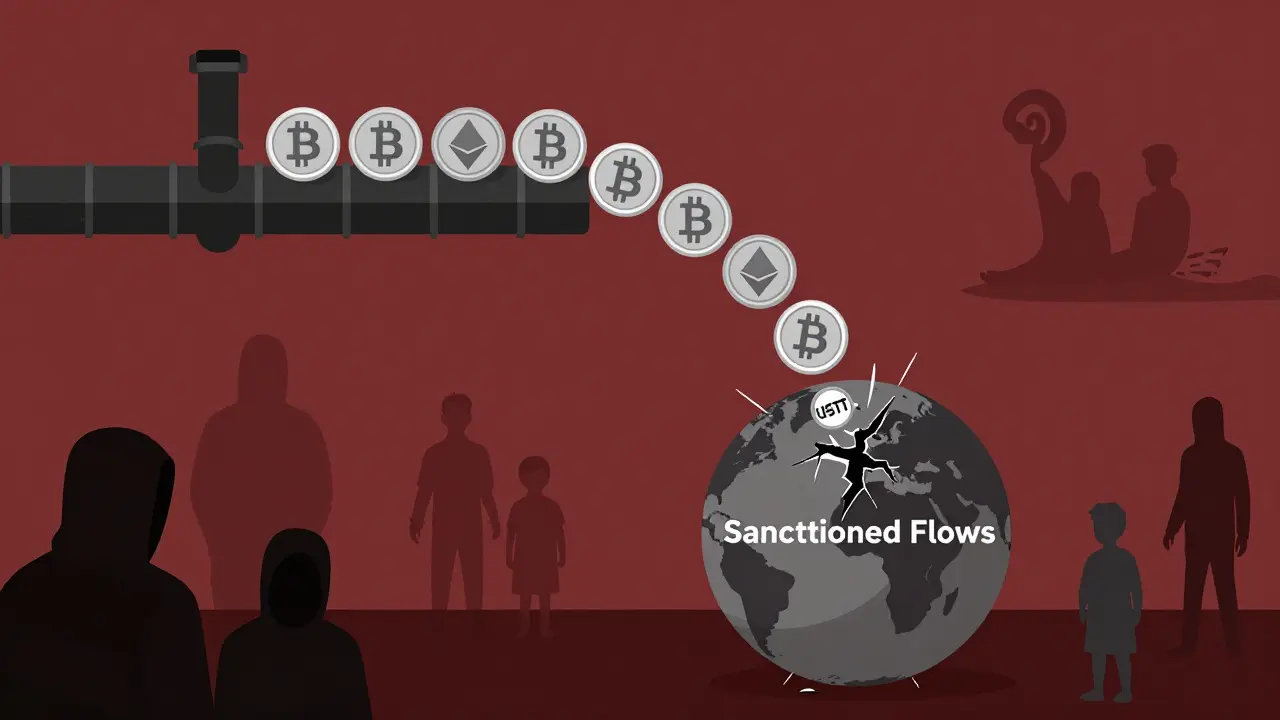
In 2024, sanctioned crypto transactions hit a record $15.8 billion - a number that didn’t just reflect criminal behavior, but a fundamental shift in how rogue states and cybercriminals move money. This wasn’t a glitch in the system. It was a calculated adaptation. As banks tightened rules, crypto became the new underground pipeline - fast, global, and hard to stop.
Bitcoin and Ethereum: The Backbone of Sanctioned Flows
Bitcoin carried nearly 70% of all crypto payments tied to sanctioned entities in 2024. Why? Because it’s the most tracked, the most liquid, and the most trusted by bad actors who need to move large sums without drawing attention. Ethereum followed at 20%, mostly because of its smart contract flexibility - useful for laundering through DeFi pools or wrapping assets into tokens that look clean on the surface. Stablecoins like USDT made up the rest. They’re the glue holding this system together. When you need to convert Bitcoin into something that doesn’t swing 20% in a day, you turn to Tether. That’s exactly what Ekaterina Zhdanova did. She moved over $2 million in Bitcoin through Garantex and turned it into USDT - a move that’s now flagged in OFAC’s public records.Who’s Really Behind the Money?
Iran and Russia dominated the list. Iran’s centralized exchanges saw a spike in activity, not because of trade, but because people were fleeing capital controls. Families, businesses, even government workers - they all turned to crypto to get money out. Russia’s role was darker: $800 million in ransomware payments flowed through sanctioned wallets in 2024. That’s up 22% from 2023. The gangs behind Conti, LockBit, and Black Basta didn’t vanish. They just got better at hiding. Darknet markets linked to sanctioned groups moved $1.1 billion in crypto last year. Most of it came from Russian-run platforms. These aren’t small-time operations. They’re organized crime with tech teams, customer support, and multi-layered laundering systems.The Exchanges That Kept the Pipes Open
Garantex and Nobitex weren’t just exchanges - they were the main gateways. Together, they handled over 85% of all crypto inflows to sanctioned entities. Garantex, in particular, became a hotspot. OFAC sanctioned it in 2024 after tracing millions in ransomware cash directly to its platform. The exchange didn’t just accept dirty money - it actively helped convert it. It served Ryuk ransomware operators. It processed payments for Phoenix Cryptolocker. It didn’t ask questions. It didn’t need to. Nobitex, based in Iran, operated similarly. It became the go-to bridge between Iranian users and the global crypto market. No KYC. No reporting. Just fast deposits and withdrawals. That’s why it’s still running, even after multiple international warnings.
DeFi: The Wild West of Sanctions Evasion
One in three illicit crypto transactions in 2024 passed through DeFi platforms. That’s the real game-changer. Unlike centralized exchanges, DeFi doesn’t have a CEO to sue or a server to shut down. Liquidity pools, automated market makers, and cross-chain bridges let funds flow without a single point of control. OFAC flagged 150 DeFi liquidity pools last year. But blocking them? Nearly impossible. You can freeze a wallet, but the protocol keeps running. You can warn users, but the code doesn’t care. That’s why experts call it a “high-stakes race.” Regulators are catching up with AI tools and chain analysis, but the bad guys are building better tools too. Cross-chain bridges were used in 19% of all sanctioned transactions. That means money moved from Bitcoin to Ethereum, then to Solana, then to a privacy coin - each hop making it harder to trace. It’s like laundering cash through ten different banks in ten different countries.Why the Numbers Don’t Add Up
You’ll see different figures depending on who you ask. Chainalysis says $15.8 billion. TRM Labs says $14.8 billion. CoinLaw.io says $2.7 billion. Why the gap? It comes down to definitions. Some firms count any transaction touching a sanctioned wallet. Others only count direct transfers from known criminal addresses. Some include DeFi swaps. Others don’t. Some track wallets for months before labeling them “sanctioned.” Others flag them instantly. Chainalysis and TRM Labs both use behavioral clustering - they watch how wallets interact, who they send to, how often they move funds. CoinLaw.io takes a narrower approach, focusing only on wallets explicitly named by OFAC. That’s why their number is so much lower. It’s not that their data is wrong - it’s just measuring a different slice of the same pie.
Megan O'Brien
23 12 25 / 20:41 PMSo let me get this straight - we’re now quantifying criminal money flows in crypto like it’s a quarterly earnings report? $15.8B. Wow. Such a big number. So impressive. Meanwhile, my Coinbase account still takes three days to process a withdrawal. The irony is thicker than a DeFi liquidity pool.
Also, why are we still acting like blockchain is some magical untraceable black hole? We’ve had chain analysis tools since 2018. This isn’t a tech problem. It’s a political one. And nobody wants to fix it because the real beneficiaries are the banks and regulators who profit from the chaos.
Also, ‘sanctioned wallets’? That’s just a fancy way of saying ‘wallets we’ve labeled after someone else’s spreadsheet.’ You’re not stopping crime. You’re just making compliance dashboards look pretty.
Ashley Lewis
24 12 25 / 12:53 PMThe conflation of liquidity with legitimacy is a hallmark of contemporary financial illiteracy. The very premise that Bitcoin’s market depth renders it suitable for illicit capital migration reflects a fundamental misapprehension of monetary function. Cryptocurrencies, absent institutional backing, are not currencies - they are speculative instruments with transient value profiles. The notion that their use by sanctioned entities constitutes ‘adaptation’ rather than exploitation is not merely erroneous - it is intellectually negligent.
Jake Mepham
25 12 25 / 17:34 PMLet’s be real - this isn’t about crypto being bad. It’s about the system being broken. Banks shut down legitimate accounts for $500 transfers, but crypto exchanges like Garantex? They’re just doing business. No one’s asking why people in Iran are turning to crypto to feed their families. Or why Russian workers are using USDT to send money home after their wages get frozen.
DeFi isn’t the villain. It’s the symptom. The real problem? Global financial exclusion. When 70% of the world’s population can’t access traditional banking, they’ll use whatever works - even if it’s ‘dirty’ money.
And yeah, AI monitoring is cool, but you can’t code morality into an algorithm. We need international cooperation, not just more flags on wallets. The U.S. can’t sanction the world into compliance. We need to build bridges, not walls - even if those bridges are built on blockchain.
Also, if you’re using an exchange with no KYC, you’re not a criminal. You’re just desperate. And that’s on us, not them.
Craig Fraser
26 12 25 / 21:10 PMIt’s not that I’m unsympathetic to the plight of Iranian families. But to suggest that this is somehow a moral gray area is to absolve the architects of this system. Garantex didn’t stumble into this. They built it. They optimized it. They advertised it. This isn’t collateral damage. It’s business model.
And yet, the same people who decry ‘banking deserts’ in developing nations are the first to defend ‘crypto deserts’ as innovation. There’s a cognitive dissonance here that borders on the pathological.
Jacob Lawrenson
27 12 25 / 08:01 AMY’all are overthinking this 😅
It’s just money. People move it. Bad people use tech to hide it. Good people use tech to track it. The tech doesn’t care. We do.
Let’s stop pretending crypto is the problem. It’s just the new ATM. And ATMs don’t care who uses them. 😎
Dan Dellechiaie
28 12 25 / 15:11 PMLet me translate this for the folks still using ‘sanctioned wallet’ like it’s a technical term instead of a bureaucratic euphemism: We’re labeling wallets after they’ve been used, not before. That’s like arresting someone after they’ve robbed a bank because their face was on camera. We’re not preventing crime - we’re doing damage control with spreadsheets.
And DeFi? Please. You think locking liquidity pools is hard? Try locking a Nigerian politician’s offshore account. At least crypto leaves a trail. The real laundering happens in shell companies with 17 layers of directors named ‘Mr. Smith.’
Also, OFAC flagged 150 DeFi pools? Cool. How many of those pools were actually built by Western devs? Bet it’s not zero. But we don’t sanction the coders. We sanction the ‘bad actors’ - which, conveniently, are always non-Western.
Stop pretending this is about justice. It’s about control. And the control is always in the hands of the people who already have it.
Shubham Singh
29 12 25 / 00:01 AMThe entire narrative is built on a fallacy - that cryptocurrency is a tool of the oppressed. It is not. It is a tool of the technologically literate. The Iranian housewife who converts Bitcoin to USDT does so not because she is resisting sanctions, but because she is outmaneuvering them - a privilege afforded only to those with smartphones, internet access, and basic financial literacy. The truly marginalized remain excluded.
Furthermore, the conflation of liquidity with legitimacy is a dangerous intellectual shortcut. A market’s depth does not confer moral legitimacy. A currency’s volatility does not negate its utility for illicit purposes. The data is clear. The moral calculus is not.
Grace Simmons
30 12 25 / 11:04 AMLet’s not pretend this is about ‘financial inclusion.’ This is about America’s enemies using our own innovation to undermine us. Bitcoin isn’t a tool - it’s a weapon. And the fact that we’re still debating whether to treat it like one is embarrassing.
Sanctioning wallets is like putting a lock on the front door while leaving the back door open. The real solution? Cut off their access to USD. No more Tether. No more USDT. No more bridges. No more loopholes. If they want to move money, they can use barter. Let them trade goats for crypto.
This isn’t about regulation. It’s about national survival.
Aaron Heaps
31 12 25 / 07:35 AM15.8 billion? That’s less than 0.1% of global crypto volume. You’re acting like this is a crisis. It’s not. It’s a footnote.
Meanwhile, $1.2 trillion in crypto transactions happen daily. The real story? The fact that 99.9% of it is clean. But no one wants to write that article.
Also, ‘sanctioned wallets’ are just wallets OFAC doesn’t like. You don’t get to label someone a criminal because they used a wallet that once received ransomware cash. That’s guilt by association. And it’s legally shaky.
And DeFi? You can’t regulate code. You can only regulate people. And nobody’s regulating the VCs who funded these protocols. Hmm.
Tristan Bertles
31 12 25 / 22:27 PMMan, I read this whole thing and just felt… tired. Not because it’s wrong, but because it’s so familiar. We’ve had this conversation every year since 2017. The tools get better. The bad actors get better. We keep playing catch-up.
But here’s the thing - most of us just want to buy Bitcoin, hold it, maybe trade a little. We don’t care about the politics. We don’t want to be cops. We just want to use the tech.
So yeah, the system’s broken. But maybe the answer isn’t more rules. Maybe it’s better tools - for everyone. Not just the regulators.
And hey - if you’re using a no-KYC exchange? Maybe just don’t. It’s not that hard.
Amit Kumar
1 01 26 / 04:35 AMBro, let’s stop pretending this is about crypto. This is about power. Who gets to control money? Who gets to decide what’s ‘clean’ and what’s ‘dirty’? The U.S. Treasury? The EU? Or the people who actually need to survive?
Garantex? Yeah, they’re shady. But so is every bank that’s ever helped a dictator move money. The difference? Garantex doesn’t have a lobby in D.C.
DeFi isn’t the problem - it’s the only thing keeping people alive in places where banks are closed. You want to fix this? Don’t freeze wallets. Open banks. Pay people. Let them eat.
And if you think blockchain is the enemy, you’ve never seen what happens when a family in Lagos gets $50 from a cousin in London through crypto - because their bank took 3 weeks and charged $100 to send it.
Stop blaming the tool. Fix the system.
Helen Pieracacos
2 01 26 / 15:11 PMSo we’re now treating crypto like it’s a villain in a Netflix documentary? Cute.
Next thing you know, we’ll be blaming pencils for stolen documents.
It’s not the medium. It’s the motive.
And if you’re shocked that criminals use tech - maybe you’ve been living under a rock since 2008.
Dustin Bright
3 01 26 / 13:35 PMim just here for the memes but this is actually wild 😳
like imagine if your bank froze your account because you sent $5 to a wallet that once got ransomware money… but then your cousin in niger sent you $100 via usdt and it cleared in 10 mins??
we’re so messed up.
also why does everyone act like crypto is new? it’s just the internet version of smuggling cash in your boots. same problem. different shoes. 🥲
chris yusunas
5 01 26 / 12:14 PMYo this whole thing feels like a soap opera written by a bureaucrat who’s never touched a phone with crypto on it
Bitcoin ain’t magic. USDT ain’t evil. Garantex? Yeah, sketchy. But so’s every bank in Lagos that takes your cash and vanishes for 3 days
The real story? People are using crypto because the old system failed them. Not because they’re evil. Because they’re hungry.
And you wanna fix it? Don’t freeze wallets. Fix the banks. Pay the farmers. Let the kids eat.
Otherwise you’re just rearranging deck chairs on the Titanic while the water rises.
Peace.
- chris, who’s still waiting for his $20 from a friend in Abuja to clear
Jake Mepham
7 01 26 / 04:13 AMJust saw someone say ‘it’s not about crypto, it’s about power’ - and that’s the whole damn truth.
The U.S. doesn’t sanction Garantex because it’s evil. They sanction it because it’s outside their control. The same way they sanction Iran’s banks - not because they’re uniquely corrupt, but because they’re not American.
DeFi isn’t a loophole. It’s a mirror. It reflects how broken the global financial system is.
And until we fix that - no amount of AI tracking, no number of sanctioned wallets, no fancy compliance dashboards will change a thing.
Real change doesn’t come from regulators. It comes from people who refuse to accept broken systems.
So yeah - the $15.8B is scary.
But the real number? The 500 million people who still can’t access basic banking.
That’s the crisis.