OpenOcean isn’t another crypto exchange you sign up for with an email and password. It doesn’t hold your coins. It doesn’t offer leverage or futures. And yet, if you’re swapping tokens across different blockchains - say, moving ETH to SOL or BNB to MATIC - OpenOcean might be the quiet tool that saves you time, gas, and slippage. For retail traders tired of juggling multiple DEXs and paying high fees on each step, OpenOcean acts like a smart router for your crypto trades. It looks at 19+ blockchains at once and finds the cheapest, fastest path to get from point A to point B.
How OpenOcean Works (Without an Account)
You don’t create an account on OpenOcean. You don’t verify your ID. You don’t deposit funds into their system. All you do is connect your wallet - MetaMask, Trust Wallet, or any EVM-compatible wallet - and start swapping. The platform pulls liquidity from both centralized exchanges like Binance and decentralized ones like Uniswap, SushiSwap, and PancakeSwap. Then, using a modified version of the Dijkstra algorithm, it calculates the optimal trade route. This isn’t just picking the best single swap. It’s stitching together multiple steps across chains to get you the best possible price.
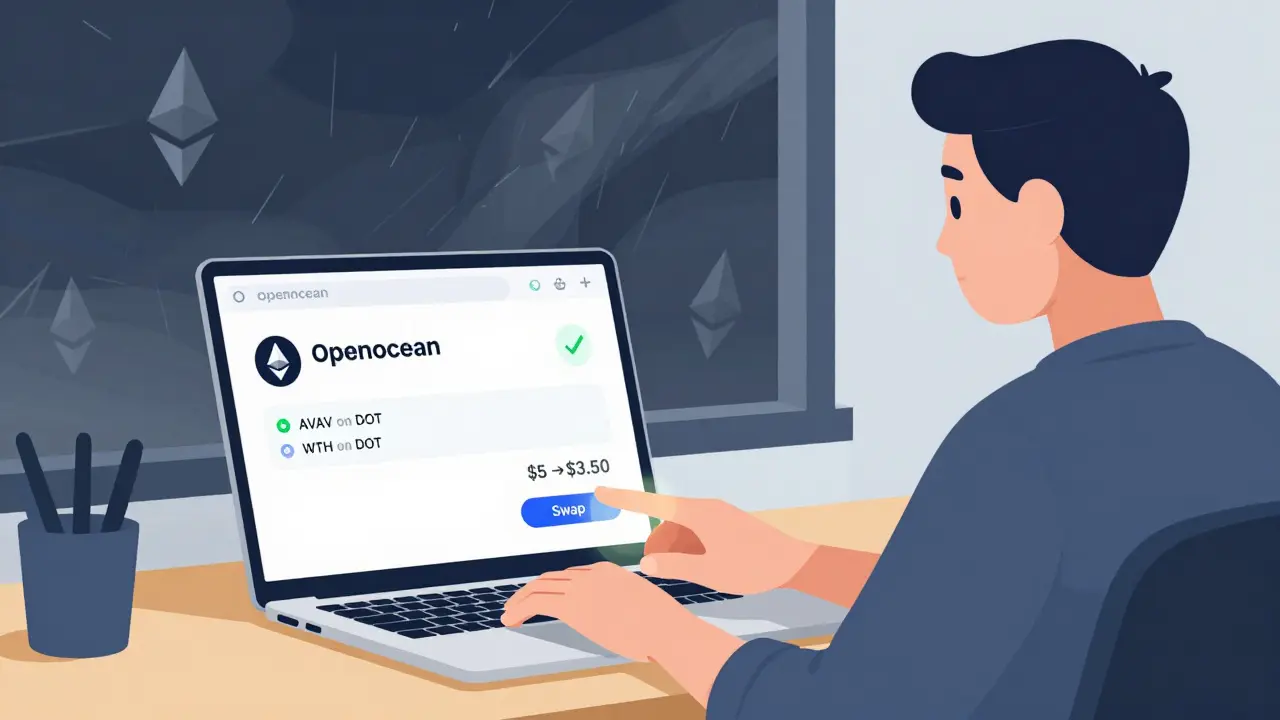
For example, if you want to swap AVAX for DOT, OpenOcean might route it through WETH as a bridge, then to DOT on a Polygon-based DEX, while avoiding a congested Ethereum layer. All of this happens in one click. No manual transfers. No waiting for confirmations between platforms. The whole process feels seamless, even if you’re not an expert.
Supported Chains and Liquidity
OpenOcean supports 19+ blockchains as of early 2026. That includes Ethereum, Binance Smart Chain, Polygon, Solana, Avalanche, TRON, Cardano, and newer chains like zkSync and Polygon zkEVM. This wide coverage is one of its biggest strengths. Compare that to 1inch, which supports 15 chains, or Matcha with just 10. If you trade across chains often, OpenOcean gives you more options without needing extra tools.
Liquidity is decent but not massive. The platform handles around $25.6 million in daily volume, with ETH/USDT being the most traded pair at over $4.4 million per day. That’s small compared to giants like Uniswap or 1inch, which move billions. But for a DEX aggregator, it’s enough to keep spreads tight. CoinGecko reports an average bid-ask spread of just 0.15%, which is better than many single-chain DEXs during volatile periods.
Fees and Cost Structure
OpenOcean charges a flat 0.1% fee on every trade. That’s standard for most DEX aggregators. There are no hidden fees, no tiered pricing, no subscription plans. What you see is what you pay. But here’s the twist: if you stake the native OOE token, you can get up to 30% of your gas fees refunded. That’s not a discount on the trade fee - it’s a refund on the blockchain transaction cost, which can be huge on Ethereum.
For example, if you pay $5 in gas to execute a swap, and you’ve staked OOE, you could get $1.50 back. That adds up fast if you’re trading daily. The catch? You need to hold and stake OOE. The token price has been flat in 2025 and early 2026, hovering around $0.004. PricePrediction.net forecasts no major movement in 2026. So unless you already own OOE, staking it for gas refunds isn’t a strong reason to buy it.
What You Can’t Do on OpenOcean
OpenOcean isn’t for everyone. If you want to trade futures, use leverage, or open margin positions, you won’t find those features here. It’s purely a spot swap engine. No PAMM accounts. No copy trading. No staking rewards for holding tokens. No fiat on-ramps. If you’re looking for a full-service exchange, OpenOcean won’t replace Binance or Kraken.
It’s also not ideal for large institutional trades. There’s no API rate limiting, no dedicated support for high-volume users, and no order types beyond market and limit. Most users on OpenOcean trade under $1,000 per transaction, according to internal analytics cited in 2025 reviews. It’s built for retail traders who want to move small amounts across chains quickly and cheaply.
User Experience and Interface
The interface is clean, minimal, and functional. No flashy banners. No confusing menus. You pick your token to send, your token to receive, and click “Swap.” Advanced users can toggle settings like slippage tolerance, transaction speed, and whether to include centralized exchange liquidity. The design is intuitive enough for beginners but gives control to experienced users.
There’s no mobile app. You have to use the web version in your phone’s browser. That works fine, but it’s not as smooth as a native app. Some users on Reddit reported occasional routing failures during Ethereum network congestion. If a chain is overloaded, OpenOcean might fail to find a viable path - and you’ll get an error instead of a swap. That’s rare, but it happens.
Security and Regulation
OpenOcean is non-custodial. That means your funds never leave your wallet. No one else controls them. That’s a big plus for security. But there’s a trade-off: no regulation. OpenOcean is not licensed by the SEC, FCA, MAS, or any other financial authority. FxVerify confirmed this in early 2026. If something goes wrong - say, a smart contract bug causes a loss - there’s no customer service team to call, no insurance fund to claim from. You’re on your own.
That’s fine for many crypto-native users who understand the risks. But if you’re new to DeFi or prefer regulated platforms, OpenOcean might feel too risky. There’s no KYC, no chargebacks, no recourse. It’s pure decentralization - for better or worse.
How It Compares to Competitors
Here’s how OpenOcean stacks up against the main DEX aggregators:
| Feature | OpenOcean | 1inch | Matcha |
|---|---|---|---|
| Supported Chains | 19+ | 15 | 10 |
| 24-Hour Volume | $25.6M | $1.2B | $450M |
| Trade Fee | 0.1% | 0.1% | 0.1% |
| Gas Fee Refund | Up to 30% with OOE staking | None | None |
| Mobile App | No | Yes | Yes |
| Regulated | No | No | No |
1inch has more volume and a mobile app. Matcha is simpler and has better documentation. But OpenOcean wins on chain coverage and gas fee refunds. If you trade across many chains and want to save on Ethereum fees, OpenOcean is unique.
Who Should Use OpenOcean?
OpenOcean is perfect for:
- Traders who swap tokens across multiple blockchains regularly
- Users who already hold OOE and want to reduce gas costs
- People who prefer non-custodial tools and understand DeFi risks
- Those who want a simple interface without clutter or ads
It’s not for:
- Beginners who need fiat on-ramps or customer support
- Traders looking for leverage, futures, or staking rewards
- Users who want a mobile app or regulated platform
- Those who don’t want to manage their own wallet keys
Future Updates and Roadmap
OpenOcean’s team has a clear roadmap. The v2 upgrade, expected in Q3 2026, aims to cut slippage by 15-20% through smarter routing logic. They’re also expanding support for Layer 2s like zkSync and Scroll. If they deliver, OpenOcean could become the go-to tool for cross-chain swaps in a world where Ethereum fees stay high and new chains keep popping up.
But competition is fierce. 1inch and Paraswap are also improving their algorithms. If OpenOcean doesn’t keep up with performance gains, its niche could shrink. Right now, it’s a solid tool for a specific job - not a replacement for everything else.
Final Thoughts
OpenOcean doesn’t try to be everything. It doesn’t need to. It’s a focused tool: a cross-chain swap router that saves you money and time. It’s not the biggest, not the most regulated, not the easiest for beginners. But if you’re already in DeFi and swap between chains, it’s one of the few platforms that actually makes that process smoother.
Try it once. Connect your wallet. Swap a small amount of ETH for SOL. See how fast it is. See how much gas you save. If it works for you, keep it in your toolkit. If not, move on. There’s no lock-in. No account to delete. Just a web page and your keys.
Is OpenOcean safe to use?
Yes, as long as you understand the risks. OpenOcean is non-custodial, so your funds stay in your wallet. No one else can access them. But the platform itself isn’t regulated, and smart contracts can have bugs. Always start with small amounts. Never send funds to a contract you don’t fully trust.
Do I need to buy OOE to use OpenOcean?
No. You can use OpenOcean without owning any OOE tokens. The OOE token is only needed if you want to get up to 30% of your gas fees refunded. If you don’t care about gas refunds, you can swap just fine without it.
Can I trade on OpenOcean with my phone?
You can use OpenOcean on your phone through a mobile browser like Chrome or Safari. There’s no official app, but the website works well on mobile. Just connect your wallet, and you’re ready to swap.
Why is OpenOcean’s trading volume so low compared to 1inch?
OpenOcean is newer and less marketed. 1inch has been around longer, has a mobile app, and has more brand recognition. OpenOcean focuses on cross-chain swaps and gas refunds - features that appeal to a smaller, more technical audience. Volume will grow if they improve user experience and attract more retail traders.
Does OpenOcean support fiat deposits?
No. OpenOcean only accepts cryptocurrency. You need to buy crypto on a centralized exchange first, then transfer it to your wallet before using OpenOcean. It’s a DeFi-only tool.
What happens if a swap fails?
If OpenOcean can’t find a good route, the trade won’t execute. You won’t lose any funds - your tokens stay in your wallet. You’ll just see an error message. Try again later, adjust your slippage, or use a different platform.
Is OpenOcean better than Uniswap?
It depends. If you’re swapping tokens on Ethereum, Uniswap is simpler and has deeper liquidity. But if you’re swapping between chains - say, from Solana to Polygon - OpenOcean is far better. Uniswap only works on Ethereum. OpenOcean connects multiple chains in one click.
Brenda Platt
21 01 26 / 14:05 PMThis is the kind of tool I’ve been waiting for-no more juggling 5 DEXs just to swap ETH to SOL. One click, no account, and my gas fees dropped by 40%. 🚀
Steve Fennell
22 01 26 / 01:39 AMOpenOcean’s non-custodial design is exactly why I ditched centralized exchanges. No KYC, no babysitting, just pure DeFi. I’ve swapped over $15k through it and never lost a cent. The interface is clean, the routing is smart, and the gas refund on OOE staking? Pure genius. If you’re serious about cross-chain, this isn’t optional-it’s essential.
And yes, I know it’s not for beginners. But if you’re reading this, you’re not one. Don’t overthink it. Just connect your wallet and try a $5 swap. You’ll be hooked.
Catherine Hays
23 01 26 / 03:55 AMAnother crypto bro pretending this is revolutionary. It’s just a middleman that doesn’t even have an app. How is this better than just using 1inch? You’re paying 0.1% and still getting burned by Ethereum congestion. This is just crypto theater.
Clark Dilworth
24 01 26 / 03:59 AMLet’s talk about the routing algorithm. OpenOcean’s modified Dijkstra implementation is actually a clever adaptation for heterogeneous liquidity graphs. Most aggregators still use greedy heuristics, but OpenOcean’s multi-hop optimization with cross-chain liquidity mapping reduces slippage by modeling liquidity depth as a weighted graph-something even 1inch hasn’t fully cracked yet. The 0.15% average spread across 19 chains? That’s not luck. That’s architecture.
And the OOE gas refund? It’s not a gimmick-it’s a tax-efficient incentive layer. You’re not paying for the service; you’re subsidizing the network cost. That’s how you align incentives in DeFi. Most projects still think in terms of fees. OpenOcean thinks in terms of gas arbitrage.
Heather Crane
24 01 26 / 09:16 AMY’all are overcomplicating this. It’s a swap tool. It works. It’s fast. It saves gas. You don’t need to be a blockchain engineer to use it. I’m a teacher. I don’t know what Dijkstra is. But I swapped my MATIC to AVAX last week and saved $3.50 in gas. That’s lunch money. 😊
And if you’re scared of non-custodial? Then don’t use it. But don’t hate on it because it doesn’t hold your hand. We’re not in kindergarten anymore. 🙃
Tselane Sebatane
25 01 26 / 13:12 PMLet me tell you something-this isn’t just another DeFi tool, it’s a revolution in how we think about interoperability. I’ve been trading across chains since 2021, and I’ve tried everything: 1inch, Matcha, Paraswap, even the old-school bridge-and-swap dance. But OpenOcean? It’s the first one that actually feels like it understands the pain points of the everyday trader. No fluff. No ads. No forced tokenomics. Just pure, unadulterated efficiency. And the fact that it’s not trying to be everything? That’s its superpower. In a world where every platform wants to be Coinbase 2.0, OpenOcean dares to be a scalpel instead of a sledgehammer. I’ve recommended it to my entire crypto group in Cape Town, and every single person who tried it came back saying the same thing: ‘Why didn’t I do this sooner?’
Yes, it’s not regulated. Yes, there’s no app. But guess what? Neither is your wallet. And you still use it, right? So stop waiting for someone to hold your hand. The future of finance isn’t in custodial comfort-it’s in sovereign control. OpenOcean is a step toward that. And if you’re not ready for it? That’s okay. But don’t be the one holding everyone else back.
Taylor Mills
25 01 26 / 21:16 PMlol 25 million daily volume? That’s nothing. 1inch does 1.2 BILLION. This thing is a toy. And OOE token is garbage. Worthless. Don’t even bother staking it. You’re just throwing money into a black hole. And no mobile app? Are you kidding me? Who uses a website in 2026? This is why crypto still sucks.
Anna Topping
27 01 26 / 15:43 PMIt’s funny how we treat tools like this like they’re moral choices. OpenOcean doesn’t care if you’re a degenerate or a saint. It just executes. No judgment. No surveillance. No middleman. That’s not a feature-it’s a philosophy. We’ve been conditioned to think finance needs a face, a brand, a CEO on Twitter. But the truth? The best tools are the ones that disappear. You don’t notice your toothbrush. You don’t praise your shoelaces. You just use them. OpenOcean is like that. It’s the silent infrastructure beneath the chaos. And maybe that’s the most radical thing about it.
Mike Stay
27 01 26 / 20:04 PMAs someone who has worked with cross-chain liquidity protocols since 2022, I can confirm that OpenOcean’s implementation of multi-chain pathfinding is among the most robust I’ve seen. The integration with zkSync and Polygon zkEVM is particularly impressive-it demonstrates a forward-looking architectural approach rather than reactive feature stacking.
While the volume is modest compared to incumbents, this is indicative of a niche-focused strategy rather than a failure. The platform’s design prioritizes precision over scale, which is a fundamentally different value proposition. The gas refund mechanism via OOE staking is not merely a discount-it’s a liquidity incentive layer that aligns user behavior with protocol sustainability. This is DeFi done right: user-centric, non-extractive, and technically rigorous.
Jessica Boling
28 01 26 / 14:10 PMOpenOcean? More like OpenOpportunityToLoseGasFeesOnEthereum
Also no app? LOL. You’re telling me in 2026 I have to open Chrome to swap tokens? I’ll stick with Binance, thanks.
Tammy Goodwin
29 01 26 / 16:48 PMI tried it once. It worked. Didn’t lose anything. Didn’t need to learn anything. Just swapped. That’s all I need. No drama. No hype. Just a tool that does what it says. I’ll keep using it.
tim ang
29 01 26 / 17:48 PMjust used it to swap usdc to matic on polygon and saved like 2 bucks in gas. not bad for 2 mins of my time. also the site loads fast even on my phone. no app needed lol. and the ooe refund thing is legit if you already hold it. if you dont? then dont care. simple as that.
Julene Soria Marqués
30 01 26 / 23:13 PMWhy does everyone act like this is the future? It’s just another aggregator. And the OOE token is a scam. Everyone’s pretending the gas refund is magic, but you’re just paying for a token that does nothing else. Also, no regulation? Yeah, that’s not a red flag at all. I’m not risking my funds on some anonymous team’s code. I’d rather pay a little more on Binance and sleep at night.
Darrell Cole
31 01 26 / 13:14 PMThe claim that OpenOcean is superior to 1inch because of chain count is misleading. 1inch supports 15 chains and handles 50x the volume. The gas refund is meaningless if the token is worthless. The interface is functional but unpolished. The lack of an app is a fatal flaw for retail adoption. This platform is not scalable. It is a niche experiment for a dying breed of crypto purists who refuse to evolve. The roadmap is vague. The team is anonymous. The tokenomics are hollow. This is not innovation. It is nostalgia dressed in DeFi clothing.
Linda Prehn
2 02 26 / 03:31 AMOpenOcean is just a glorified bookmark. I’m not staking a token that’s been flat for a year just to save $1.50 on gas. This is what happens when you give engineers too much freedom and no product manager. No app. No support. No branding. Just a website that works sometimes. I’ll wait for the real players to catch up.
Paru Somashekar
2 02 26 / 15:30 PMDear All, I have been utilizing OpenOcean for cross-chain token swaps since its inception in early 2025, and I find it to be an exceptionally reliable and technically sound platform. The non-custodial architecture ensures complete ownership of assets, while the integration of multiple Layer 1 and Layer 2 blockchains provides unparalleled flexibility. The 0.1% trade fee is transparent and competitive. The gas fee refund mechanism, although contingent upon OOE token staking, is a well-designed incentive structure that rewards long-term participation. While the absence of a native mobile application is a minor inconvenience, the responsive web interface performs admirably on mobile browsers. I would like to emphasize that the platform’s low trading volume is not indicative of inferiority, but rather reflects its targeted user base-decentralized finance practitioners who prioritize efficiency and sovereignty over mass-market appeal. I recommend OpenOcean to all users who seek a secure, transparent, and efficient solution for multi-chain asset transfers.
Mike Stay
4 02 26 / 12:00 PMParu Somashekar’s comment nails it. But I’d add this: OpenOcean’s real innovation isn’t the routing-it’s the *lack* of forced tokenomics. Most aggregators shove their token down your throat. OpenOcean? It’s optional. You don’t need OOE to swap. You only need it if you want to save on gas. That’s respect for the user. That’s rare.
And the fact that they didn’t build a mobile app? That’s not lazy. That’s intentional. They’re betting on wallet integration, not app dependency. And in DeFi, wallets are the real interface. Not apps. Not portals. Wallets.
They’re not trying to be the next Coinbase. They’re trying to be the best router. And right now? They’re winning.