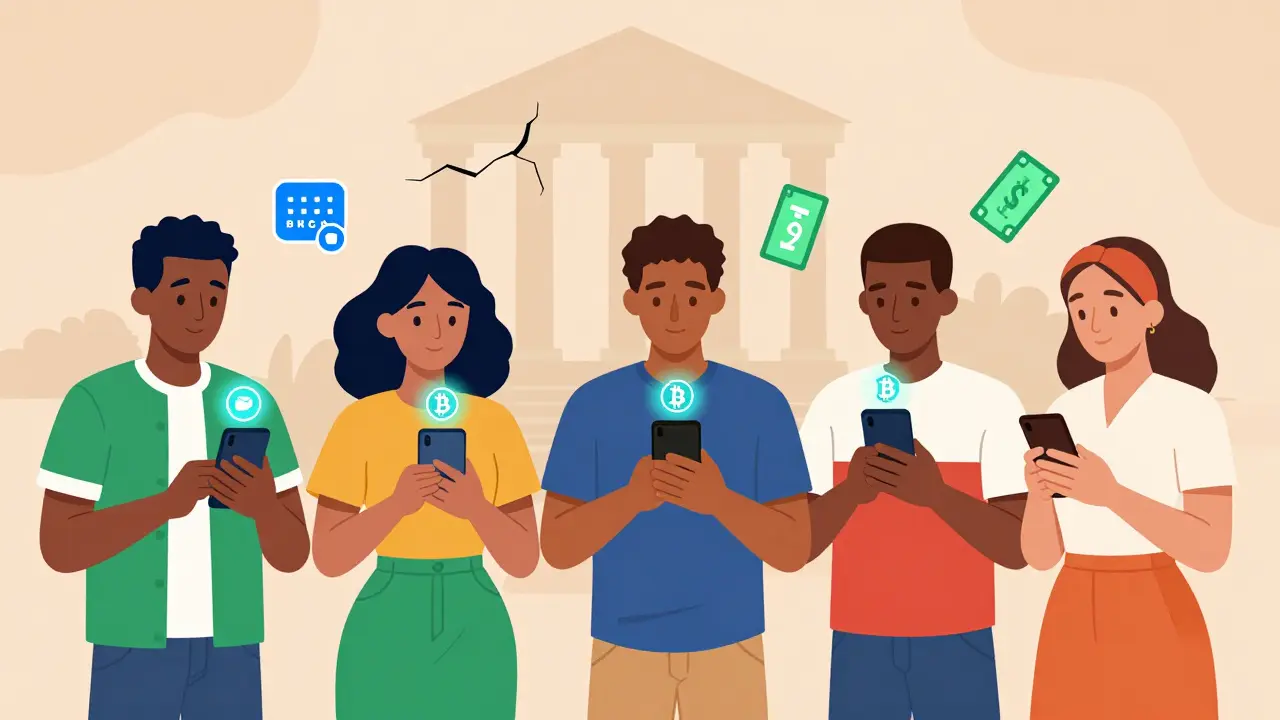
When your country bans cryptocurrency exchanges, your bank freezes your account for using Bitcoin, or your local currency is losing half its value in a year - what do you do? For millions of people in places like Nigeria, Venezuela, Bangladesh, and Egypt, the answer isn’t waiting for government approval. It’s using P2P crypto platforms.
These aren’t fancy exchanges with sleek apps and customer service lines. They’re digital marketplaces where you trade crypto directly with another person. No middleman. No bank. Just you, a seller, and a digital escrow system that holds the crypto until you send the cash. And in countries where traditional finance has shut the door, this is the only window left open.
Why P2P Crypto Exists in Restricted Countries
It’s not about rebellion. It’s about survival.
In 2021, Turkey’s central bank banned banks from processing cryptocurrency payments. Within weeks, P2P trading volume there jumped 300%. Why? The lira had lost 84% of its value against the dollar in just three years. People weren’t gambling on Bitcoin - they were trying to protect their savings. In Nigeria, after the Central Bank banned banks from handling crypto in 2017, P2P trading became the main way people sent money abroad, bought medicine, or paid for school fees. A 2022 Binance study found 87% of Nigerian P2P users had never had a bank account before.
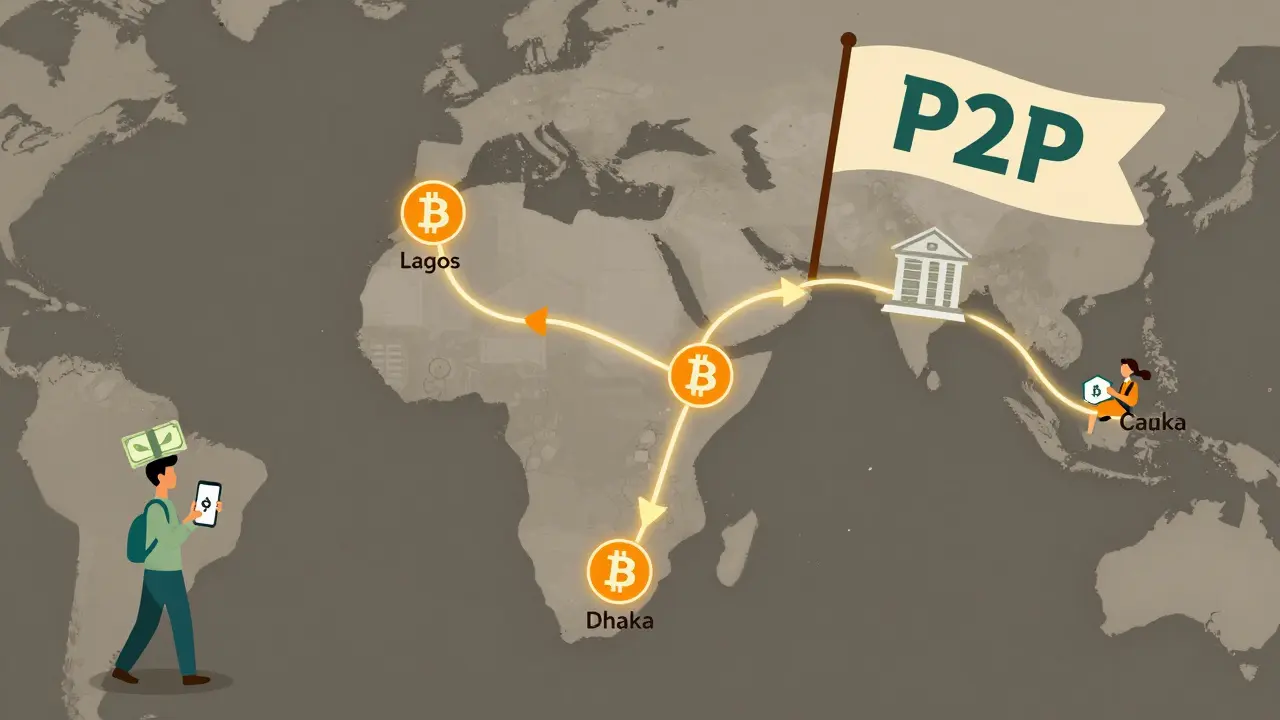
These platforms fill gaps that governments ignore: inflation, capital controls, and remittance costs. In Zimbabwe, sending $100 home via Western Union costs $22.40. On P2P crypto, it costs $1.20. That’s not a luxury - it’s how families eat.
How P2P Platforms Work (Without a Bank)
Here’s how it actually works on the ground:
- You open an app like Binance P2P or Paxful.
- You pick a seller offering Bitcoin for Nigerian Naira via mobile money.
- You pay them through MTN Mobile Money or OPay - no bank needed.
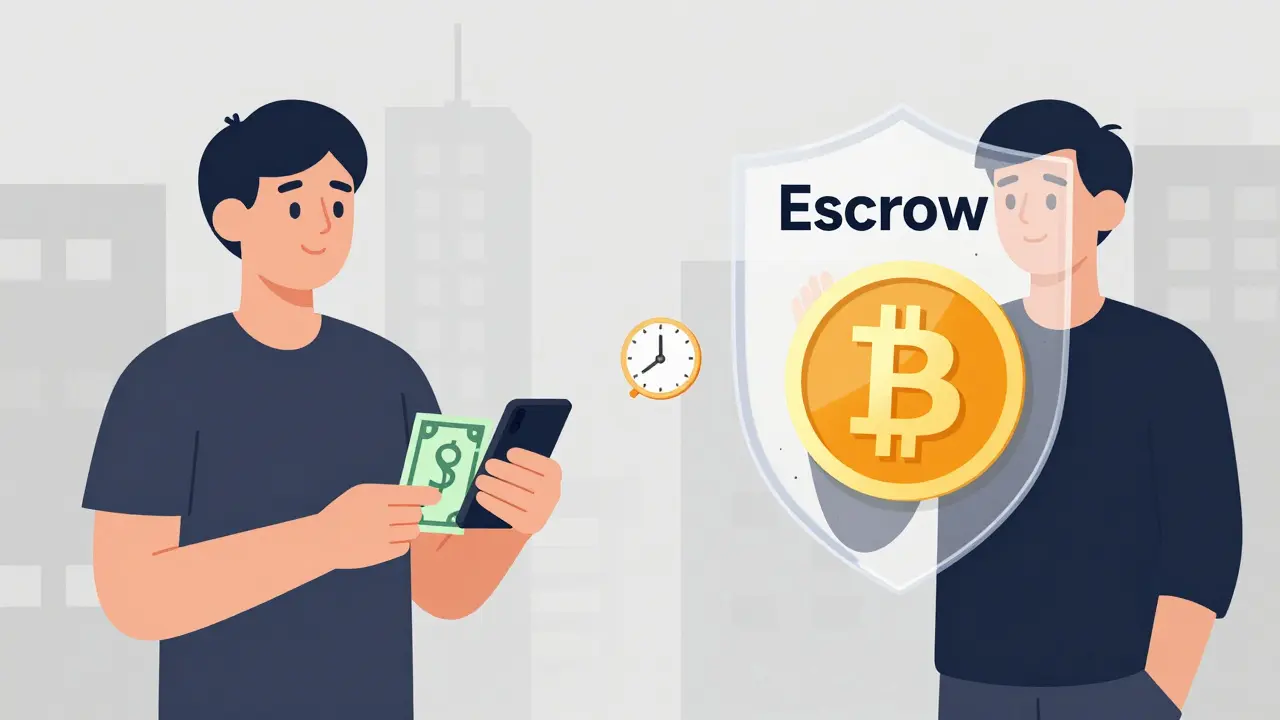
- The platform holds the Bitcoin in escrow.
- Once the seller confirms payment, the Bitcoin is released to you.
The whole thing takes 12 to 18 minutes - longer than in the U.S. because of extra checks. But it works even on 2G networks. No Wi-Fi? No problem. A basic Android phone from 2018 is enough.
These platforms don’t hold your money. That’s key. Unlike Coinbase or Binance’s main exchange, P2P doesn’t store your crypto. It’s like a trusted third party watching a handshake - not the person handing over cash.
Top Platforms and How They Differ
Not all P2P platforms are the same. Here’s how the big ones stack up:
| Platform | Supported Payment Methods | Identity Verification | Transaction Fees | Best For |
|---|---|---|---|---|
| Binance P2P | 20+ (bank, mobile, cash, gift cards) | Basic KYC (ID + selfie) | 0% - 0.5% | High liquidity, global reach |
| Paxful | 300+ (including PayPal, Amazon gift cards) | Strict KYC, risk-based screening | 0.5% - 1.5% | Flexible payments, 24/7 support |
| LocalBitcoins | 50+ (mostly bank transfers) | Strict KYC since 2020 | 1% - 2% | Legacy platform, declining in banned regions |
| HodlHodl | 10-15 (bank, cash, crypto) | No KYC required | 0.3% - 0.5% | Privacy-focused, decentralized |
| Yellow Card | 15+ (mobile money, bank, cash) | Strict KYC, Africa-focused | 1% - 1.5% | African markets, local currency support |
Binance P2P leads in volume - $3.2 billion in Q2 2023 alone. But Paxful wins for flexibility. You can buy Bitcoin with a $50 Amazon gift card in Nigeria, then sell it for cash in Ghana. HodlHodl doesn’t ask for your ID at all - perfect if you’re in a country where even registering your name could get you flagged.
The Hidden Risks
It’s not all smooth sailing.
Scams happen. In 2022, 37% of all fraud cases on P2P platforms came from users in restricted countries. Why? Because scammers know people are desperate. A fake seller might send a screenshot of a mobile money payment - but it’s edited. Or a buyer might claim they paid, then reverse the transaction hours later.
And then there’s the bank. In Nigeria, 22% of P2P users had their bank accounts frozen in 2023 - not because they broke the law, but because their bank saw crypto-related payments and shut them down automatically. One Reddit user in Lagos said he lost access to 7 of his 8 bank accounts. He now uses cash deposits and mobile wallets just to stay under the radar.
Liquidity is another issue. In regulated markets, you can trade $200,000 in Bitcoin in seconds. In restricted countries, the deepest order book might be $8,500. You might have to wait hours to find a buyer who accepts your payment method.
How Users Adapt: Real Workarounds
People aren’t sitting around waiting for help. They’ve built their own systems.
- APK files: In China, Egypt, and Algeria, Google Play blocks crypto apps. Users download APKs directly from websites - risky, but necessary. 34% of users in banned countries say they struggled to install these apps.
- Tor and VPNs: Some use Tor browsers to hide their IP address. Others use VPNs to appear as if they’re in a country where P2P is legal.
- Payment splitting: Instead of sending $500 in one go, users break it into five $100 transactions to avoid bank flags.
- Local communities: Telegram groups in Nigeria and Bangladesh share verified sellers. If someone gets scammed, they post it. If someone’s trustworthy, they get added to a “safe list.”
Dr. Garrick Hileman from Cambridge’s Centre for Alternative Finance put it simply: “P2P platforms aren’t just tools - they’re parallel financial systems.” In places where the official system failed, people built their own.
What You Need to Know Before Starting
If you’re in a restricted country and thinking about trying P2P crypto, here’s what you need:
- Know your country’s rules: India taxes crypto profits at 30%. Vietnam bans using crypto as payment. China bans all crypto services. Don’t assume “no ban” means “no risk.”
- Use escrow: Never send money before the crypto is locked in escrow. Always wait for the platform’s confirmation.
- Start small: Try $20 first. Test the seller, the payment method, and the speed.
- Use trusted channels: Stick to platforms with 24/7 support and local language help. Binance supports Swahili and Hausa. Paxful has Arabic and Turkish.
- Keep records: Save screenshots of payments, chat logs, and transaction IDs. If your bank freezes your account, you’ll need proof.
And don’t fall for “too good to be true” rates. If someone’s selling Bitcoin at 10% below market price, they’re either a scammer or setting you up to get arrested.
The Future: More Growth, More Pressure
P2P crypto volume in restricted countries hit $128 billion in 2022. By 2025, it’s projected to hit $210 billion. Why? Because inflation isn’t going away. In 6 of the top 10 P2P markets, annual inflation is over 50%.
But governments are pushing back. China arrested over 1,200 people for crypto-related activity in 2023. The FATF wants all P2P trades over $1,000 to report user details - something most platforms in restricted countries can’t comply with without shutting down.
Some governments are trying to control it. Nigeria’s Central Bank now runs a “sandbox” to test blockchain tech - quietly allowing P2P to keep running. The World Bank supports P2P for remittances because it cuts costs. Meanwhile, the IMF tells countries like Bangladesh to keep the ban.
It’s a tug-of-war. And right now, the people on the ground are winning - not because they’re tech experts, but because they have no other choice.
Is P2P crypto legal in restricted countries?
It’s rarely clearly legal or illegal. Most countries don’t have specific laws for P2P trading. Instead, they ban banks from handling crypto, making P2P a gray area. In Nigeria, trading crypto isn’t illegal - but banks can freeze your account if they catch you. In China, any crypto activity is banned. Always check your country’s latest regulations - laws change fast.
Can I get arrested for using P2P crypto?
In countries like China, Algeria, and Egypt, yes - especially if you’re running a business or making large trades. In most others, you won’t be arrested for personal use, but your bank might freeze your account. The real risk isn’t jail - it’s losing access to your money. Always use small amounts, avoid public posts about crypto, and don’t advertise your activity.
Which P2P platform is safest in a banned country?
For safety, use Binance P2P or Paxful - they have strong escrow, 24/7 support, and fraud monitoring. For privacy, use HodlHodl - no KYC, no identity checks. But remember: no platform is 100% safe. The safest approach is to use small amounts, stick to trusted sellers, and never store large sums on the platform.
How do I avoid getting scammed on P2P platforms?
Always use the platform’s escrow system. Never send money before the crypto is locked. Check the seller’s history - 100+ completed trades with 95%+ positive feedback is a good sign. Avoid sellers offering rates way below market price. Use chat logs to document everything. If something feels off, walk away.
Do I need a bank account to use P2P crypto?
No. That’s the whole point. Many users use mobile money (like MTN Mobile Money or M-Pesa), cash deposits, or gift cards. In places like Nigeria and Ghana, over 60% of P2P trades happen without a bank account. You just need a phone and access to a payment method the seller accepts.
Avantika Mann
19 02 26 / 08:21 AMThis is honestly one of the most human stories I've read in a long time. I work with NGOs in rural India, and we've seen firsthand how mobile money and crypto are saving lives. A woman in Bihar used Binance P2P to send $50 to her son in Dubai so he could buy insulin. No bank. No paperwork. Just a phone and trust. These platforms aren't about speculation - they're about survival. And honestly? We should be celebrating this, not policing it.
Beth Erickson
20 02 26 / 11:16 AMSo let me get this straight - you're glorifying people who circumvent national laws because inflation is bad? Cool. Meanwhile in the US we're trying to build actual financial infrastructure not just gambling on digital chaos. This isn't innovation it's anarchy with a smartphone
Jenn Estes
22 02 26 / 04:21 AMI mean sure it's cute that people are using gift cards to buy Bitcoin but let's be real - this is just a way for scammers to launder money under the guise of "survival". If you're that desperate you should be calling your government not downloading random APKs from forums
Jeremy Fisher
23 02 26 / 01:03 AMYou know what's wild? This whole thing is basically a global parallel economy that grew out of necessity. In the U.S. we think of money as something you get from a job and deposit in a bank. But in places like Lagos or Caracas money is just a concept - and crypto is the only thing that actually holds value. It's not about tech it's about culture. People aren't using P2P because they love Bitcoin they're using it because their pesos or nairas are paper. And honestly? I respect that more than I respect any Wall Street trader
Angela Henderson
23 02 26 / 17:42 PMI read this whole thing and just felt so weirdly hopeful. Like imagine being able to send money home without paying half your cash in fees. Or buying medicine because your bank won't let you. It's not glamorous. It's not flashy. But it's real. And it's working. I think we're seeing the future of money - messy unofficial and totally human
Geet Kulkarni
25 02 26 / 13:02 PMOMG this is sooo true 😍 I live in Mumbai and my cousin in Kenya uses M-Pesa + Paxful to send money to her mom every month. $1.20 fee vs $20? 🤯 I mean like why are we even still using banks? #CryptoIsTheFuture 🌍💎
Paul David Rillorta
26 02 26 / 10:09 AMThey say it's about survival but what if it's just the fed's next move? I mean think about it - if you let people bypass banks you're creating a decentralized network that can't be tracked. And who controls the blockchain? The same people who control the dollar. This is a psyop. They want us to think we're free while they monitor every single transaction through the escrow system. Wake up sheeple
andy donnachie
26 02 26 / 16:51 PMI've been working in fintech in Dublin for over a decade and this is one of the most compelling use cases I've ever seen. The real innovation here isn't the tech - it's the community trust networks. Telegram groups in Nigeria verifying sellers? That's organic financial inclusion. No regulation needed. Just people helping each other. We should be studying this model not shutting it down
sruthi magesh
27 02 26 / 07:59 AMCapitalism's last gasp. When the state fails the market doesn't fill the void - it exploits it. P2P isn't liberation it's financial colonialism repackaged as empowerment. You're not saving your family you're feeding a Silicon Valley algorithm that takes 1% and calls it a service.
Aileen Rothstein
28 02 26 / 13:01 PMI just want to say thank you for writing this. It gave me hope. I'm from Venezuela and I've been using Paxful for three years. I bought my daughter's insulin this way. I paid my rent. I sent my mom money when she got sick. It's not perfect. But it's something. And that's more than the government ever gave us
JJ White
28 02 26 / 19:09 PMOh wow so now we're romanticizing financial anarchy? Let me get this straight - people are using gift cards to buy Bitcoin because their currency is collapsing? That's not innovation. That's collapse. And the fact that you're calling this "survival" is just embarrassing. You're not building a system. You're surviving in the ruins. And you think this is progress?
Alan Enfield
1 03 26 / 05:42 AMThis is actually kind of beautiful. No bureaucracy. No forms. Just people trading value directly. Reminds me of how barter systems worked before money. The tech just makes it scalable. And honestly? The fact that people are using 2G phones to move crypto? That's resilience. We need more of that.
Jennifer Riddalls
2 03 26 / 03:45 AMI just started using Binance P2P last month and I can't believe how easy it was. I used mobile top-up credits to buy my first $20 of BTC. No bank. No ID. Just me and a guy in Ghana who had a good rating. It took 15 minutes. I felt like I was part of something real
Kyle Tully
3 03 26 / 02:48 AMI'm not sure if this is the future or just another pyramid scheme wrapped in humanitarian language. People think they're being empowered but really they're just becoming data points for a new financial elite. And don't get me started on the 37% fraud rate - that's not innovation that's a feeding ground
Ian Plunkett
3 03 26 / 19:22 PMI'm from Belfast. We've seen what happens when people lose faith in institutions. This isn't crypto. It's a refugee economy. And honestly? It's the only thing keeping families alive. If your government won't protect you then you build your own safety net. That's not rebellion. That's wisdom.
yogesh negi
5 03 26 / 12:44 PMThis is exactly why I believe in decentralized systems! I run a small shop in Jaipur and we've been accepting crypto via P2P for six months now. Customers pay with UPI then we convert to BTC. No bank fees. No delays. And guess what? Our sales went up 40%. People trust us because we're transparent. This isn't the future - it's happening right now. Let's stop calling it a workaround and start calling it progress
Sasha Wynnters
7 03 26 / 09:05 AMThe real story here isn't crypto - it's the collapse of the social contract. When your currency becomes worthless and your banks become jailers, you don't ask for permission. You build. You adapt. You become invisible. This isn't about Bitcoin. It's about the quiet revolution of dignity - one mobile money transfer at a time.
george chehwane
8 03 26 / 13:50 PMThe entire P2P ecosystem is built on regulatory arbitrage. It's not innovation - it's exploitation. You're leveraging information asymmetry and desperation to create a gray market that benefits tech billionaires while the average user gets scammed, frozen out, or arrested. This isn't financial inclusion - it's financial predation dressed up in blockchain jargon