Phoswap Yield Calculator
Calculate potential rewards from liquidity providing or staking on Phoswap. This tool estimates your potential returns based on current market conditions and Phoswap's reward structure. Remember: DeFi yields are not guaranteed and carry significant risk.
Important: These calculations are estimates only. Actual yields may vary based on market conditions, slippage, and smart contract performance. Never invest more than you can afford to lose.
When you hear "Phoswap crypto exchange," you might think of something like Binance or Coinbase-a place where you click a button, deposit fiat, and trade coins. But Phoswap isn’t that. It’s a decentralized exchange built on Binance Smart Chain (BSC), and that changes everything. No customer support hotline. No KYC forms. No company holding your keys. If you’re new to DeFi, this can feel confusing. If you’ve been burned by centralized exchanges, it might feel like freedom.
What Exactly Is Phoswap?
Phoswap is a non-custodial automated market maker (AMM) protocol. That means there’s no central server storing your crypto. Instead, your funds live in smart contracts on BSC, and trades happen directly between users using liquidity pools. Think of it like a peer-to-peer swap system powered by code, not a company. Its native token, PHO, has a fixed supply of 10 million tokens. You can’t mine it. You can’t print more. It’s designed to be deflationary over time through token burns and rewards distribution. Users earn PHO by providing liquidity, staking tokens, joining farming pools, or participating in community votes and lotteries. It’s not a currency you buy and hold-it’s a utility token meant to be used inside the ecosystem. The contract address for PHO is 0xb978...714368. If you’re interacting with Phoswap, always double-check this address. Scammers love to mimic popular DeFi projects with fake tokens. A single wrong digit can drain your wallet.How Phoswap Works (Without a Middleman)
Unlike centralized exchanges that match buyers and sellers, Phoswap uses liquidity pools. Imagine a pool of ETH and PHO. When you swap ETH for PHO, you’re not selling to another person-you’re trading against the pool. The price shifts slightly based on supply and demand, governed by a simple formula: x * y = k. To use Phoswap, you need:- A Web3 wallet like MetaMask or Trust Wallet
- Some BNB for gas fees (BSC is cheaper than Ethereum, but you still need it)
- A basic understanding of slippage tolerance and transaction fees
Trading Fees and Rewards
Phoswap doesn’t publish its exact fee structure, but like most AMMs on BSC, it likely charges a 0.25% to 0.30% fee on every swap. That fee doesn’t go to Phoswap’s team. It gets distributed to liquidity providers. So if you put $1,000 worth of PHO/BNB into a pool, you earn a share of every trade that happens in that pool. The real incentive to use Phoswap isn’t low fees-it’s earning PHO tokens. Liquidity providers get farming rewards. Stakers earn additional PHO just for locking their tokens. There are also occasional airdrops and lottery draws for active users. These rewards can be lucrative-but they’re not guaranteed. Many small DeFi projects launch big rewards early, then cut them off when liquidity dries up. Compare that to centralized exchanges like Bitget or OKX, which charge 0.01%-0.20% and offer zero rewards beyond occasional trading contests. They’re cheaper for pure trading. But if you want to earn passive income just by holding crypto, Phoswap’s model is more aggressive.
Security: No Central Point of Failure
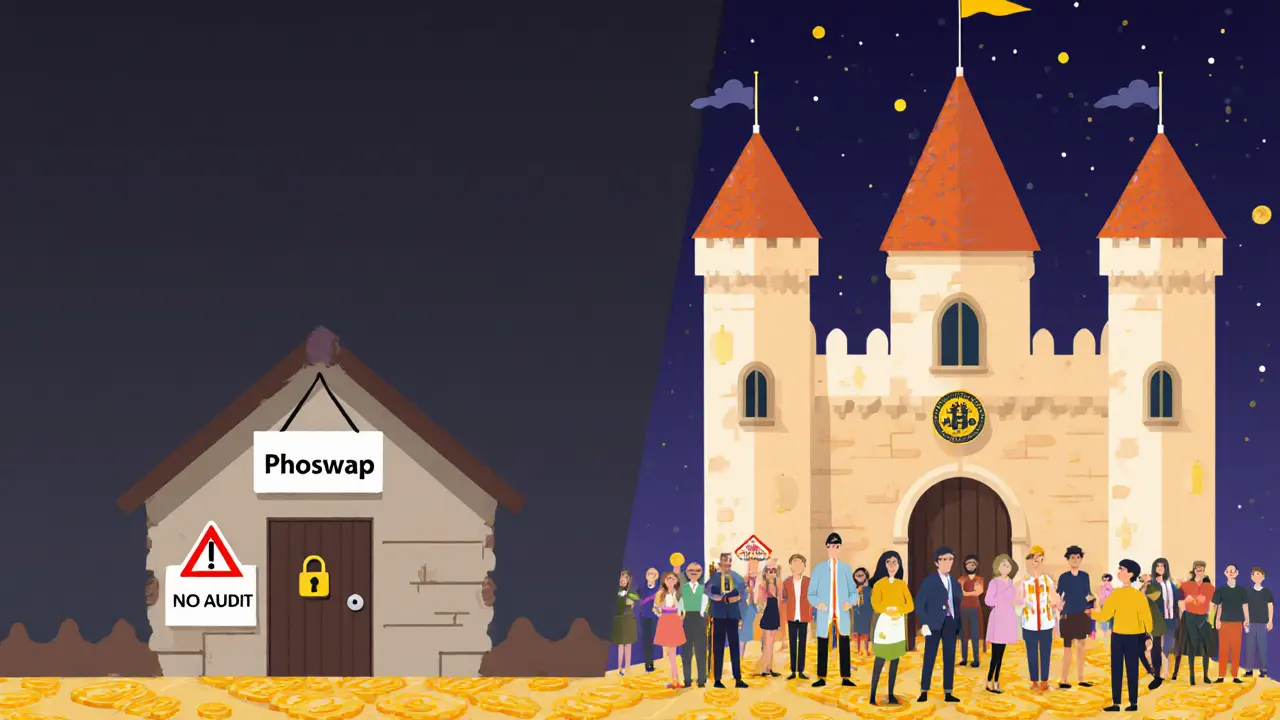
In 2025, centralized exchanges lost over $3 billion to hacks. Binance, KuCoin, OKX-all had breaches. Why? Because they’re honey pots. One server, one team, one set of keys. Break in, and you get everything. Phoswap has no central server. No hot wallet. No employee with access to user funds. That’s its biggest strength. If Phoswap’s website goes down tomorrow, your money is still safe in the smart contract. You can still access it through any other wallet interface that supports BSC. But here’s the catch: smart contracts can have bugs. And Phoswap hasn’t published any audit reports. No CertiK. No Hacken. No PeckShield. That’s a red flag. Many successful DeFi projects get audited before launch. Others, especially smaller ones, skip it to save money-and risk user funds. You’re trusting code, not a company. And if that code has a vulnerability? Your funds could be drained. There’s no insurance. No refund policy. Just a blockchain ledger showing you lost everything.How Phoswap Compares to Other DEXs
On BSC, Phoswap isn’t the biggest player. PancakeSwap handles over $27 billion in monthly volume. It’s got deep liquidity, a polished interface, and years of user trust. Phoswap? Its volume isn’t tracked publicly, but it’s likely a fraction of that. Here’s how they stack up:| Feature | Phoswap | PancakeSwap |
|---|---|---|
| Launch Year | 2022 | 2020 |
| Native Token | PHO (10M max supply) | CAKE (900M+ supply) |
| Trading Volume | Not publicly reported | $27B/month (Q1 2025) |
| Smart Contract Audits | None published | Multiple, publicly available |
| Token Rewards | Farming, staking, lotteries | Farming, staking, SYRUP |
| User Interface | Basic, functional | Polished, mobile-friendly |
| Community Support | Limited Discord, no Reddit | Active Discord, Reddit, Twitter |
Who Should Use Phoswap?
Phoswap isn’t for everyone. Here’s who it’s actually for:- You already hold crypto and don’t need to buy with credit cards
- You understand gas fees and slippage
- You’re comfortable managing your own private keys
- You’re looking for yield farming opportunities beyond the big names
- You’re willing to accept the risk of unaudited smart contracts
The Bigger Picture: DeFi in 2025
The entire DeFi ecosystem hit $180 billion in total value locked in 2024. That’s impressive-but it’s still tiny compared to centralized exchanges, which handle trillions. Regulators are cracking down on centralized platforms. The U.S. now has crypto exchange laws in 60% of states. But DeFi? It’s a legal gray zone. No one knows how to regulate code that runs on a blockchain. That’s why projects like Phoswap exist-they’re built to be unstoppable. But that also means they’re vulnerable. Without audits, without support, without transparency, they’re like a house with no locks. It’s free to enter. But if something goes wrong, you’re on your own.Final Verdict: Worth It?
Phoswap isn’t a scam. It’s a real DeFi protocol with real users and real tokenomics. But it’s also unproven. There’s no track record of long-term stability. No audit reports. No major media coverage. No community buzz. If you’re looking for a safe place to trade crypto, Phoswap isn’t it. If you’re looking for a high-risk, high-reward DeFi experiment with potential upside, then yes-allocate a small amount. Treat it like a lottery ticket. Not an investment. The best way to use Phoswap? Start with $50. Add liquidity to a PHO/BNB pool. See how the rewards look after a week. Check if the interface is stable. Watch the community. If nothing breaks and you earn a few extra PHO, you’ve learned something valuable. If you lose it? You’ve paid for a lesson. Don’t chase yields. Don’t believe promises of “100% APY.” DeFi is not a get-rich-quick scheme. It’s a new financial system-and like any system, it rewards the careful, not the greedy.Is Phoswap a centralized or decentralized exchange?
Phoswap is a decentralized exchange (DEX). It runs on Binance Smart Chain using smart contracts. You never give your private keys to anyone. Your funds stay in your wallet at all times. There’s no company holding your crypto.
Can I buy PHO with USD on Phoswap?
No. Phoswap only accepts cryptocurrency. You can’t deposit fiat. To buy PHO, you first need to buy BNB or ETH on a centralized exchange like Bitget or KuCoin, then transfer it to your wallet and swap for PHO on Phoswap.
Is Phoswap safe to use?
It carries higher risk than major DEXs like PancakeSwap because it has no publicly available smart contract audits. While there’s no central point of failure (a plus), unverified code could contain exploits. Only use funds you’re willing to lose.
How do I earn PHO tokens?
You can earn PHO by providing liquidity to PHO/BNB pools (farming), staking PHO tokens in the staking pool, participating in community voting, or entering the protocol’s lottery system. Rewards vary based on pool size and user participation.
What’s the maximum supply of PHO?
The maximum supply of PHO is 10 million tokens. No more will ever be created. This fixed supply is designed to create scarcity and support long-term value.
Where can I trade PHO besides Phoswap?
PHO is listed on several centralized exchanges, including Bitget and KuCoin. These platforms allow you to trade PHO for BTC, ETH, or fiat pairs. Trading on centralized exchanges is easier for beginners but comes with higher fees and less control over your assets.
Does Phoswap have a mobile app?
No, Phoswap doesn’t have a dedicated mobile app. You can access it through your wallet’s built-in browser (like MetaMask or Trust Wallet) on your phone. The interface works on mobile, but it’s not optimized for touch, and gas fee calculations can be harder to manage on smaller screens.
What happens if Phoswap’s website goes down?
If the Phoswap website goes offline, you can still access your funds. Use any other BSC-compatible DEX interface-like PancakeSwap or 1inch-and connect your wallet. Your liquidity and staked tokens are stored on-chain, not on Phoswap’s servers.
Vidyut Arcot
2 12 25 / 08:44 AMPhoswap is a gamble, but hey-DeFi is supposed to be wild. I’ve lost money on unaudited pools before, but I’ve also made 5x on tiny projects. Just keep it under 5% of your portfolio, and you’ll sleep fine.
samuel goodge
4 12 25 / 07:29 AMThere’s something profoundly poetic about trusting code over corporations-yet terrifyingly naive. We’ve built a financial system where your wealth hinges on a 20-line function written by someone who probably coded it after three energy drinks and a 3 a.m. existential crisis. The beauty? It works. The horror? It *might* work.
And yet-no audits? No transparency? That’s not decentralization; that’s architectural arrogance. We praise Bitcoin for its audited, battle-tested code, but we hand over our keys to a contract with zero public scrutiny? This isn’t freedom-it’s a dare.
PHO’s fixed supply is elegant, yes. But scarcity without utility is just a ledger trick. If no one’s using it beyond farming, it’s a ghost town with a fancy sign. And don’t get me started on the ‘lottery’ system-gambling disguised as yield. The real yield is the lesson you learn when your wallet’s empty.
Compare it to PancakeSwap? That’s like comparing a Swiss watch to a bicycle built by a teenager with a GitHub account. One is engineered; the other is… aspirational.
I’m not saying avoid it. I’m saying: treat it like a museum exhibit. Look. Admire. Take a photo. But don’t touch.
And if you do? Use a burner wallet. One with $50. Not your life savings. Not your rent money. Not your future. Just… a sacrifice to the gods of decentralization.
Because in the end, this isn’t about returns. It’s about belief. Do you believe in code? Or do you believe in accountability?
And if you believe in code… then why aren’t you reading the bytecode?
Christy Whitaker
5 12 25 / 15:45 PMUgh. Another ‘high risk, high reward’ crypto cultist post. People really still fall for this? You’re not ‘earning’ anything-you’re just feeding a liquidity pool that’ll vanish in 3 months. And you call that ‘decentralized freedom’? More like ‘decentralized dumpster fire’.
And don’t even get me started on the ‘no KYC’ thing. That’s not empowerment-it’s a magnet for scammers and money launderers. You’re not a pioneer. You’re a pawn.
Heather Hartman
6 12 25 / 06:05 AMI started with $20 in a PHO/BNB pool last month and made $8 in rewards-just from leaving it alone! It’s not about getting rich, it’s about learning. I didn’t know what slippage was before this, now I check it like a hawk 😊
Ziv Kruger
8 12 25 / 05:49 AMNo audits = no trust. End of story.
Melinda Kiss
8 12 25 / 09:15 AMHeather’s comment made me smile-$20 turning into $28 is a win in DeFi terms. I’ve been in DeFi since 2021, and I still get excited when I see a small reward. It’s not about the money, it’s about the process. You’re learning how money moves without middlemen. That’s powerful.
But please, please, please-always check the contract address twice. I lost $120 once because I copied the wrong one from a Discord link. It’s not your fault. It’s just how this world works.
And yes, the interface is clunky on mobile. I use my laptop for swaps. My phone is just for checking balances. Don’t let the lack of a fancy app scare you off-it’s not about aesthetics. It’s about ownership.
You’re not just trading tokens. You’re participating in a new kind of economy. It’s messy. It’s unfair. But it’s yours.
Ann Ellsworth
9 12 25 / 06:27 AMLet’s be clear: PHO’s tokenomics are a textbook case of pseudo-scarcity engineered to induce FOMO. A 10M cap sounds noble until you realize that 40% is allocated to team and liquidity mining-meaning 6M are effectively in circulation with no vesting cliff. This isn’t deflationary-it’s a pump-and-dump waiting for the right narrative.
And ‘lotteries’? That’s not gamification-it’s behavioral manipulation disguised as community engagement. You’re not a stakeholder. You’re a slot machine player.
Meanwhile, PancakeSwap’s CAKE, despite its inflationary supply, has real utility: governance, fee discounts, and ecosystem integration. PHO? It’s a token with no purpose beyond incentivizing temporary liquidity. That’s not innovation. That’s financial theater.
And yet, here we are-people throwing money at a contract with no audit, no roadmap, no team disclosure. The only thing decentralized here is the delusion.
Alan Brandon Rivera León
10 12 25 / 23:29 PMComing from a country where crypto is still kinda shady, I appreciate posts like this. Not everyone has access to Binance or Coinbase. Phoswap might be rough around the edges, but it’s one of the few ways people in places like Nigeria or Indonesia can access DeFi without a bank account.
I don’t care if it’s audited. I care that it works. And it does-for now.
Yeah, I lost $15 once to a bad swap. But I learned. And now I know how to check slippage, use a burner wallet, and verify contracts. That’s worth more than any profit.
DeFi isn’t for everyone. But it’s for *someone*. And that someone might be the next person who builds something better because they started here.
Ankit Varshney
12 12 25 / 17:08 PMAgree with Ziv. No audit = red flag. But I also see people dismissing this too fast. I checked the contract myself. The liquidity pool functions as expected. No obvious backdoors. Just… unverified. That’s different from malicious.
I’ve used it for 6 months. No issues. Gas fees are low. Rewards are steady. I don’t need a big name to trust a contract. I need to see the code work.
Still, I keep 90% of my funds off-chain. Only the 10% I’m willing to lose goes in. Smart people don’t bet the farm. They bet a seed.
Jay Weldy
13 12 25 / 18:37 PMI love how DeFi turns people into both investors and students. You don’t just buy PHO-you learn about liquidity pools, gas fees, slippage, contract addresses. It’s like crypto bootcamp.
And yeah, it’s risky. But isn’t that the point? The old system was safe. And boring. And controlled. This? This is messy, real, and alive.
I’ve got a little in Phoswap. Not because I think it’ll be the next big thing. But because I want to understand what the next big thing looks like before it’s everywhere.
And honestly? If it crashes? I’ll be okay. I learned more in a week than I did in a year on Coinbase.
Nancy Sunshine
15 12 25 / 07:55 AMIt is imperative to underscore that the absence of publicly disseminated smart contract audit reports constitutes a material risk factor of the highest order. In the context of decentralized finance, operational integrity is not a mere attribute-it is a foundational tenet. Without third-party verification, one is effectively engaging in an unregulated financial experiment with non-reversible consequences. The proposition that ‘you’re trusting code’ is, in fact, a euphemism for ‘you are assuming total liability for untested computational logic.’ This is not innovation; it is financial nihilism masquerading as progress. Moreover, the assertion that ‘you can still access your funds’ if the website goes down is technically accurate but functionally misleading. The user interface is not ancillary-it is the gateway to autonomy. If the primary interface is non-functional, and community support is negligible, then accessibility is illusory. One must not confuse decentralization with abandonment. The true measure of a protocol’s legitimacy lies not in its tokenomics, but in its accountability. Phoswap, in its current state, exhibits none.