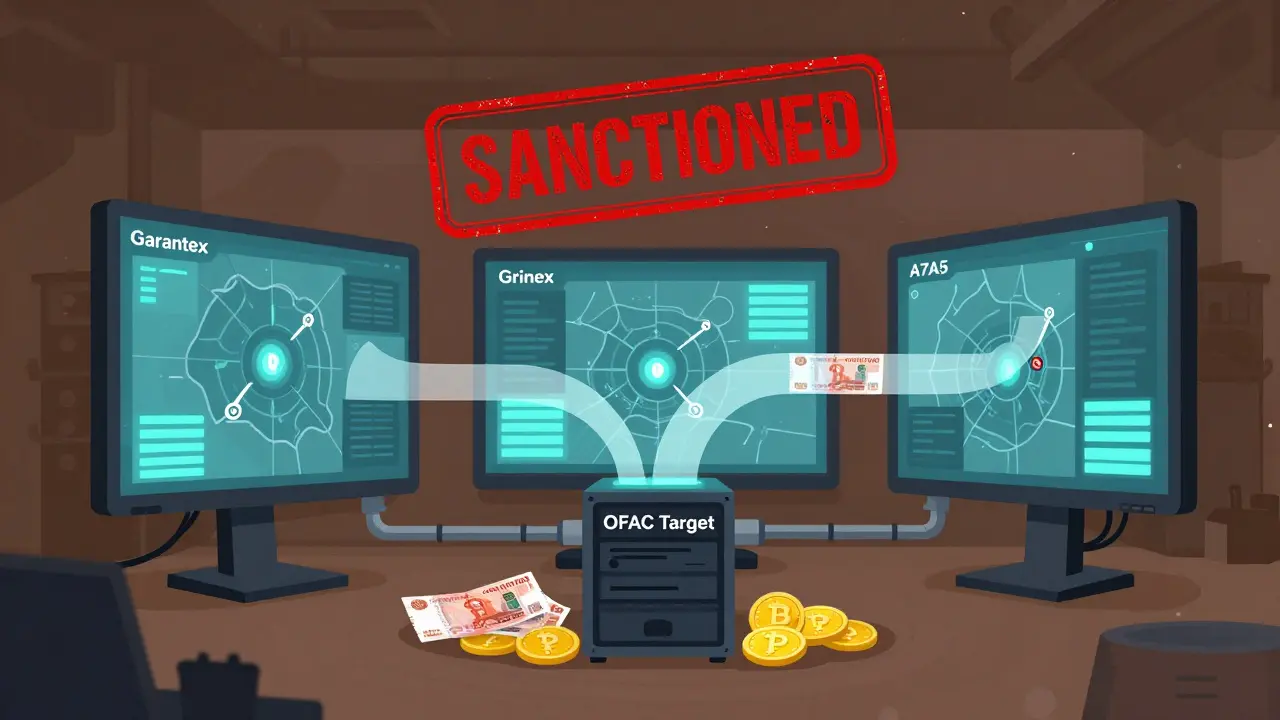
When Russia was cut off from SWIFT and Western banking systems in 2022, cryptocurrency became one of the few ways its citizens and businesses could move money across borders. What followed wasn’t just a shift in behavior - it was the creation of an entire underground financial ecosystem built to bypass sanctions. And for a while, it worked.
At the center of it all was Garantex, a Russian-operated cryptocurrency exchange founded in 2018 by Sergey Mendelev, Aleksandr Mira Serda, and Pavel Karavatsky. It wasn’t just another crypto platform. It became the go-to hub for Russians who needed to convert rubles into stablecoins, send funds overseas, or receive payments without going through banks. By 2024, Garantex was processing over $100 million in transactions tied to ransomware, fraud, and other illicit activity, according to U.S. Treasury records. But the U.S. government wasn’t watching silently.
How Garantex Was Taken Down
The first major blow came on March 6, 2025. The U.S. Secret Service led a global operation that seized three of Garantex’s domain names, confiscated its server hardware, and froze over $26 million in USDT - the most widely used stablecoin at the time. The arrest of co-founder Aleksej Besciokov in India was the final signal: this wasn’t just a warning. It was a takedown.
What happened next was predictable. Within hours, Garantex’s team launched a new platform: Grinex. Its own website openly admitted it was created "in response to sanctions and asset freezes that affected Garantex." Grinex wasn’t just a replacement - it was a direct continuation, with the same team, same infrastructure, and same customers trying to get their money back.
The Rise of A7A5: A Ruble-Backed Alternative
One of the biggest problems Garantex faced after its shutdown was that users couldn’t access their funds. USDT, while popular, was centralized. Tether Inc. could freeze wallets. So Garantex’s engineers built something new: the A7A5 token.
A7A5 was designed to be a ruble-backed stablecoin, pegged 1:1 to the Russian currency. Unlike USDT, it ran on decentralized blockchains - TRON and Ethereum - making it harder for any single company to freeze. It was issued by a Kyrgyzstani firm, adding another layer of distance from Russian authorities. Users could swap their frozen Garantex balances for A7A5, then move them freely across borders.
By early 2024, the A7A5 network had become a lifeline. Blockchain analytics firm Elliptic found that wallets linked to the "A7 network" - which included Grinex, A7 Agent, InDeFi Bank, and others - had received over $8 billion in cryptocurrency since early 2024. That number is likely conservative. Many wallets were hidden behind layers of obfuscation, mixing, and fake addresses.
OFAC Strikes Back: The August 2025 Sweep
On August 14, 2025, the U.S. Department of the Treasury’s Office of Foreign Assets Control (OFAC) dropped a bombshell. It designated Grinex as a sanctioned entity - not just because it was a successor to Garantex, but because it was owned or controlled by Garantex. This legal move was critical. It meant that even if Grinex changed its name or moved servers, it was still blocked under U.S. law.
OFAC didn’t stop there. It also sanctioned the three founders of Garantex: Mendelev, Serda, and Karavatsky. Six companies tied to them - in Russia and Kyrgyzstan - were added to the blacklist. The message was clear: you can’t just rebrand. You can’t just move. If you’re part of this network, you’re targeted.
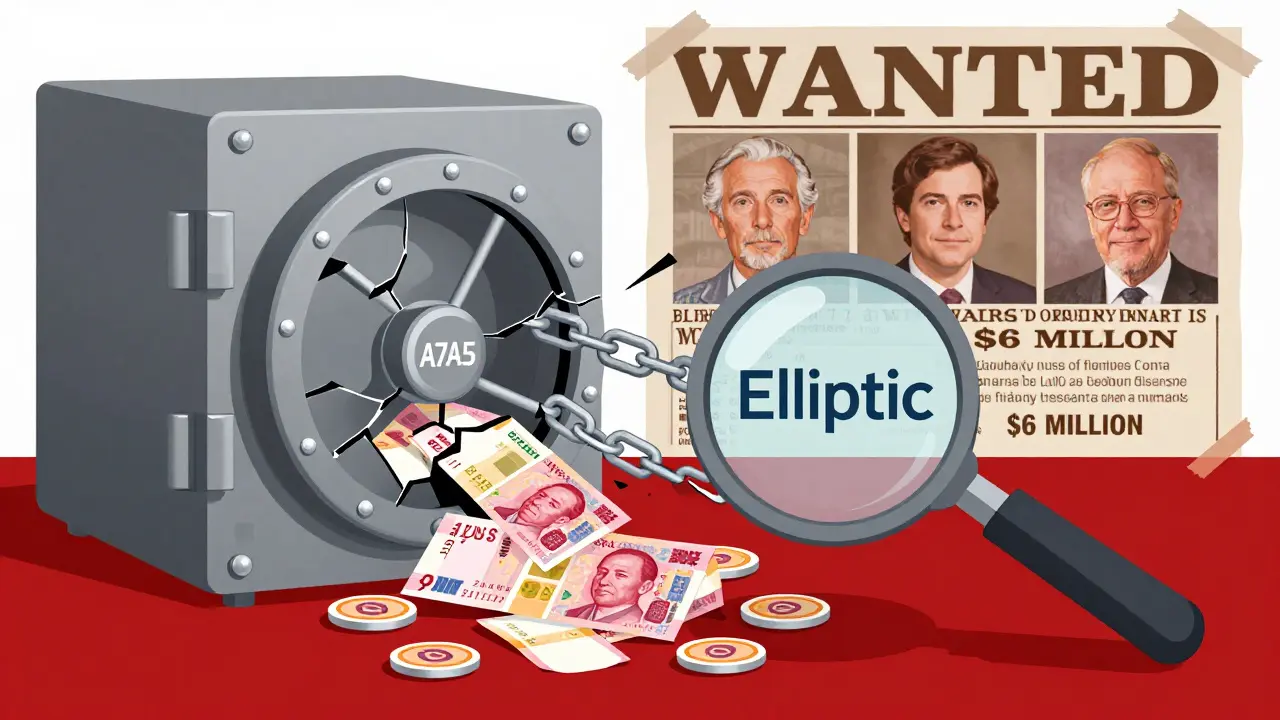
At the same time, the U.S. State Department offered up to $6 million in rewards for information leading to the arrest of Garantex’s leadership. $5 million was specifically for Serda. This wasn’t just about freezing assets anymore - it was about hunting people.
Why A7A5 Still Matters - and Why It’s Vulnerable
A7A5 was meant to be untraceable. But Elliptic’s investigators cracked it. By analyzing transaction patterns, wallet behavior, and timing of transfers, they traced how A7A5 wallets interacted with known Garantex and Grinex addresses. On August 14, 2025 - the same day OFAC announced the sanctions - unusual spikes in A7A5 transactions occurred. That’s not coincidence. It’s panic.
Something had been compromised. Either a key was leaked, a server was breached, or a developer made a mistake. The result? Elliptic added A7A5 to its screening tools. Now, any exchange or wallet service using Elliptic’s software can flag A7A5 transactions. That’s a death knell for anonymity.
Before 2025, Russian users chose USDT because it was stable and widely accepted. But its centralization made it fragile. A7A5 was supposed to fix that. Instead, it became a bigger target because it was so heavily used. The more people relied on it, the more visible it became.
What This Means for Users in Sanctioned Regions
If you’re in Russia, Iran, North Korea, or any other sanctioned country, the message is simple: crypto isn’t a safe haven anymore. Every platform you use - even if it’s based overseas - is being watched. Every token you trade is being mapped. Every wallet you create is being linked.
Exchanges like Garantex and Grinex didn’t fail because they were poorly run. They failed because they grew too big, too fast, and became too visible. The U.S. didn’t just shut them down - it dismantled their entire support network: the developers, the issuers, the legal shell companies, and even the people who helped them move money.
For users, this means two things:
- Stablecoins like USDT or A7A5 aren’t immune to freezing - they’re now monitored at the blockchain level.
- Using a "new" exchange after a shutdown doesn’t help if the same people are behind it.
There’s no magic bullet. No anonymous wallet. No offshore server that can’t be traced. The tools to track crypto are now faster, smarter, and more coordinated than ever.
The Bigger Picture: A New Era of Crypto Enforcement
This isn’t just about Russia. It’s a blueprint. The U.S. government didn’t wait for Congress to pass new laws. It used existing sanctions powers - EO 14024, EO 13694 - and applied them creatively. It worked with private companies like Elliptic. It coordinated with international law enforcement. It used financial rewards to turn insiders.
Other countries are watching. The EU, UK, Canada, and Australia are already building similar systems. If you’re running a crypto service that serves sanctioned users, you’re not just breaking rules - you’re on a watchlist.
The days of easy crypto evasion are over. The technology didn’t change. The rules did.
Can I still use cryptocurrency if I live in Russia?
Yes - but with major risks. You can still trade on non-sanctioned platforms, but most major exchanges now screen for Russian IP addresses and sanctioned tokens like A7A5. Using peer-to-peer (P2P) markets or decentralized exchanges (DEXs) is possible, but every transaction you make could be flagged and traced. If you’re holding funds tied to Garantex, Grinex, or A7A5, those assets may be frozen if you try to move them to a compliant exchange.
Why was A7A5 created instead of just using USDT?
USDT is controlled by Tether, a U.S.-based company that can freeze wallets on command. After Garantex was shut down in March 2025, users lost access to their USDT balances because Tether froze them. A7A5 was built to avoid that. It’s issued by a Kyrgyz firm, runs on decentralized blockchains, and has no central authority to freeze funds. But because it was used so heavily by sanctioned entities, it became the next target.
Is Grinex still active?
No. After being officially designated by OFAC on August 14, 2025, Grinex was legally blocked from operating in any jurisdiction that respects U.S. sanctions. Its websites were taken down, its domain names seized, and its executives added to the sanctions list. Any platform claiming to be Grinex today is either a scam or a mimic trying to attract users.
How did Elliptic help shut down Garantex?
Elliptic provided blockchain intelligence to the U.S. Secret Service. They traced how Garantex used complex wallet obfuscation techniques - like chain-hopping, mixing, and fake addresses - to hide transactions. But by analyzing patterns across millions of transactions, they identified clusters of wallets linked to Garantex. This allowed law enforcement to pinpoint and freeze over $26 million in USDT, and later track the flow of funds into Grinex and A7A5.
Are there any safe crypto alternatives for Russians?
There are no truly "safe" alternatives. Even platforms that claim to be "non-custodial" or "decentralized" are now under scrutiny. Any exchange that accepts Russian users, allows ruble-linked tokens, or has ties to the A7 network is at risk of being sanctioned. The safest option is to avoid crypto altogether - or use it only for small, one-time peer-to-peer transfers with no history of association with sanctioned entities.
What happens if I hold A7A5 tokens?
Holding A7A5 isn’t illegal, but it’s extremely risky. If you try to transfer it to a regulated exchange, your wallet will likely be flagged and frozen. If you try to cash out, you may be asked to prove the source of funds - and if it traces back to Garantex or Grinex, you could face legal consequences. The token’s value has dropped significantly since August 2025, as exchanges and wallets have blocked it. It’s essentially frozen in place.
Brittany Meadows
12 02 26 / 07:48 AMSo let me get this straight... we spent billions tracking crypto like it's a spy thriller, and the real lesson is? 🤡 People are still gonna use it. The system didn't break the network. It just made it *fancier*. A7A5? More like A7-Oh-No-We-Are-Still-Here. 🚨💸 #cryptoisforever
Santosh kumar
13 02 26 / 01:14 AMI'm from India and I've seen how people adapt. This isn't about tech. It's about survival. The real story here is how fast people rebuilt when cut off. Respect to the engineers, even if I don't agree with the use case.
Will Lum
14 02 26 / 03:54 AMHonestly? This is just capitalism with a side of geopolitics. People needed a way out. They built one. The US didn't shut down crypto - it just made it harder to use without getting flagged. The tech didn't fail. The assumptions did.
Elijah Young
14 02 26 / 12:39 PMI appreciate the depth of this analysis. It's rare to see a breakdown that connects the technical, legal, and human elements without oversimplifying. The fact that A7A5 was traced through behavioral patterns - not just addresses - is chilling.
Donna Patters
16 02 26 / 12:14 PMThis is precisely why we need centralized oversight. Decentralization is a fantasy for the naive. When you enable money laundering on a $8 billion scale, you're not innovating - you're enabling tyranny. The U.S. did what it had to.
Michelle Cochran
17 02 26 / 03:55 AMI feel so sad for the people who lost their funds. This isn't about sanctions. It's about how the powerful crush the desperate. The real crime? Making survival a crime. A7A5 was a lifeline. And now they're calling it a weapon. What a world.
monique mannino
18 02 26 / 14:59 PMI’ve been following this since Garantex first popped up. The fact that they built A7A5 on TRON and Ethereum? Genius. And the panic spike on Aug 14? That’s the moment they knew they were exposed. 💔 Still, I’m glad Elliptic stepped in. Transparency > chaos.
Lindsey Elliott
19 02 26 / 16:14 PMYawn. Another crypto saga. They get shut down, rebuild, get shut down again. News flash: if you’re using crypto to dodge sanctions, you’re not a hacker. You’re a mug with a wallet.
blake blackner
20 02 26 / 00:43 AMyo so like... if u hold a7a5 n try 2 cash out, ur wallet gets flagged? so its basically digital handcuffs now? lmao. who even designed this system? its like playing chess with a 1000 yr old grandmaster while blindfolded 😭
Elizabeth Choe
21 02 26 / 01:29 AMYou know what’s wild? They didn’t just build a new exchange. They built a whole ecosystem - Grinex, A7 Agent, InDeFi Bank. That’s not evasion. That’s entrepreneurship. Even if it’s shady, you gotta respect the hustle. The system didn’t win. It just got louder.
Crystal McCoun
21 02 26 / 19:39 PMI’ve worked in compliance for over a decade. What’s happening here is unprecedented: private firms like Elliptic working hand-in-hand with OFAC. This isn’t regulation - it’s surveillance capitalism with a legal coat of paint. We’re not just tracking money. We’re tracking behavior.
Ekaterina Sergeevna
23 02 26 / 11:28 AMThe notion that this is a 'blueprint' is laughable. The U.S. didn't create a new enforcement model - it weaponized its existing financial hegemony. If you're not a dollar-based economy, you're not on the radar. This isn't justice. It's colonialism with blockchain emojis.
Robbi Hess
24 02 26 / 18:17 PMThe downfall of Garantex was not technical. It was existential. When a platform becomes too essential, it becomes too visible. The moment it stopped being a tool and started being a system - it became a target. The lesson? Never become indispensable.
Keturah Hudson
25 02 26 / 14:50 PMAs someone who’s lived in three countries, I’ve seen how money moves when borders close. This isn’t unique to Russia. It’s universal. People will always find a way. The question isn’t whether they’ll evade - it’s whether we’ll ever stop trying to stop them.
Ace Crystal
27 02 26 / 01:43 AMThis is the future. No more banks. No more borders. Just code, chaos, and cash. The fact that A7A5 hit $8B? That’s not a failure - that’s a revolution. The system’s not broken. It’s evolving. And we’re all just watching from the sidelines.
krista muzer
28 02 26 / 06:40 AMi mean... i get that the u.s. is trying to stop bad actors but like... what about the moms who just wanna buy meds? or the students who got their tuition stuck? this whole thing feels like using a sledgehammer to kill a mosquito. and now the mosquito’s got a whole new hive. and it’s bigger. and it’s angry.
Tammy Chew
1 03 26 / 04:36 AMA7A5 was doomed from day one because it was too popular. The more people used it, the brighter it glowed on the blockchain. The real failure? Not the tech. The arrogance. Thinking you could build a shadow economy and nobody would notice. Hubris. Pure hubris.