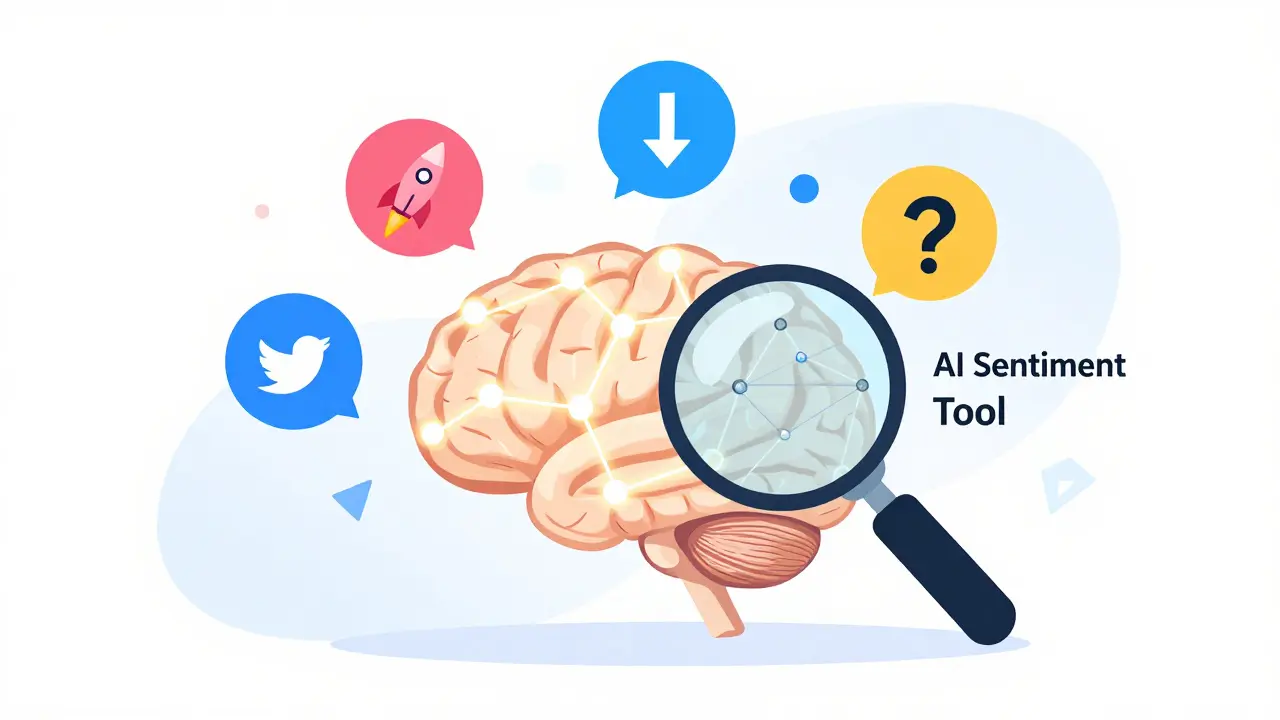
When you look at Bitcoin or Ethereum prices, you’re not just seeing numbers. You’re seeing the collective heartbeat of thousands of traders, investors, and speculators-all pouring their fears, hopes, and frustrations into tweets, forums, and chat groups. The market doesn’t move on fundamentals alone. It moves on sentiment. And now, AI tools are turning that noise into signals.
What Sentiment Indicators Actually Measure in Crypto
Sentiment indicators in blockchain don’t guess what people think. They scan millions of data points-Reddit threads, Twitter posts, Telegram groups, Discord chats, and even news headlines-to detect emotion. Is the mood excited? Panicked? Confused? Skeptical? These tools use natural language processing (NLP) to spot words like “HODL,” “to the moon,” “dumping,” or “FUD” and assign them emotional weights. But it’s not just about positive or negative. Advanced tools now detect urgency, sarcasm, and even subtle shifts in tone that signal a coming move.
For example, a spike in posts saying “I’m selling everything” on r/CryptoCurrency might not mean panic yet-but if those same posts suddenly include phrases like “I’ve had enough” or “never again,” the emotional intensity shifts. That’s when sentiment tools flag it as a potential bearish signal. In early 2025, one major crypto fund used sentiment data to exit a position 36 hours before a 22% drop in SOL, based on rising frustration signals in Telegram groups.
Top Tools Used by Crypto Traders in 2026
There are over 40 sentiment analysis platforms today, but only a handful are built for crypto’s unique chaos. Here’s what’s actually working:
- IBM Watson NLU - Used by institutional traders for its 50+ language support. It catches sentiment in Chinese, Russian, and Turkish crypto communities where retail volume is growing fast. Accuracy drops to 78% on slang-heavy crypto Twitter, but it’s still the most reliable for global coverage.
- Level AI - Favored by hedge funds for its 91.4% accuracy in detecting emotion. It doesn’t just say “negative”-it identifies frustration, greed, and confusion separately. Its May 2025 update added voice tone analysis from crypto YouTube commentaries and live streams, giving it an edge in spotting early panic.
- SentiSum - Popular among smaller traders because it integrates directly with TradingView and MetaTrader. It tracks sentiment across 12 major crypto forums and gives a simple 0-100 score. Accuracy on voice data is lower, but for text-based signals, it’s fast and clean.
- Meltwater - Used by exchanges like Binance and OKX to monitor brand sentiment. It scans 242 languages and flags fake news campaigns or coordinated FUD attacks. In late 2024, it detected a coordinated smear campaign against a DeFi project weeks before the token crashed.
Most of these tools cost money. IBM Watson charges $0.003 per 1,000 characters-so analyzing 10,000 tweets costs about 3 cents. SentiSum runs $1,000/month for 5,000 conversations. For solo traders, free alternatives like CryptoSentiment or LunarCrush exist, but their accuracy is often below 65%, and they miss sarcasm and context entirely.
Why Sentiment Tools Fail More Than You Think
Here’s the uncomfortable truth: 63% of users report false positives. A tweet saying “This coin is garbage” might be sarcastic. A Reddit thread titled “I made 10x” could be a bot. Sentiment tools don’t understand irony. They don’t know if someone’s joking-or if they’re a bot farm paid to manipulate sentiment.
One trader in Wellington told me he lost $18,000 in January 2025 because his tool flagged “extreme bullishness” on a Solana meme coin. Turns out, the buzz came from a single influencer who had just been paid $50,000 to pump it. The sentiment score was high. The intent? Pure manipulation.
Another problem? Setup complexity. Enterprise tools like CallMiner take 8-12 weeks to configure. Most crypto traders don’t have data scientists. They want a dashboard that works today. That’s why tools like SentiSum and Zonka Feedback are gaining ground-they’re plug-and-play. But they sacrifice depth for speed.
The Real Edge: Sentiment + On-Chain Data
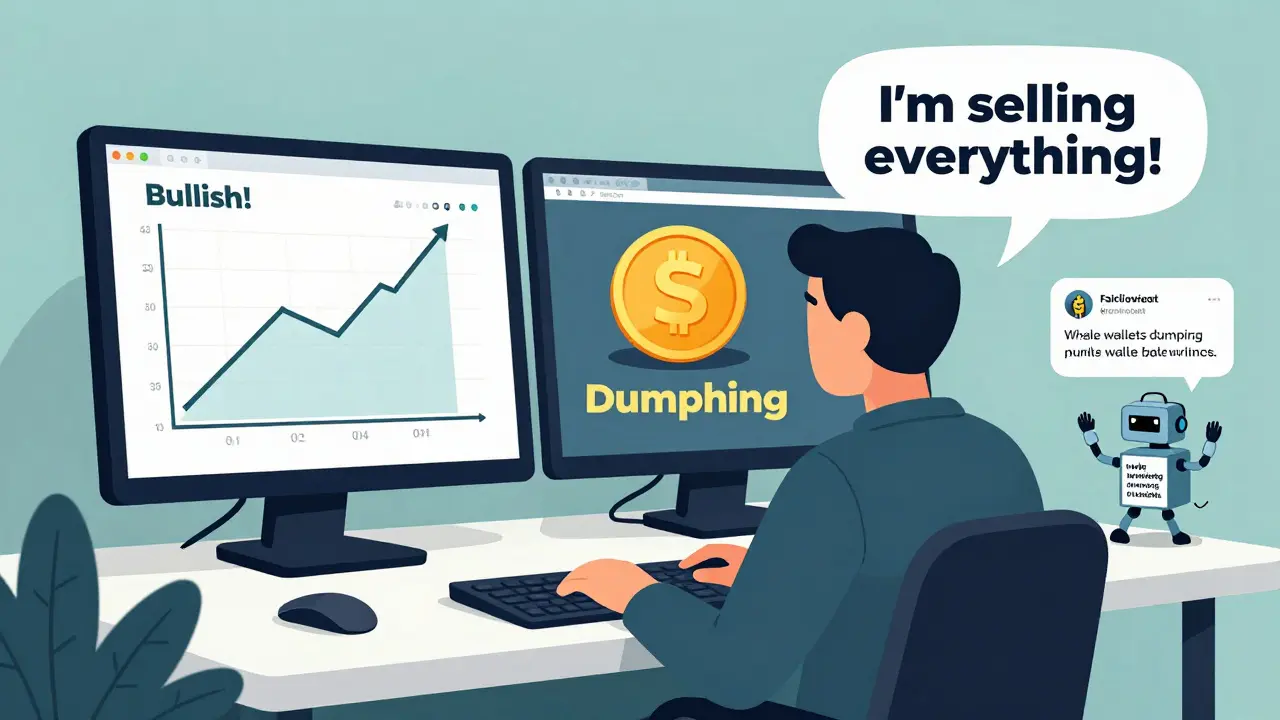
The smartest traders don’t rely on sentiment alone. They combine it with on-chain metrics. For example:
- If sentiment is bullish but whale wallets are dumping-ignore the hype.
- If sentiment is bearish but exchange inflows are dropping and staking rates are rising-this could be accumulation.
- If Twitter is screaming “FOMO” but GitHub commits for the project have dropped 70%-the tech isn’t keeping up.
That’s the real insight: sentiment tells you what people are saying. On-chain data tells you what they’re doing. Together, they’re powerful. In Q4 2024, a group of traders used this combo to predict the Bitcoin halving rally. Sentiment was neutral, but on-chain showed miners holding coins and retail wallets increasing holdings. They went long two weeks before the price jumped 40%.
What’s Next? Predictive Sentiment
The next leap isn’t just detecting emotion-it’s predicting behavior. Early trials show AI can forecast whether a trader will buy, sell, or hold based on their language patterns over time. McKinsey’s March 2025 report found predictive sentiment models hit 82.4% accuracy in forecasting short-term price moves in altcoins.
Tools like Balto are already using real-time sentiment coaching for crypto customer support teams. When a user types “I lost everything,” the system flags it, suggests a response, and even alerts the trader’s portfolio manager if the user is a high-net-worth client. This isn’t sci-fi-it’s live in some DeFi platforms today.
And regulation is catching up. By Q3 2026, EU-based exchanges must use GDPR-compliant sentiment tools that don’t store personal identifiers. That’s pushing innovation toward anonymized, aggregate analysis-making sentiment tools more ethical but also harder to game.

Should You Use Sentiment Tools?
If you’re a casual trader checking CoinMarketCap every day? Probably not. The noise outweighs the signal.
If you’re trading crypto full-time, managing a portfolio, or running a DeFi project? Yes-but only if you:
- Use it as a filter, not a signal. Never trade on sentiment alone.
- Combine it with on-chain data and volume trends.
- Test it against past market moves. Did it catch the 2024 ETH ETF rally? The LUNA collapse?
- Watch for manipulation. If sentiment spikes overnight with no news, it’s likely artificial.
Think of sentiment tools like a weather radar. It shows storms coming-but you still need to know where you’re standing, what gear you have, and whether you’re in a flood zone. The tool doesn’t make the decision. You do.
Can sentiment indicators predict crypto price movements?
Sentiment indicators don’t predict prices directly, but they can signal shifts in market mood that often precede price moves. For example, a sudden spike in fear or greed across social media has historically preceded 10-20% price swings within 24-72 hours. However, sentiment alone is unreliable-combine it with on-chain data and volume trends for better accuracy.
Are free sentiment tools any good for crypto trading?
Free tools like LunarCrush or CryptoSentiment give a basic idea of buzz, but their accuracy is often below 65%. They miss sarcasm, context, and bot-driven noise. For serious traders, they’re useful as a quick check-but not for making trades. Paid tools like Level AI or SentiSum offer 85%+ accuracy and better context handling.
How do sentiment tools handle memes and slang in crypto?
Modern tools like Level AI and IBM Watson NLU have been trained on crypto-specific slang-words like “wen lambo,” “diamond hands,” and “paper hands.” They recognize these as emotional cues, not just keywords. But they still struggle with layered sarcasm. For example, “This is the best coin ever” from a known troll might be flagged as positive, when it’s actually negative. Human oversight is still needed.
Can sentiment analysis detect crypto scams?
Yes, but indirectly. Tools like Meltwater and CallMiner flag coordinated FUD (fear, uncertainty, doubt) campaigns or sudden bursts of hype from unknown accounts. If 500 new Twitter accounts suddenly start praising a low-cap token with identical wording, the tool flags it as a potential pump-and-dump. It doesn’t prove fraud-but it raises a red flag worth investigating.
Do I need to be tech-savvy to use sentiment tools?
Not anymore. Tools like SentiSum and Zonka Feedback have simple dashboards that show sentiment scores, trends, and alerts without coding. Enterprise tools like IBM Watson require setup and data integration, which may need IT support. For most retail traders, plug-and-play tools integrated with TradingView or Telegram bots are enough.
Final Thought: Sentiment Is a Mirror, Not a Crystal Ball
Sentiment tools reflect what people are saying right now-not what they’ll do tomorrow. They’re powerful, but only when used with discipline. The best traders don’t chase sentiment. They watch it. They compare it to what’s happening on-chain. They wait for confirmation. And they know that the loudest voices online are rarely the smartest ones.
Mandy McDonald Hodge
3 01 26 / 02:56 AMI tried LunarCrush for a week and thought I was a genius... until I lost $3k on a meme coin that was just a bot farm. 😅 Sentiment tools are like mood rings for crypto-pretty colors, zero substance unless you know what you're looking at.
Jordan Fowles
3 01 26 / 19:07 PMSentiment is the echo of human fear and hope. It doesn't predict the market-it reveals the crowd's heartbeat. But hearts lie. They get tired. They get manipulated. The real edge isn't in the data-it's in knowing when to ignore it entirely.
Steve Williams
4 01 26 / 20:31 PMThis is a remarkably comprehensive analysis. The integration of sentiment analysis with on-chain metrics represents a paradigm shift in algorithmic trading frameworks. One must, however, remain cognizant of the epistemological limitations inherent in linguistic AI when applied to decentralized, emotionally volatile markets.
Alexandra Wright
6 01 26 / 00:48 AMOh wow, so we're paying $1000/month to get told that 'wen lambo' means someone's greedy? Newsflash: the guy saying that is probably broke and lives in his mom's basement. These tools are just glorified keyword scanners with a fancy UI and a price tag to match. And don't even get me started on 'sarcasm detection'-AI can't even tell if someone's joking in a text message, let alone in crypto Twitter.
Jack and Christine Smith
6 01 26 / 02:48 AMmy bf and i were laughin at how some of these tools flag 'diamond hands' as bullish but if someone says 'diamond hands but im sellin at 2x' its still bullish?? lmao. like bro its not a signal its a meme. and the bots? theyre all over the place. i saw a post that said 'this coin will make you rich' and it was from an account created 2 mins ago with 3 followers. still got a 92% positive score. 🤡
Jackson Storm
6 01 26 / 19:13 PMI started using SentiSum last month and it’s wild how much it catches. I was about to buy a coin because the Twitter feed was going nuts-then the tool flagged a 70% drop in GitHub commits and a spike in Telegram spam. Turned out it was a rug pull. Saved me $5k. But yeah, it’s not perfect. Still need to cross-check with on-chain. Don’t trust the vibe alone.
Raja Oleholeh
8 01 26 / 02:16 AMIndia crypto traders know this. Sentiment tools are useless. Only on-chain. Only volume. Only smart money. Rest is noise. 🇮🇳
Prateek Chitransh
9 01 26 / 12:14 PMFunny how the same tool that says 'FUD' when someone says 'this project is dead' is the same one that says 'EXTREME BULLISH' when a guy with 200 followers says 'to the moon' after a single tweet. The irony is that the most accurate sentiment detector is still the one between your ears. And the one that tells you to walk away.
Michelle Slayden
9 01 26 / 12:55 PMThe notion that sentiment analysis can reliably quantify emotional nuance in unstructured, adversarial, and often deliberately obfuscated textual data is, at its core, a statistical fallacy. While aggregation may reveal macro-patterns, the attribution of causality to sentiment-driven price movements remains empirically unsound without rigorous control variables. Moreover, the ethical implications of anonymized behavioral profiling within decentralized financial ecosystems warrant immediate regulatory scrutiny.
christopher charles
10 01 26 / 22:57 PMI love how everyone’s obsessed with these tools like they’re magic crystals… but honestly? The best indicator I’ve found? Check if the guy who’s posting all the hype has a verified badge… or if he’s got 3 followers and posted 50 times in the last hour. If it’s the latter? Run. 🚩 I’ve lost money twice because I trusted the score instead of the source. Don’t be me.