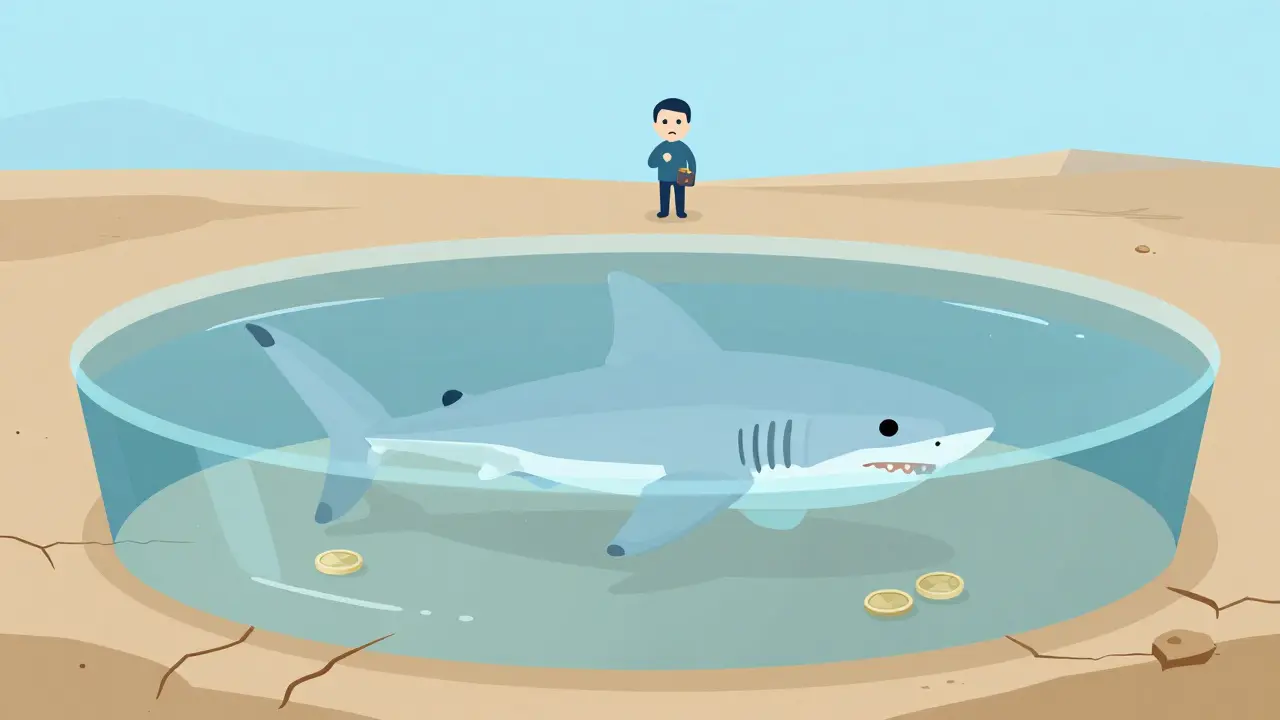
Have you ever clicked on a link for a new crypto exchange because the name sounded cool or the promise of low fees seemed too good to pass up? That is exactly what happens with SharkSwap, a decentralized exchange operating on the Base blockchain that currently lacks sufficient liquidity and security verification for safe trading. It sits quietly on the Base Layer 2 network, hoping users will overlook its glaring red flags. But here is the hard truth: as of mid-2026, SharkSwap is not just a small player-it is a high-risk platform that experts advise avoiding entirely.
You might be wondering why an exchange would exist if it offers no real benefits. The short answer is that it doesn’t. SharkSwap functions as an automated market maker (AMM), but unlike giants like Uniswap or PancakeSwap, it has failed to attract meaningful liquidity. In fact, CoinMarketCap lists SharkSwap as an 'Untracked Listing,' a status reserved for platforms that cannot prove consistent daily trading volume above $50,000. If you are looking for a place to swap tokens safely, this review will show you why SharkSwap should stay off your watchlist.
The Liquidity Problem: Why Your Trades Will Fail
Liquidity is the lifeblood of any decentralized exchange. Without it, you cannot buy or sell assets at fair prices. SharkSwap’s total value locked (TVL)-the amount of money actually sitting in its pools-was a mere $0.2 million in late 2025. Compare that to Uniswap, which held over $3.2 billion during the same period. This isn't just a difference in scale; it's a difference in survival.
When liquidity is this thin, something called slippage becomes your enemy. Slippage is the difference between the price you expect and the price you get. On major exchanges, slippage is often less than 0.1%. On SharkSwap, user reports from October 2025 describe slippage exceeding 5% on trades larger than $500. One user, u/CryptoSeeker2025, reported failing three times to swap just $200 from USDC to DAI, even after setting their slippage tolerance to a massive 12%. Another user noted that pools were 'practically empty.' If you try to trade more than $100 on SharkSwap today, you are likely to lose money simply because there is no one else to take the other side of your trade.
Security Risks: No Audits, High Danger
In the world of DeFi, code is law-but only if that code is secure. SharkSwap operates on the Base blockchain, which inherits Ethereum’s robust security model. However, the platform itself relies on smart contracts that have never been publicly audited by reputable firms like OpenZeppelin or CertiK. As of October 2025, HittinCorners.com confirmed that no public audit reports existed for SharkSwap.
This absence of verification is a massive red flag. CryptoLegal.uk, a database tracking potential fraud, lists SharkSwap under 'Emerging DEX Platforms with Unverified Contracts.' While they haven't labeled it a confirmed scam yet, the classification places it alongside 17 other high-risk projects. CoinDesk’s 2025 DeFi security report warned about dozens of small Base-based DEX forks using identical code patterns to known scam projects. Without an audit, you have no way of knowing if the contract contains backdoors that could drain your wallet. Is saving $0.02 on gas fees worth risking your entire portfolio?
Fee Structure and Hidden Costs
On paper, SharkSwap looks cheap. It charges a standard 0.3% trading fee, which is identical to Uniswap V2. Transaction costs on Base are also incredibly low, averaging around $0.02 per swap compared to Ethereum mainnet’s average of $1.25. So why isn't everyone using it?
The hidden cost is time and frustration. A simple $50 swap on SharkSwap took one reviewer 43 minutes to complete due to multiple failed attempts and constant adjustments to slippage settings. On Uniswap, that same transaction takes about 8 minutes. Furthermore, SharkSwap offers no fee tiers or volume discounts for large traders. You pay the same percentage whether you are swapping $10 or $1,000, but you get none of the reliability that comes with higher volumes. There are also no staking rewards or yield opportunities, meaning your capital sits idle without earning anything while exposed to risk.
How SharkSwap Compares to Established DEXs
| Feature | SharkSwap (BASE) | Uniswap | PancakeSwap |
|---|---|---|---|
| Total Value Locked (TVL) | $0.2 Million | $3.2 Billion+ | $1.1 Billion+ |
| Security Audit | None Publicly Available | Multiple Independent Audits | Multiple Independent Audits |
| Monthly Volume | Below $1 Million | $37.5 Billion+ | $10 Billion+ |
| User Reviews | Extremely Negative/Limited | 4.2/5 (2,400+ reviews) | Positive Community Sentiment |
| Cross-Chain Support | Base Only | Multi-Chain (Ethereum, L2s) | BSC, Ethereum, Arbitrum |
| Staking/Yield | No Rewards | Vaults & Yield Options | Up to 12% APY |
The table above makes the choice clear. SharkSwap lags behind in every critical metric. It has no cross-chain functionality, meaning you can't easily move assets from other networks. It lacks advanced features like leveraged trading or NFT marketplaces found on PancakeSwap. Most importantly, it has zero developer activity. GitHub monitoring shows only three commits in the last 90 days, suggesting the team has largely abandoned the project.
Why Experts Are Warning Against SharkSwap
If you listen to the people who build and analyze these systems, the message is uniform: avoid SharkSwap. DexCircle, a prominent DeFi analytics site, gave SharkSwap a rating of 2.8 out of 5 stars, stating bluntly that it 'fails to solve any problems that Uniswap or PancakeSwap don't already address better.' They concluded that without dramatic liquidity injections, the platform would likely become inactive within six to nine months.
HittinCorners.com echoed this sentiment, noting that SharkSwap offers 'no meaningful differentiation in a crowded DEX market where liquidity is paramount.' Messari, a leading research firm, predicted in their 2025 DeFi Outlook that over 70% of untracked DEXs would cease operations by Q2 2026 due to unsustainable liquidity models. SharkSwap fits this profile perfectly. Its TVL dropped 63% between July and October 2025, falling from $0.54 million to $0.2 million while the rest of the DeFi sector grew by 18%.

Practical Issues: Tax Reporting and Support
Even if you ignore the security risks, using SharkSwap creates administrative nightmares. The platform provides no transaction history export functionality. For tax purposes, you must manually reconstruct every trade using blockchain explorers. Users report this process taking approximately 25 minutes per trade. Imagine doing that for hundreds of transactions.
Customer support is nonexistent. During testing, submissions to their contact form received no response after 72 hours. If your funds get stuck in a failed transaction, you are on your own. There is no help desk, no live chat, and no community manager to assist you. In contrast, established exchanges offer comprehensive documentation and active Discord communities.
Who Should Avoid SharkSwap?
Let’s be direct: almost everyone should avoid SharkSwap. It is not suitable for beginners who need guidance and security. It is not suitable for experienced traders who require deep liquidity and low slippage. It is not suitable for investors looking for yield through staking. The only reason to interact with SharkSwap is if you are a researcher studying failed DeFi projects or if you hold a very small amount of dust tokens that you cannot move elsewhere-and even then, proceed with extreme caution.
The regulatory landscape is also tightening. The SEC’s 2025 'Decentralized Exchange Framework' specifically targets 'untracked liquidity venues' for potential enforcement action if they facilitate trading of securities. While SharkSwap wasn't named explicitly, its lack of compliance infrastructure puts it squarely in the danger zone. If regulators crack down on unverified DEXs, SharkSwap is likely to be among the first to shut down.
Better Alternatives for Base Blockchain Trading
If you want to trade on the Base blockchain, you have safer options. Aerodrome Finance has emerged as a leading DEX on Base, offering significantly higher liquidity and integrated reward mechanisms. Uniswap also supports Base, allowing you to access its massive liquidity pool with the security guarantees you know and trust. These platforms undergo regular audits, have transparent teams, and integrate with major aggregators like 1inch and Matcha, ensuring you always get the best price.
Don't let the lure of low fees blind you to the reality of risk. In crypto, security and liquidity are not optional-they are essential. SharkSwap fails to deliver either. Save yourself the headache, the lost time, and the potential financial loss by sticking to proven platforms.
Is SharkSwap a scam?
While not officially labeled a confirmed scam by all authorities, SharkSwap is listed in high-risk categories by databases like CryptoLegal.uk due to its unverified smart contracts and lack of audits. Experts warn that its code patterns resemble those of known fraudulent projects, making it extremely dangerous to use.
Why is SharkSwap so cheap compared to Ethereum?
SharkSwap operates on the Base Layer 2 network, which offers much lower transaction fees than Ethereum Mainnet. However, the low gas fees do not compensate for the high slippage and failed transaction rates caused by poor liquidity.
Can I recover my funds if a transaction fails on SharkSwap?
If a transaction fails due to slippage, your funds usually remain in your wallet. However, if the smart contract has vulnerabilities or bugs, recovery may be impossible. Given the lack of customer support, you would need to seek technical assistance from independent developers, which can be costly.
What is the Total Value Locked (TVL) of SharkSwap?
As of late 2025, SharkSwap's TVL was approximately $0.2 million, representing a 63% decline from earlier in the year. This is significantly lower than competitors like Uniswap, which holds billions in TVL.
Are there any safe DEXs on the Base blockchain?
Yes. Aerodrome Finance and Uniswap (which supports Base) are considered safer alternatives due to their higher liquidity, regular security audits, and integration with major DeFi aggregators.
Why does CoinMarketCap list SharkSwap as 'Untracked'?
CoinMarketCap marks exchanges as 'Untracked' when they fail to meet minimum criteria for consistent daily trading volume and liquidity transparency. This indicates that SharkSwap does not have enough genuine trading activity to be considered reliable.
Does SharkSwap offer staking rewards?
No. Unlike PancakeSwap or Uniswap, SharkSwap does not offer any staking rewards, yield farming, or liquidity incentives. Users receive no benefit for providing liquidity beyond the minimal trading fees.
Leave a comments