
On April 16, 2025, Canada became the first country in the world to launch Solana ETFs-exchange-traded funds that let investors buy and sell Solana (SOL) like a stock, without ever touching a crypto wallet. This wasn’t just another product drop. It was a regulatory milestone that put Canada ahead of the U.S., Europe, and every other major market when it came to altcoin access. For everyday investors, this meant something simple: you could now hold Solana in your TFSA or RRSP, earn staking rewards automatically, and avoid the risks of keeping crypto on an exchange.
What Exactly Is a Solana ETF?
A Solana ETF is a fund that holds actual Solana tokens in secure custody and issues shares traded on the Toronto Stock Exchange. You don’t need to understand blockchain, private keys, or gas fees. You just open your brokerage account-Questrade, Wealthsimple, TD Direct Investing-and buy shares of PSOL, ESOL, QSLN, or another Solana ETF ticker. The fund handles everything else: buying SOL, storing it in cold wallets, staking it to earn rewards, and reporting performance daily.What makes these ETFs different from buying SOL on Binance or Coinbase? Three things: regulation, tax advantages, and staking.
Why Canada Got There First
The Ontario Securities Commission (OSC) approved four asset managers-Purpose Investments, Evolve Funds Group, CI Financial, and 3iQ Corp-to launch Solana ETFs in early 2025. This followed their January 2025 regulatory update that clearly defined how cryptocurrency funds could operate. Unlike the U.S. Securities and Exchange Commission (SEC), which still hasn’t approved a single altcoin ETF, Canada’s provincial system lets Ontario act independently. No need for federal approval. No endless legal battles. Just a clear rulebook and fast approvals.Canada didn’t invent crypto ETFs-Purpose launched the world’s first Bitcoin ETF in February 2021-but they’ve kept leading. By April 2025, Canada had approved spot ETFs for Bitcoin, Ethereum, XRP, and now Solana. The U.S. still only has Bitcoin and Ethereum ETFs. And even those don’t earn staking rewards.
Staking: The Game-Changer
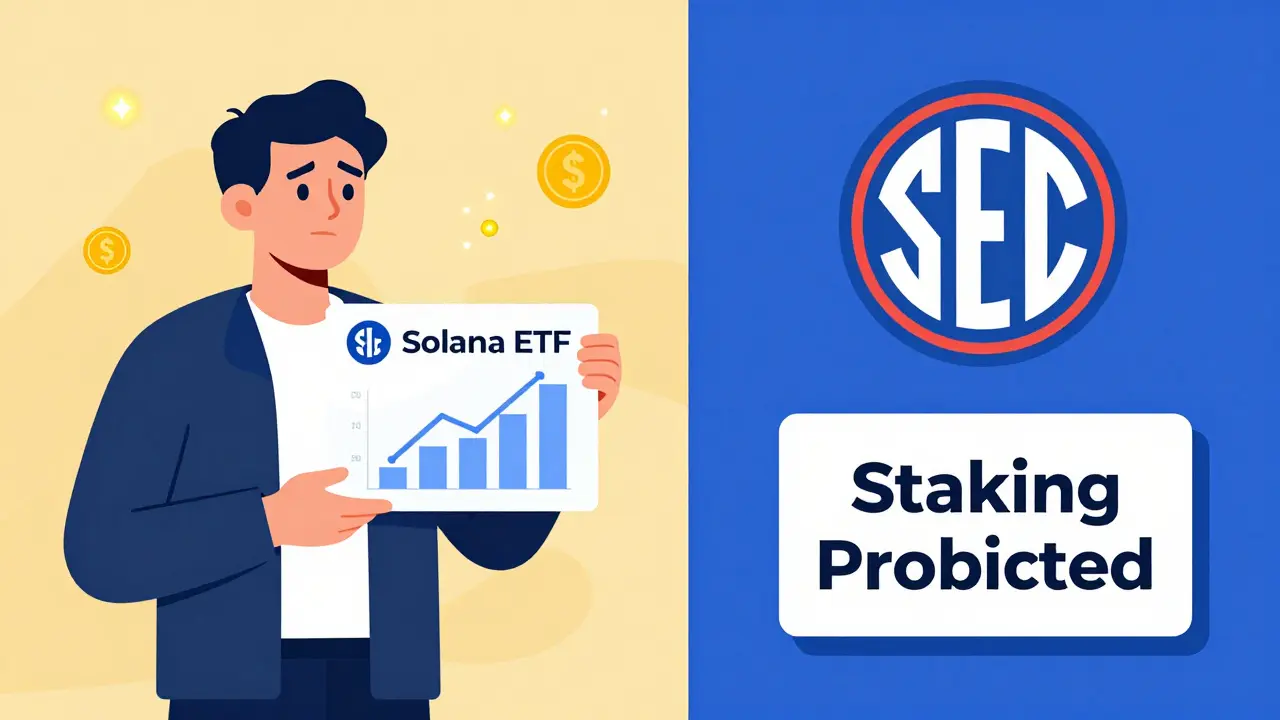
Here’s where Canadian Solana ETFs blow past everything else. In the U.S., staking is banned in ETFs because regulators worry about investor funds being mixed with the network’s validator nodes. In Canada? Not a problem.The 3iQ Solana Staking ETF (QSLN) doesn’t just track Solana’s price-it actively stakes the SOL it holds. Validators on Solana’s network secure transactions and earn new SOL tokens in return. The ETF captures that yield and adds it directly to the fund’s net asset value (NAV) every single day. By October 2025, QSLN had over $258 million CAD in assets under management, growing from just $10 million at launch.
Unlike Ethereum, where unbonding can take up to two weeks, Solana’s unstaking period is only 2-3 days. That means the ETF can respond quickly to market shifts while still earning consistent rewards. The 3iQ fund also uses segregated cold storage, experienced validator operators, and daily transparency reports. No hidden fees. No guesswork.
How It Compares to Other Crypto ETFs
| Feature | Canadian Solana ETFs | U.S. Bitcoin/Ethereum ETFs |
|---|---|---|
| Staking Allowed | Yes, daily yield accretion | No, prohibited by SEC |
| Available in TFSA/RRSP | Yes | No |
| Regulator | Ontario Securities Commission | Securities and Exchange Commission |
| Launch Date | April 16, 2025 | Not approved as of December 2025 |
| Transaction Speed Supported | 65,000 TPS (Solana) | 30 TPS (Ethereum) |
| Management Fee (Year 1) | 0% for QSLN | 0.20%-0.95% |
For investors, this isn’t just about getting exposure to Solana. It’s about getting exposure to Solana’s performance-including the yield it generates. That’s a huge edge. Over a year, even a 5% annual staking return can add thousands in gains without you lifting a finger.
Who Should Buy a Solana ETF?
If you’re a Canadian investor who’s been waiting to get into crypto without the hassle, this is your moment. These ETFs are perfect for:- People who want Solana exposure but don’t want to manage wallets or private keys
- Those saving for retirement and want to hold crypto in their RRSP or TFSA
- Investors tired of paying high exchange fees and dealing with withdrawal delays
- Anyone who believes in Solana’s tech-fast, cheap, scalable-but fears its past outages
But be clear: this isn’t a safe investment. Solana’s price swung between $194 and $203 in late 2025. Its network had an 11-hour outage in December 2024. It’s still a high-risk, high-reward asset. The ETF doesn’t remove that risk-it just makes it easier to access.
How to Buy One
Buying a Solana ETF is as simple as buying Apple stock:- Open a brokerage account with any Canadian platform (Questrade, Wealthsimple, Scotia iTrade, etc.)
- Search for the ticker: PSOL (Purpose), ESOL (Evolve), QSLN (3iQ), or CI.SOL (CI Financial)
- Place a market or limit order
- Hold it in your account-no need to move anything to a wallet
You can buy as little as one share. The price per share hovers around $20-$25 CAD. And since these are listed on the TSX, you can trade them during regular market hours, just like any other stock.
What About Taxes?
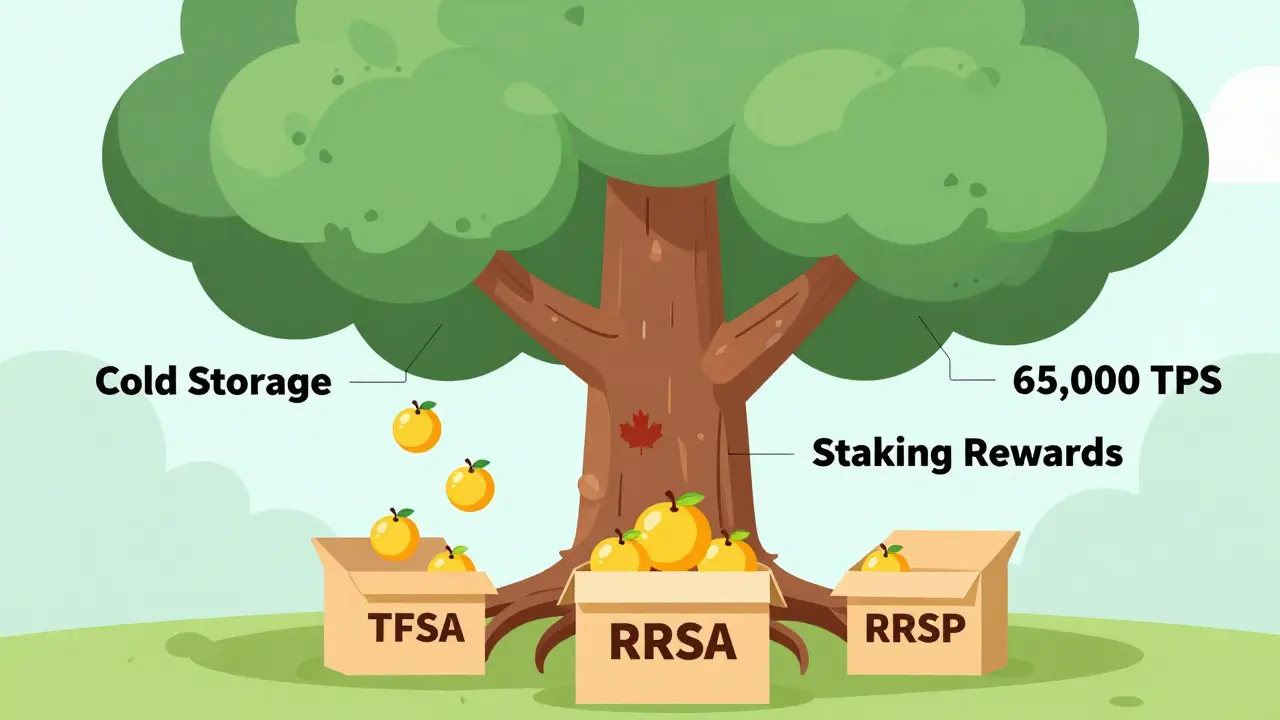
This is one of the biggest advantages. In Canada, you can hold Solana ETFs in a TFSA or RRSP. That means:- Capital gains inside a TFSA are completely tax-free
- Dividends or staking rewards inside an RRSP grow tax-deferred
- You don’t have to track each SOL purchase or sale for tax purposes-the ETF does it for you
With direct crypto holdings, you can’t use registered accounts. You’d need to report every trade, even small ones. With an ETF? You get the same exposure with 90% less paperwork.
What’s Next?
The success of Solana ETFs has already sparked interest in similar products for Cardano, Polkadot, and even Polygon. Vanir Assets predicted in April 2025 that these could be next. Meanwhile, the U.S. is watching. Bloomberg’s James Seyffart thinks the SEC might allow Ethereum staking ETFs by mid-2025-but Solana? Still nowhere on the radar.Canada’s move isn’t just about Solana. It’s about proving that regulated, institutional-grade crypto products can work. And with over $3 billion in crypto ETFs already in Canada, and Solana’s $69 billion market cap, this is just the beginning.
Final Thoughts
The launch of Solana ETFs in Canada didn’t change the crypto market overnight. But it did change what’s possible for retail investors. For the first time, you can get exposure to one of the fastest blockchains in the world, earn passive income from staking, and hold it all in a tax-advantaged account-all without ever touching a crypto exchange.It’s not perfect. Solana’s still volatile. Its network isn’t bulletproof. But if you believe in its technology and want a simple, safe, regulated way to invest, this is the best option available today. And right now, Canada is the only country offering it.
Can I buy a Solana ETF in the U.S.?
No, not yet. As of December 2025, the U.S. Securities and Exchange Commission (SEC) has only approved Bitcoin and Ethereum spot ETFs. No altcoin ETFs-including Solana-are approved. The closest thing is Grayscale’s GSOL, which is still under review and not yet trading on U.S. exchanges.
Are Solana ETFs safe?
They’re safer than holding Solana on an exchange because they use institutional-grade custody, cold storage, and regulated fund structures. But they’re not risk-free. Solana’s price can swing sharply, and its network has had outages in the past. The ETF doesn’t eliminate market risk-it just makes access easier and more regulated.
Do Solana ETFs pay dividends?
Not in the traditional sense. Instead of paying out cash dividends, they add staking rewards directly to the fund’s net asset value (NAV). That means your shares increase in value over time as rewards are earned. You don’t get cash payments-you get growth in your holdings.
Can I hold a Solana ETF in my TFSA?
Yes. All four approved Solana ETFs in Canada are eligible for Tax-Free Savings Accounts (TFSAs) and Registered Retirement Savings Plans (RRSPs). This is a major advantage over direct crypto holdings, which cannot be held in registered accounts.
What’s the management fee for Solana ETFs?
The 3iQ Solana Staking ETF (QSLN) charges 0% management fees for the first 12 months. After that, it’s expected to be around 0.50%. Purpose Investments’ PSOL and Evolve’s ESOL have fees between 0.60% and 0.75%. Compare that to U.S. Bitcoin ETFs, which typically charge 0.20%-0.95% and don’t earn staking rewards.
Is Solana better than Ethereum for ETFs?
It depends on your goals. Ethereum has a larger market cap and more developer activity. Solana is faster (65,000 transactions per second vs. Ethereum’s 30) and cheaper, making it better for real-time applications. For ETF investors, Solana’s staking yield and lower fee structure give it a unique edge. But Ethereum has more proven long-term adoption. Both have risks.
What happens if Solana has another network outage?
The ETF still holds the SOL tokens. Network outages affect price and trading activity, but not ownership. The fund’s custodians continue to secure the assets. The ETF’s NAV will drop if SOL’s price falls during an outage, just like any other stock. The fund doesn’t lose your money-it just reflects the market’s reaction.
Kevin Gilchrist
1 01 26 / 00:43 AMOkay but like… staking rewards in an ETF??? 🤯 I’ve been waiting for this my whole crypto life. No more juggling wallets, no more gas fee nightmares. Canada just turned crypto into something your grandma can invest in and still sleep at night. I’m jealous. So. Damn. Jealous.
Khaitlynn Ashworth
2 01 26 / 12:48 PMOh wow. Another ‘Canada is better’ post. Newsflash: they’re just less scared of regulation. Also, Solana’s had 3 major outages in 2 years. This is like buying a Lamborghini with a known engine defect and calling it ‘safe’ because it has seatbelts. 😒
Brooklyn Servin
4 01 26 / 00:46 AMCan I just say how insane it is that the 3iQ ETF charges 0% fees for the first year?? That’s not just competitive-that’s a gift. And the fact that they’re staking SOL and adding it to NAV daily? That’s next-level institutional thinking. I’ve been holding direct SOL since 2021 and I’m seriously considering switching. The tax simplicity alone is worth it. 🙌
surendra meena
5 01 26 / 07:29 AMTHIS IS THE MOMENT!!! THE WORLD IS WATCHING!!! CANADA JUST MADE HISTORY!!! SOLANA ETFs are not just a product-they’re a revolution!!! Imagine your RRSP growing with staking rewards while you sleep!!! The SEC is still stuck in 2018!!! I’m crying!!! I’m screaming!!! I’m buying 50 shares right now!!!
Mandy McDonald Hodge
5 01 26 / 16:33 PMjust bought my first share of qsln last night 😭 i’ve been waiting for this for years. no more panic selling because i forgot my seed phrase. no more exchange hacks. just… chill. holding in my tfsa. life is good. thank you canada. 🙏💙
Andy Reynolds
6 01 26 / 15:19 PMFor real, this is the blueprint for how crypto should be integrated into mainstream finance. Not ‘buy crypto on Binance and pray’-but ‘buy a fund that does everything for you, legally, safely, and with passive income.’ Canada didn’t just lead-they built the future. The U.S. is still arguing about whether crypto is a commodity or a security. Meanwhile, Canadians are earning yield in their RRSPs. 🤦♂️
Prateek Chitransh
8 01 26 / 13:50 PMLet’s not pretend this is risk-free. Solana’s speed is great, but its centralization risks are real. The validators are concentrated. The network’s still vulnerable. The ETF doesn’t fix that-it just hides it behind a shiny prospectus. But hey, if you want exposure without the tech headache? This is the path. Just don’t call it ‘safe.’ Call it ‘convenient.’
Alex Strachan
9 01 26 / 13:35 PM0% fees for a year?? 😏 someone’s trying to get rich quick with this. Wait till year 2 when it jumps to 0.5% and everyone’s already hooked. Classic bait-and-switch. But… I’m still buying. 🤷♂️
Phil McGinnis
10 01 26 / 15:53 PMCanada thinks it’s so smart. Meanwhile, the U.S. has the world’s largest capital markets, deepest liquidity, and real legal clarity. Let Canada have its little sandbox. When the next bear market hits, you’ll see who’s really holding the bag. And no, I don’t care if it’s in a TFSA.
dayna prest
11 01 26 / 15:48 PMWow. So Solana’s the ‘best’ because it’s fast? That’s like saying a Ferrari is the best car because it goes 200 mph… until it explodes on a dirt road. Also, why is everyone acting like this is the first time crypto has been regulated? It’s not innovation-it’s compliance theater.
NIKHIL CHHOKAR
11 01 26 / 17:53 PMLet me be the one to say this quietly: the real win here isn’t Solana. It’s that Canadian regulators finally said ‘yes’ without waiting for Washington. That’s the real story. The U.S. is paralyzed by fear and lawsuits. Canada said ‘let’s move.’ And now, everyday people get access to real yield. That’s not crypto-it’s financial inclusion.
Mike Reynolds
12 01 26 / 15:36 PMBeen holding SOL directly since 2022. This ETF thing is actually making me reconsider. I hate managing keys, and I’ve lost sleep over exchange outages. If I can just buy a share and forget about it… yeah. I’m in. Even if it’s just 10% of my portfolio. Less stress = better mental health.
Willis Shane
13 01 26 / 00:58 AMWhile I appreciate the innovation, it’s critical to recognize that the Ontario Securities Commission’s approval does not equate to federal endorsement. The regulatory framework remains fragmented, and investor protections are still evolving. Moreover, the claim that staking rewards are ‘automatically’ captured requires deeper scrutiny-there are potential counterparty risks in validator selection, and the daily NAV accretion model may not be sustainable under prolonged market stress. As a fiduciary advisor, I recommend thorough due diligence before allocation.
Gavin Hill
14 01 26 / 00:38 AMWhat does it mean to own something you can’t touch? If I hold a Solana ETF I’m not holding Solana I’m holding a promise that someone else is holding Solana for me and maybe staking it and maybe not losing it to a hack or a bug or a government crackdown. So am I investing in blockchain or am I investing in bureaucracy? And if the ETF fails… who do I sue? The fund manager? The custodian? The validator? The Canadian government? I’m not sure anymore
Monty Burn
15 01 26 / 04:58 AMStaking in an ETF is like having a gardener grow flowers in your backyard and then telling you the flowers are yours but you can’t pick them. You get the beauty but not the smell. The value accrues but you don’t feel the harvest. It’s elegant. It’s efficient. But it’s also a little lonely. Are we losing something essential about ownership? Or is this just progress dressed in suits?
Ian Koerich Maciel
15 01 26 / 19:44 PMJust checked my Questrade app… QSLN is up 12% since launch. The staking rewards alone added 3.7% in 3 weeks. I didn’t do anything. I just… held. And now I’m crying happy tears. Canada, you did it. I’m so proud. 🇨🇦💙
Rick Hengehold
17 01 26 / 19:01 PMOne share. That’s all I bought. Just to say I did it. No need to go all in. But I’m in. And I’m not looking back.
Mike Pontillo
18 01 26 / 13:29 PMSo… you’re telling me I can now invest in Solana without even knowing what a blockchain is? That’s not innovation. That’s dumbing down. What’s next? Crypto ETFs for toddlers?
Alison Hall
18 01 26 / 17:18 PMJust bought my first QSLN share. My first crypto investment that doesn’t make me feel like a hacker. So proud. 🥹💙