The Bitspawn Protocol (SPWN) airdrop wasn’t just another free token giveaway. It was a strategic move to build a real community around a blockchain-based esports platform - and it happened on Solana, not Ethereum. If you’re wondering whether this airdrop still matters today, or if you missed it and want to know what really went down, here’s the full story with no fluff.
What Was the SPWN Airdrop?
The Bitspawn Protocol airdrop launched in late 2021, tied directly to CoinMarketCap’s platform. Winners didn’t get airdropped tokens automatically. They had to claim them manually through a dedicated Solana-based interface. This wasn’t a mass distribution - it was selective. Only users who met specific, undisclosed criteria got in. That’s why so many people still ask: Who qualified? The answer? We don’t know for sure. Bitspawn never published exact rules. But we do know it targeted active CoinMarketCap users who had engaged with crypto projects before. The token, SPWN, was built to power Bitspawn’s esports ecosystem: tournaments, rewards, in-game items, and community governance. The airdrop was meant to seed that ecosystem with real users, not just speculators. That’s why they chose Solana - low fees, fast transactions, and a growing gaming community. No one wanted to pay $50 in gas to claim 100 SPWN tokens. Solana made it possible to claim even small amounts without breaking the bank.How Was the Token Distributed?
Bitspawn didn’t rely on one platform. They used multiple channels to reach different audiences:- CoinMarketCap: The main airdrop hub. Winners received an email or in-app notification to claim SPWN.
- MantradDAO’s Zendit: Used for community-driven distribution, likely rewarding early supporters and contributors.
- CyberFi’s Samurai: Focused on DeFi-savvy users who were already active in yield farming or liquidity pools.
Why Solana?
Choosing Solana wasn’t random. Ethereum was too expensive and slow for gaming. Every time a player won a match and got SPWN as a reward, the transaction had to be instant and cheap. Solana handles over 65,000 transactions per second with fees under $0.00025. That’s why Bitspawn built their entire claiming and reward system on it. Compare that to Ethereum, where a simple token transfer can cost $2-$10 during peak times. For a gaming platform that needs to reward thousands of players daily, Solana wasn’t just convenient - it was necessary. Bitspawn also partnered with Solana-based NFT marketplaces and gaming wallets. That meant users could hold their SPWN tokens in Phantom or Solflare wallets, and use them directly in games without switching chains. No bridges. No conversions. Just plug in and play.What’s the Token Worth Today?
As of February 2026, SPWN trades at around $0.0000101 per token. That’s down from its peak in late 2021, when it briefly hit $0.00008. The market cap? Just $6,570. The 24-hour trading volume? Only $1.10. These numbers aren’t just low - they’re nearly dead. Why? Because the community didn’t grow fast enough. The airdrop brought in users, but few stuck around. Most claimed their tokens, sold them on decentralized exchanges, and disappeared. There was no clear use case outside of speculation. Analysts have made wild predictions: CoinLore says SPWN could hit $0.0134 by end of 2025 - a 226,000% jump. DigitalCoinPrice says $0.000143. Both are based on hope, not data. The real number? The token has traded below its 50-day and 200-day moving averages for over a year. Technical indicators show no sign of recovery. The Fear & Greed Index says “Greed,” but sentiment is still bearish. That’s not a contradiction - it’s a warning.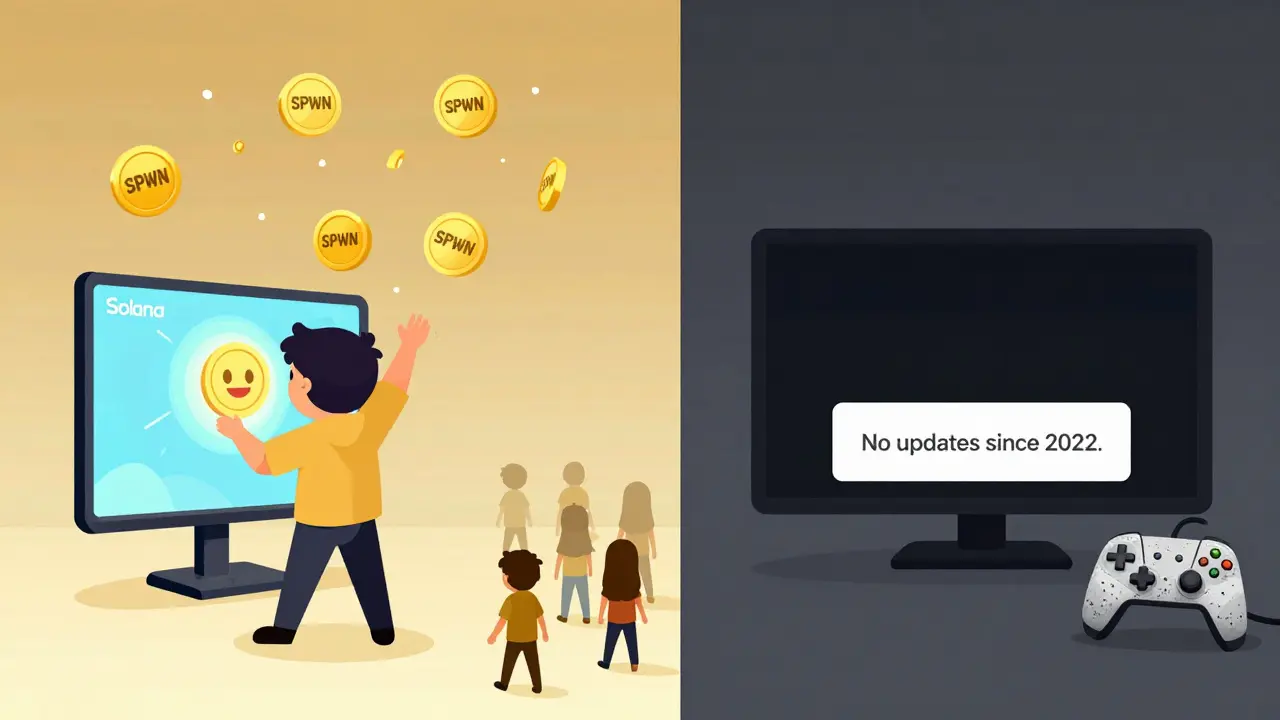
Who Holds SPWN Today?
There are only 2,190 unique wallet addresses holding SPWN. That’s not a community. That’s a small group of traders and a few early believers. For comparison, Polygon’s MATIC has over 1.2 million holders. Even lesser-known gaming tokens like GALA or AXS have 10x more. Bitspawn’s failure wasn’t technical. It was community. They built a great blockchain infrastructure - but they didn’t build a reason for people to keep using SPWN. No tournaments. No rewards. No updates. No roadmap. Just a token with no home. The airdrop worked - technically. People got tokens. But the project didn’t follow up. No blog posts. No Discord engagement. No new game integrations. Without that, the airdrop became a one-time event, not the start of something bigger.Can You Still Claim SPWN Tokens?
No. The CoinMarketCap airdrop ended in December 2021. The claiming window closed. No extensions. No reopens. If you didn’t claim it back then, you missed it. Some third-party sites claim they can “recover” old airdrops. Don’t trust them. They’re scams. Bitspawn never offered a recovery tool. No wallet import. No backup. No second chance. If you still have SPWN in your wallet, you can sell it on Solana-based DEXs like Raydium or Jupiter. But there’s almost no liquidity. You might get a few cents - if you’re lucky.What Went Wrong?
Bitspawn raised $6.44 million across six funding rounds. That’s real money. Investors believed in the vision: a global esports platform powered by blockchain. But execution failed. They focused too much on token distribution and not enough on product. No one cared about SPWN because no one was playing the games. No tournaments. No leaderboards. No rewards. Just a token floating in a vacuum. Compare that to Axie Infinity. They launched with a game first - then added tokens. Bitspawn did the opposite. They gave away tokens before anyone knew what they were for. Also, they didn’t localize. No中文, no Español, no Русский. Just English. For a global esports platform, that’s a huge blind spot.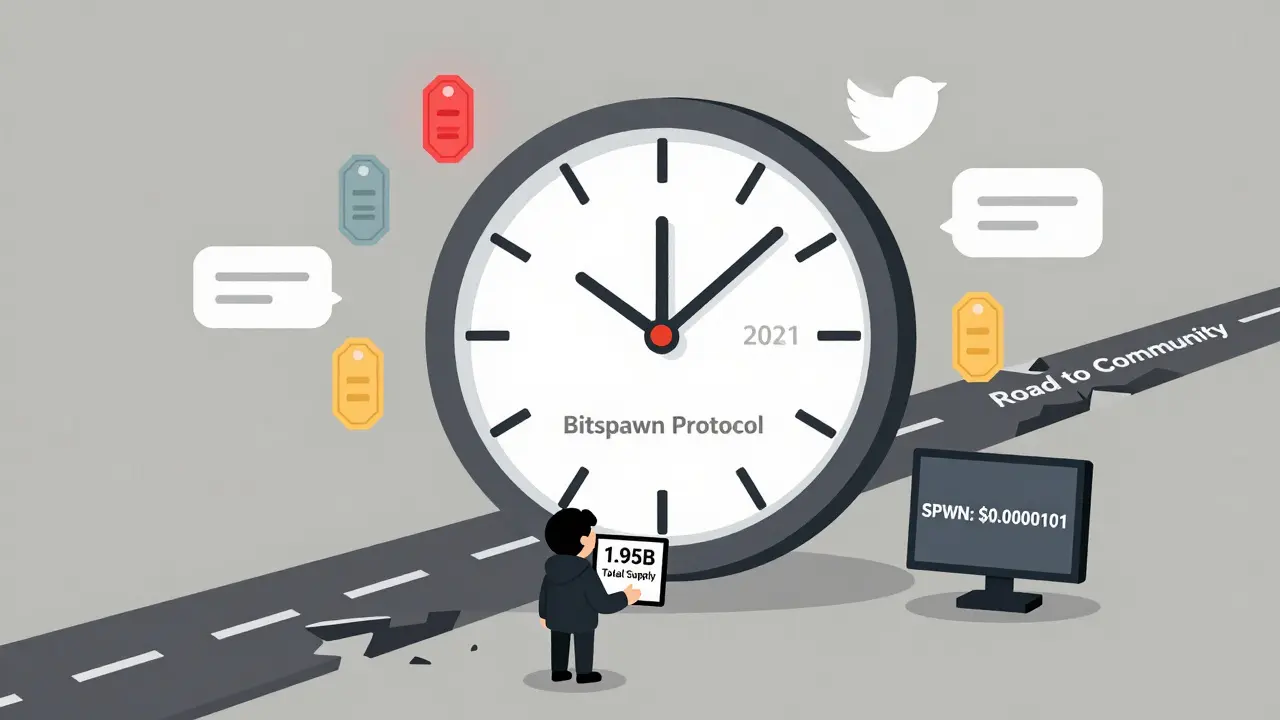
What Could Have Been Done Differently?
Here’s what would’ve worked:- Launch a free-to-play game first - even a simple browser-based tournament.
- Give SPWN as rewards for winning, not as a claimable airdrop.
- Partner with real esports teams, not just crypto influencers.
- Use the airdrop to reward players who completed tutorials, joined tournaments, or referred friends.
- Update the community weekly - even if it’s just a short video saying “Here’s what we built this week.”
Is SPWN Worth Anything Now?
Honestly? Not really. The token has no utility. No active development. No community. No price catalyst. The airdrop was a smart idea - but without follow-through, it became a footnote. If you’re holding SPWN, you’re holding a digital collectible with no market. If you’re thinking of buying it now, you’re gambling on a ghost. Bitspawn Protocol didn’t fail because of blockchain. It failed because it forgot the people.What’s Next for Bitspawn?
No one knows. The official website hasn’t been updated since 2022. Their Twitter hasn’t posted since 2023. The GitHub repo is empty. The project is silent. Unless they return with a real product - not just another token announcement - SPWN will keep drifting toward zero. The lesson? Airdrops don’t build communities. Products do.Did the Bitspawn Protocol airdrop still have value after claiming?
Not for most people. The SPWN token had no real use case outside of trading. Claiming the tokens was easy, but using them wasn’t. Without tournaments, rewards, or games tied to SPWN, most holders sold immediately. The token’s value dropped fast because there was no demand beyond speculation.
Can I still claim SPWN tokens from the 2021 airdrop?
No. The claiming window closed in December 2021. Bitspawn never reopened it. Any website or service claiming to help you claim old SPWN tokens is a scam. The only way to get SPWN now is to buy it on a Solana DEX - but liquidity is extremely low.
Why did Bitspawn choose Solana for the airdrop?
Solana was chosen because of its speed and low fees. Ethereum transactions were too expensive for gaming use cases. With Solana, users could claim tiny amounts of SPWN without paying $5 in gas. It also aligned with the growing trend of blockchain gaming on Solana, which already had wallets like Phantom and marketplaces like Raydium.
How many SPWN tokens were distributed in the airdrop?
The exact number was never disclosed. However, with a total supply of 1.95 billion and only 514 million in circulation today, the airdrop likely distributed under 1% of the total supply. It was designed to seed the community, not flood the market.
Is SPWN still being traded today?
Yes, but barely. As of early 2026, SPWN trades at $0.0000101 with a 24-hour volume of just $1.10. It’s listed on Solana-based DEXs like Jupiter and Raydium, but there are almost no buyers. The token has no liquidity, no updates, and no active development - making it nearly worthless.
Sharon Lois
10 02 26 / 05:43 AMSPWN? More like SPWNt happen. Airdrop was a marketing stunt dressed up as a revolution. They gave away digital confetti and wondered why no one showed up to the party. Classic crypto failure.
laura mundy
10 02 26 / 15:22 PMLet me guess-someone thought ‘blockchain + esports’ = instant success. No. You don’t just drop tokens and hope people care. You build something people want to use. This wasn’t a failure of tech. It was a failure of imagination.
Deeksha Sharma
11 02 26 / 10:48 AMI still believe in the vision. The airdrop wasn’t the problem-it was the silence after. Imagine if they’d posted weekly updates: ‘Here’s our new tournament UI.’ ‘Here’s the first partnered pro team.’ Even small wins build momentum. They gave up before they started.
Shruti Sharma
11 02 26 / 13:26 PMlmao the indian community is still out here claiming they ‘missed the boat’ like it was a crypto train and not a ghost ship with a half-baked game and zero devs. we all know the truth-no one cared because there was nothing to care about. just another token with a fancy whitepaper and zero soul.
aryan danial
13 02 26 / 12:47 PMThe tragedy isn’t that SPWN failed-it’s that it could’ve been monumental. Solana was the perfect canvas. Airdrop as a seed, not a flood. But they didn’t plant the garden. They scattered seeds on concrete and blamed the soil. No community-building. No storytelling. No emotional hook. Just cold, transactional tokenism. A monument to hubris.
Danica Cheney
14 02 26 / 06:51 AMi read this whole thing and still dont know if spwn is worth anything. like maybe its worth 0.0000101 but also maybe its worth 0.0000001. who even knows anymore. also why is everyone still talking about this like its 2021
Jacque Istok
14 02 26 / 17:18 PMYou know what’s wild? They raised $6.44M and didn’t even hire a single community manager. Not one. Not even a temp. That’s like building a Ferrari and leaving the keys in the trunk. The tech was solid. The people? Nonexistent.
Kieren Hagan
15 02 26 / 12:33 PMThe fundamental flaw was conflating token distribution with ecosystem development. An airdrop is not a product. It is a mechanism. Without a functional, engaging, and persistent product to anchor its utility, the token becomes a speculative artifact. This is not unique to SPWN-it is a pattern in Web3. The market rewards utility, not announcements.
sabeer ibrahim
15 02 26 / 23:47 PMthey thought solana was the answer. but no. the answer was: do you have a game? do you have players? do you have a reason to log in? no. just a wallet full of dust. and now? now it’s a graveyard. with 2190 ghosts. and they’re all selling.
Udit Pandey
16 02 26 / 17:55 PMIndia built the world’s largest digital payment system with UPI. We didn’t need airdrops. We built utility first. Bitspawn didn’t understand that. You don’t give people a coin and say ‘use it.’ You give them a reason to want it. We know this. They didn’t.
Oliver James Scarth
17 02 26 / 04:48 AMThere is a certain poetic injustice in this narrative: a project designed to empower competitive gamers chose the path of financial abstraction over experiential engagement. The irony is not lost-that a platform meant to reward skill, strategy, and perseverance became a monument to the very laziness it purported to transcend. This was not a blockchain failure. It was a human one.
Nathaniel Okubule
18 02 26 / 11:06 AMIf you’re holding SPWN, don’t sell in despair. Hold it as a lesson. A reminder that crypto isn’t about tokens. It’s about trust. And trust is built one update, one tournament, one thank-you post at a time. They skipped all three.
Freddie Palmer
18 02 26 / 20:37 PMI actually tried to claim it back then... I got like 800 SPWN and sold them for $0.02. I thought I was smart. Now I look back and realize I was just part of the problem. The system didn’t fail because people sold-it failed because no one ever had a reason to keep them.
Kyle Pearce-O'Brien
20 02 26 / 11:28 AMthis is why i stopped believing in crypto. they gave us tokens like they were candy. then disappeared. no one even posted a ‘thank you’ or ‘we’re still here’. just... silence. like we were all just test subjects. and now? we’re ghosts in the machine. 🫠
James Harris
20 02 26 / 15:57 PMI’ve been in esports for 15 years. I’ve seen bad projects. But this? This was the first time I saw a team build a blockchain around a dream they never bothered to share with anyone. You don’t need a billion tokens. You need one excited player. They had zero.
sachin bunny
22 02 26 / 08:09 AMi think the real airdrop was the lesson. we all got spwn. but the real token was awareness. now we know: no product = no future. no community = no future. no updates = no future. this is the blockchain truth. and it hurts. 💔
Matthew Ryan
24 02 26 / 01:29 AMI don’t even know why I’m still reading this. It’s over. The website is dead. The devs are gone. The token is a footnote. I just wanted to say… I’m sorry I ever believed.
Jordan Axtell
25 02 26 / 23:30 PMthey didn’t lose because of tech. they lost because they thought ‘community’ meant a discord server with 500 bots. real community is when someone wakes up and says ‘I gotta play today.’ no one said that. ever.
David Bain
27 02 26 / 03:56 AMThe economic structure was sound. The tokenomics were elegant. The infrastructure was robust. Yet, absent a narrative of belonging, of participation, of shared purpose, the system collapsed under the weight of its own abstraction. The token was not the product. The product was the experience. And the experience was never delivered.
Mendy H
28 02 26 / 00:59 AMI’m not even mad. Just disappointed. This was a $6.44M opportunity to build something real. Instead, they built a tombstone. And now we’re all just standing around it, taking selfies.