Bitcoin Difficulty Calculation: How Mining Adjusts to Keep Block Times Stable
When you mine Bitcoin, you're solving a math puzzle that gets harder or easier automatically. This is called Bitcoin difficulty calculation, the system that adjusts how hard it is to find a valid block hash based on how much computing power is on the network. It's not set by humans—it runs on code, every 2,016 blocks, which is roughly every two weeks. Without this, blocks would come too fast or too slow, and the whole chain would break. This mechanism is what keeps Bitcoin running smoothly, even as miners join or leave the network.
The hash rate, the total computing power being used to mine Bitcoin across the globe is the main driver behind difficulty changes. If more miners come online, the hash rate goes up, and the network responds by making the puzzle harder. If miners shut down their rigs—maybe because electricity costs rose or Bitcoin’s price dropped—the difficulty drops so mining stays profitable. This feedback loop is why Bitcoin stays secure: it’s always adjusting to whoever is trying to control it.
It’s not just about speed. The blockchain difficulty adjustment, the algorithm that recalculates the target threshold for valid blocks every 2,016 blocks ensures that even if every miner on Earth doubled their power overnight, Bitcoin would still produce one block every 10 minutes on average. This predictability is why wallets, exchanges, and payment processors can rely on Bitcoin’s timing. No other crypto has this exact system—Ethereum uses a different approach, and altcoins often just guess at difficulty. Bitcoin’s method has worked for over 14 years without a single failure.
What you won’t see in real time is the math behind it. The difficulty is stored as a number that represents the target hash value. Lower target = harder to find. Higher target = easier. Miners compete to find a hash below that target. The network doesn’t care who wins—it just needs someone to solve it within the right window. That’s why difficulty isn’t about luck—it’s about scale. The more power you throw at it, the higher the bar moves.
There’s no magic here. No secret formula. Just clean, predictable code. And that’s the point. Bitcoin’s strength isn’t in its price or its hype—it’s in its rules. The difficulty adjustment is one of the most elegant parts of the system. It doesn’t need trust. It doesn’t need a central authority. It just needs time and computing power.
In the posts below, you’ll find real examples of how this plays out in the wild—from mining pool reports to how global events like power outages or hardware bans affect the network. You’ll see how difficulty spikes after Bitcoin halvings, how miners in certain countries adapt, and why some projects try to copy this system and fail. This isn’t theory. It’s what’s happening right now, on a network that’s never stopped running.
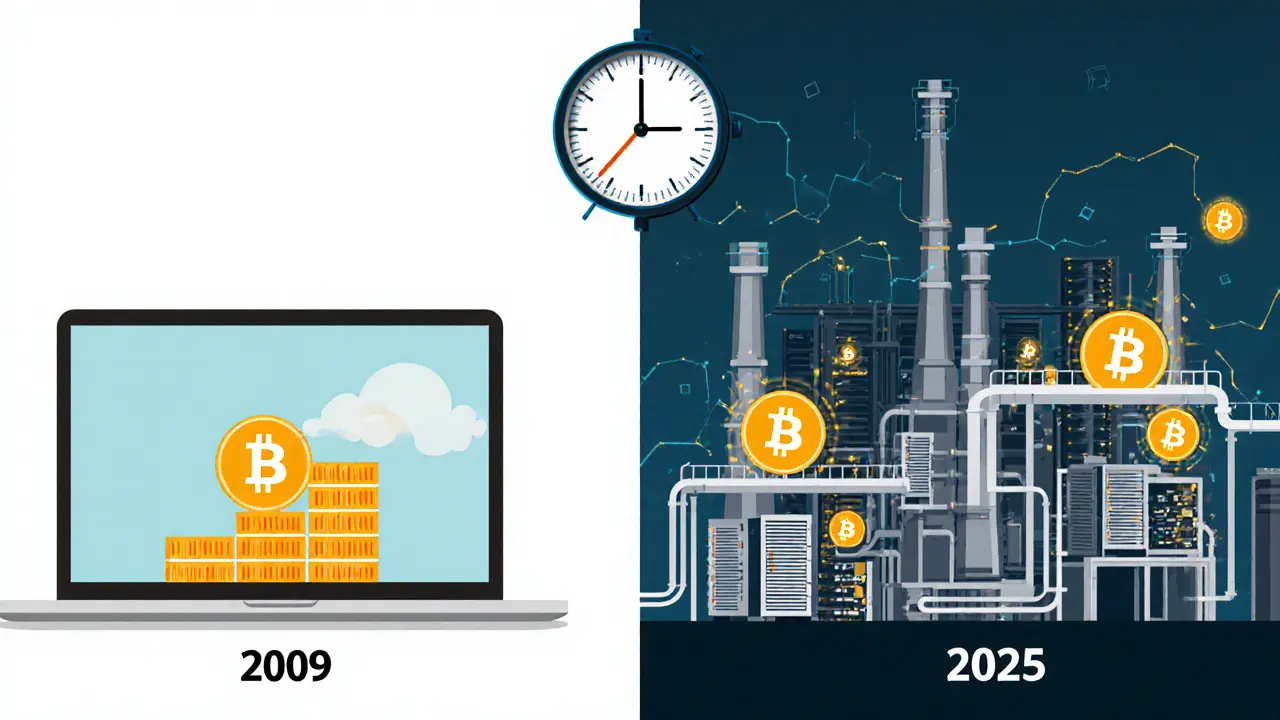
How Mining Difficulty Is Calculated in Bitcoin and Why It Matters
Bitcoin's mining difficulty adjusts every two weeks to keep block times at 10 minutes, no matter how much computing power joins the network. Understand how it works, why it matters for security and profitability, and what it means for miners today.
Details +