 If you've tried trading digital assets in India recently, you've probably noticed a small chunk of your transaction value disappearing into a tax bucket. It's not a fee from the exchange, but a government requirement. While a 1% cut might sound tiny, it's actually a powerful tool the Indian government uses to track every single move you make in the crypto market. Whether you're a casual holder or a daily trader, ignoring this can lead to some nasty surprises during tax season.
To get this straight, 1% TDS on crypto is a Tax Deducted at Source mechanism implemented under Section 194S of the Income Tax Act, 1961, requiring a 1% deduction on the transfer of virtual digital assets. It isn't a final tax on your profits, but rather a prepayment that the government uses to ensure you're reporting your crypto activity. It's a way for the tax department to say, "We know you're trading; now make sure you pay the rest of your taxes later."
How the 1% TDS Actually Works
The core idea is simple: whenever you "transfer" a Virtual Digital Asset (VDA) is a broad category including cryptocurrencies, NFTs, and other digital tokens , 1% of the total transaction value is sliced off and sent to the government. But here is the catch-the law defines "transfer" as a change of ownership. If you're just moving Bitcoin from your Coinbase account to a hardware wallet, that's not a transfer. But if you sell that Bitcoin for Rupees or trade it for Ethereum, the 1% rule kicks in.
If you use an Indian exchange like WazirX is one of India's oldest and largest cryptocurrency exchanges or CoinDCX is a popular Indian crypto trading platform focusing on compliance , they handle the heavy lifting. They deduct the tax and file the paperwork for you. However, if you're doing P2P trades or using international platforms, the responsibility falls squarely on the buyer's shoulders. You have to deduct the tax, get the seller's PAN, and file the returns yourself.
The Thresholds: Do You Actually Have to Pay?
Not everyone is hit by this tax immediately. There are two different "trigger points" depending on who you are in the eyes of the tax office. If you're a regular person-someone who doesn't need a professional tax audit-you have a higher cushion. But if you're running a business or are a high-earner subject to audits, the limit is much tighter.
| Taxpayer Category | Annual Transaction Limit | TDS Rate |
|---|---|---|
| Specified Persons (Individuals/HUFs not requiring audit) | ₹50,000 | 1% |
| Others (Companies, Audit-eligible Individuals) | ₹10,000 | 1% |
| Non-Filers (Failed to file returns for 2 prev. years) | N/A | 5% (Section 206AB) |
Keep in mind that these limits are cumulative. It's not ₹50,000 per trade; it's ₹50,000 for the entire financial year. A common mistake people make is thinking they can just stay under the limit per transaction. If you do ten trades of ₹6,000, you've crossed the ₹50,000 mark, and the tax applies.
The Hidden Cost for Active Traders
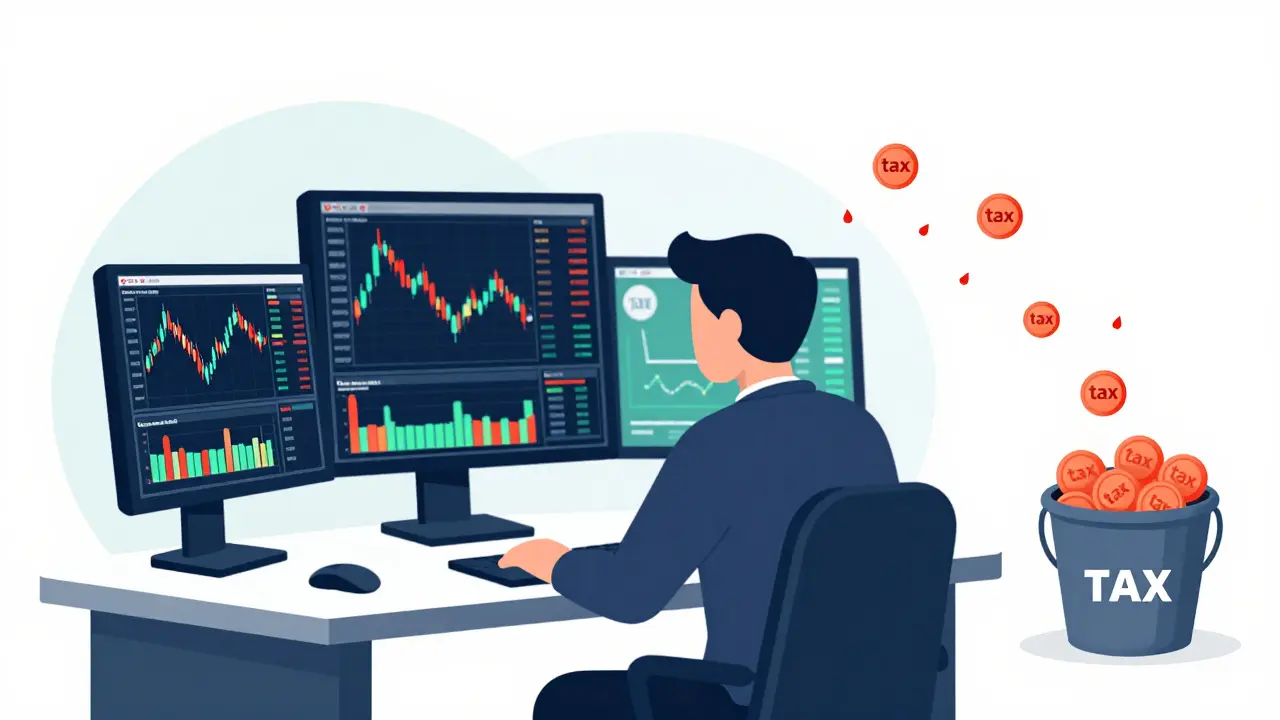
For someone buying one Ethereum coin and holding it for five years, 1% is barely noticeable. But for day traders, this rule is a nightmare. Because TDS is calculated on the transaction value and not the profit, it eats into your working capital very quickly. Imagine a trader moving ₹10,000 per trade, 100 times a month. That's ₹1,00,000 in volume. The 1% TDS takes ₹1,000 every month. Over a year, that's ₹12,000 gone from their trading balance, regardless of whether they actually made a profit or lost money on those trades.
This is even worse during crypto-to-crypto swaps. Since both the buyer and seller are essentially "transferring" an asset, 1% is deducted from both sides. Effectively, a 2% chunk of value disappears from the trade. This has led to a massive shift in behavior, with many Indian traders moving toward decentralized exchanges (DEXs) to avoid the automated claws of centralized platforms.
Dealing with the Paperwork: Form 26QE and 26AS
If you are handling your own TDS (P2P or International), you can't just send the money and forget about it. You have to use Form 26QE is the specific challan-cum-statement used to report TDS on the transfer of virtual digital assets . This form must be submitted within 30 days from the end of the month in which the tax was deducted.
To verify that the tax was actually paid and credited to your account, you need to check your Form 26AS is an annual consolidated tax statement showing all taxes deducted at source and deposited with the government . If your exchange says they've deducted TDS but it's not showing up in your 26AS, you've got a problem. This often happens due to PAN mismatches or delays in the government's processing system, which can take anywhere from 7 to 90 days.
The Bigger Picture: TDS vs. The 30% Tax
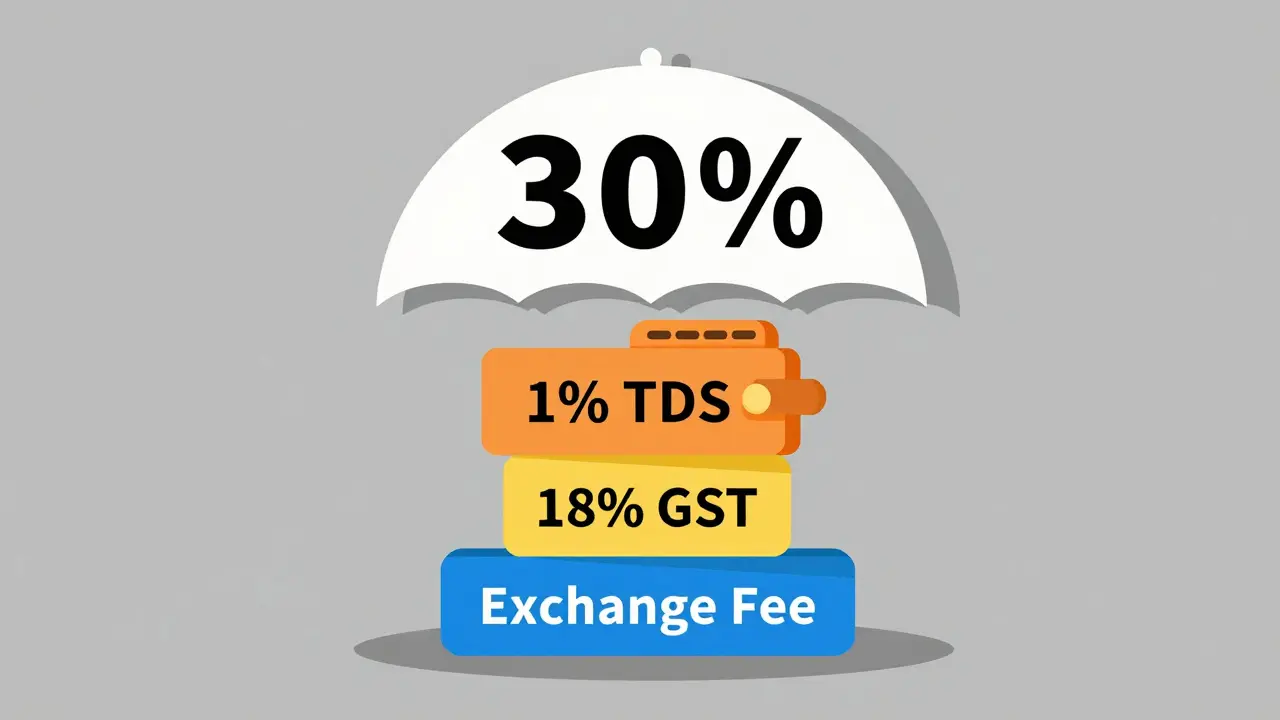
It is critical to understand that the 1% TDS is not your final crypto tax. India has one of the strictest crypto tax regimes in the world. On top of the TDS, you have to deal with a flat 30% tax on any gains you make from your digital assets. This 30% tax is governed by Section 115BBH, and the worst part is that you cannot offset your losses. If you make ₹1 lakh on Bitcoin but lose ₹1 lakh on Dogecoin, you still owe 30% tax on that first ₹1 lakh.
Adding to this complexity, as of July 2025, there is now an 18% GST on the services provided by crypto exchanges. So, if you execute a trade, you pay the exchange fee, you pay 18% GST on that fee, and the government takes 1% TDS from the trade value. It's a layered system that makes high-frequency trading incredibly expensive in India.
Common Pitfalls and How to Avoid Them
Many users struggle with the transition to this system. The most frequent error is the "PAN mismatch." If the PAN provided by the seller doesn't match the records, the TDS filing will be rejected. Another issue is the valuation of non-fiat trades. When you trade one crypto for another, you have to determine the fair market value in Indian Rupees at the exact time of the trade to calculate the 1% deduction.
- Double-check your PAN: Ensure your KYC is updated and the PAN is correctly linked to your exchange account.
- Track cumulative volume: Keep a spreadsheet of your total trade volume for the year so you know exactly when you hit the ₹10k or ₹50k limit.
- Audit your Form 26AS: Check your tax credit statement every quarter. If a deduction is missing, contact the exchange immediately.
- Separate your portfolios: Some traders use different accounts for long-term holdings and active trading to keep the administrative burden manageable.
Is 1% TDS the same as the 30% crypto tax?
No. The 1% TDS is a preliminary deduction at the time of the transaction to help the government track trades. The 30% tax is the actual income tax you pay on your profits at the end of the financial year. You can usually claim the 1% TDS as a credit against your final tax liability.
What happens if I trade on a foreign exchange like Binance?
Foreign exchanges typically do not deduct TDS automatically because they aren't registered in India. In this case, the responsibility shifts to the buyer. You must manually deduct the 1% TDS from the payment, obtain the seller's PAN, and file Form 26QE. Failure to do this can lead to penalties from the Income Tax Department.
Does the 1% TDS apply to transferring crypto between my own wallets?
No. TDS is only applicable to the "transfer" of assets, which is defined as a change of ownership (like selling or trading). Moving your own funds from one wallet to another is not a transfer of ownership and does not trigger TDS.
Can I get a refund for the 1% TDS if I made a loss?
Yes, but not immediately. Since TDS is a tax payment made on your behalf, you can claim it back as a refund when you file your annual Income Tax Return (ITR), provided your total tax liability for the year is less than the amount already deducted.
What is the penalty for not deducting TDS on P2P trades?
If you fail to deduct TDS as a buyer, you may be liable to pay the tax amount yourself, along with interest for the delay. Furthermore, the expense of the transaction might not be allowed as a deduction in your tax filings, increasing your overall taxable income.
Nitin Gupta
1 05 26 / 00:38 AMThis is a really solid breakdown of the current situation. For anyone doing P2P, please be extra careful with the PAN verification because the government doesn't take mistakes lightly on Form 26QE. It is definitely a bit of a headache for active traders, but staying compliant is the only way to avoid those massive penalties later on.
Noel Mandotah
2 05 26 / 21:20 PMAbsolute joke of a tax system.
Pramendra Singh
3 05 26 / 20:35 PMI appreciate the clarity here. Even though the rules are strict, it is good to see a guide that helps people stay on the right side of the law. Hopefully, the regulations become a bit more trader-friendly in the future!
Ipsita Seal
4 05 26 / 20:23 PMToo much reading. Just tell me if I'm going to lose money or not.
Jimmy vasquez
5 05 26 / 09:12 AMJust wanted to add that for those using DEXs, while you might avoid the automated TDS, the 30% tax on gains still applies when you eventually cash out to fiat. It's always a good idea to keep a detailed log of your entry and exit prices across all platforms to make the year-end filing a lot smoother!
Jan Conrad
5 05 26 / 10:20 AMInteresting point about the cumulative volume. I wonder if there's any legal way to structure trades to stay under the threshold without actually splitting accounts, or if the tax authorities have already closed those loopholes through the 'specified persons' definition.
Nitin Gupta
6 05 26 / 14:35 PMActually, trying to artificially split transactions to stay under the 50k limit is usually seen as tax evasion. The authorities track the PAN, so it's better to just account for the 1% from the start rather than risking an audit.
debra hoskins
7 05 26 / 14:12 PMThe whole concept of a "virtual digital asset" is such a clumsy umbrella term. It's essentially a financial dragnet designed to catch everything from a high-value piece of digital art to a meme coin with zero utility. This isn't regulation, it's just an aggressive cash grab masquerading as oversight.
Carli Bates
9 05 26 / 07:44 AMimagine paying tax on a loss because you can't offset gains... absolute peak comedy lol
edie rosa
9 05 26 / 12:14 PMIt's honestly disgusting how people try to "game" the system by moving to DEXs. If you live in a country and use its infrastructure, you have a moral obligation to contribute to the state. Avoiding TDS isn't "smart trading," it's just lack of integrity and basic civic duty.
its me
9 05 26 / 12:28 PMThe state is simply the ultimate mirror of our own greed. By taxing the movement of coins, they are taxing the very essence of digital volatility. We think we are free because we use blockchain, but we are still bound by the archaic laws of territorial sovereignty. It's a fascinating paradox of the modern era.
Amanda Macy
10 05 26 / 12:34 PMIt makes one wonder if the true value of crypto was the decentralization of power or if we've just created a new way for centralized powers to monitor us more efficiently.
Aaron Zeiler
12 05 26 / 00:32 AMfor those of you on binance or bybit just remember you are the one responsible for the tds if you are the buyer. don't wait until march to realize you owe the government money or you'll get hit with interest penalties that hurt way more than 1%
Barbara Jones
12 05 26 / 08:37 AMthanks for the guide!! i always get confussed with the 26AS form so its helpful to know exactly where to look for the credits
Rushell Perry
14 05 26 / 05:25 AMjust take it one step at a time and keep your spreadsheets updated it seems scary but once you have a system it becomes second nature