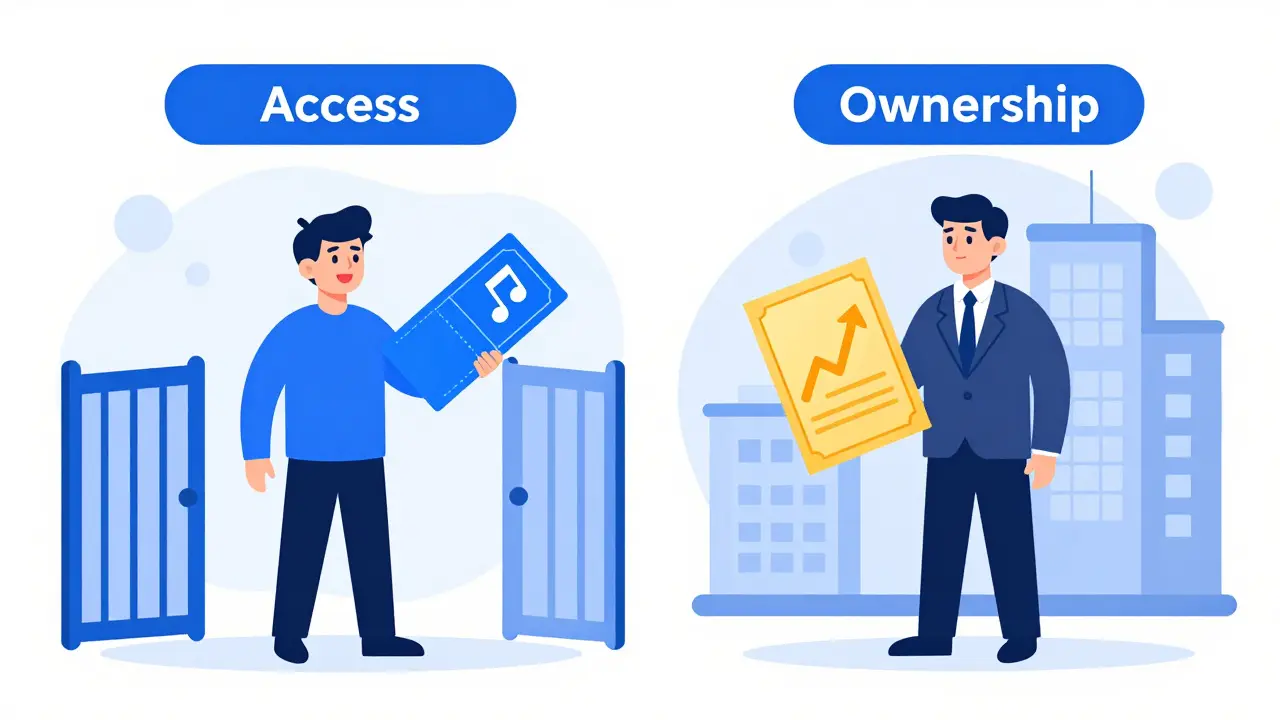
Imagine you buy a ticket to a concert. You hold that ticket to get into the venue and see the band. You don't expect the ticket seller to pay you dividends if the concert makes a profit. Now imagine you buy a share in the company that owns the venue. You aren't there for access; you are there because you believe the company will grow, and you expect your investment to appreciate in value. This simple difference-access versus ownership-is the heart of the legal distinction between utility tokens and security tokens.
In the world of blockchain, this isn't just a philosophical debate. It is the line between operating freely and facing federal prosecution. For years, the regulatory landscape was a gray area where projects could claim their digital assets were purely functional "utilities." Today, regulators like the U.S. Securities and Exchange Commission (SEC) are drawing sharper lines, often using enforcement actions rather than clear rules. Understanding whether your project or investment falls into the utility or security bucket is no longer optional-it is the single most important factor in your compliance strategy.
The Cornerstone: The Howey Test
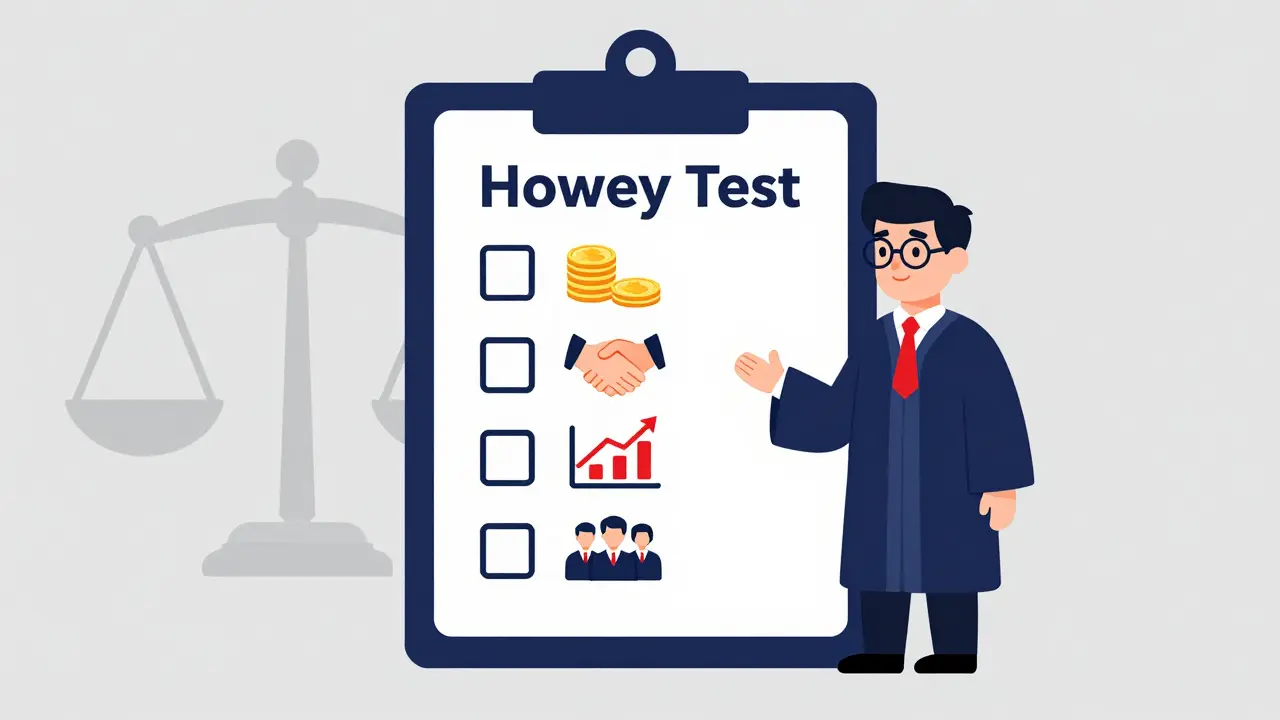
To understand why some tokens are treated as investments while others are treated as software keys, we have to look back to 1946. The Supreme Court case SEC v. W.J. Howey Co. established a four-part test to determine if an arrangement constitutes an "investment contract," which is legally defined as a security. This framework, known as the Howey Test, remains the gold standard for classification in the United States and influences regulators globally.
For a digital asset to be classified as a security under this test, four conditions must be met:
- Investment of Money: Does the buyer pay cash or other consideration for the token?
- Common Enterprise: Is the success of the investment tied to the overall success of the project or issuer?
- Expectation of Profit: Does the buyer anticipate financial returns from holding the token?
- Efforts of Others: Are those profits derived primarily from the managerial or entrepreneurial efforts of the development team or third parties?
If the answer to all four questions is yes, the token is likely a security. If the primary purpose is simply to gain access to a network's services, and the value fluctuation is secondary to that usage, it may qualify as a utility token. However, the SEC has argued that even if a token has utility, it can still be a security if investors are buying it with the expectation of profit from the developers' work.
Defining Utility Tokens: Access Over Ownership
A Utility Token is designed to provide access to a specific product or service within a blockchain ecosystem. Think of it as a digital key or a coupon. Its value is derived from its usefulness within the platform, not from a promise of future appreciation.
Key characteristics include:
- No Ownership Rights: Holding the token does not give you equity in the issuing company.
- No Dividends: You do not receive a share of the profits.
- Functional Use: The token is used to pay for transaction fees, access premium features, or participate in governance votes.
Consider Ethereum (ETH). In April 2018, the SEC stated that ETH did not constitute a security at that time because the Ethereum network was sufficiently decentralized. Users bought ETH to power smart contracts and applications on the network, not primarily to profit from the efforts of the Ethereum Foundation. Another example is IXS Token by IX Swap, which grants users access to decentralized finance trading platforms. These tokens operate largely without the heavy registration requirements of securities laws, though they still face scrutiny regarding anti-money laundering (AML) and consumer protection rules.
Defining Security Tokens: Digital Ownership
In contrast, a Security Token represents legal ownership in real-world assets (RWAs). These could be equity in a startup, debt instruments, real estate shares, or royalty rights. When you hold a security token, you are essentially holding a digitized version of a traditional financial instrument.
These tokens are issued via Security Token Offerings (STOs) and must comply with stringent securities laws. For example, Tradeflow eNote™ is a tokenized debt offering that allows investors to hold fractional interests in commercial loans. Because these tokens represent an investment contract, they trigger full regulatory oversight.
Issuing a security token means adhering to the Securities Act of 1933 for registration and the Securities Exchange Act of 1934 for ongoing reporting. This provides significant investor protection but comes at a steep price. As of mid-2023, legal compliance costs for issuing a security token in the U.S. ranged from $100,000 to $500,000, according to data from InvestaX. Furthermore, sales are often restricted to accredited investors-individuals with high net worth or income-to protect less sophisticated buyers from potential losses.
Comparative Analysis: Utility vs. Security
| Feature | Utility Token | Security Token |
|---|---|---|
| Primary Purpose | Access to services/products | Investment/Ownership stake |
| Regulatory Status | Largely unregulated (subject to AML/tax) | Heavily regulated (Securities Laws) |
| Profit Expectation | Not the primary driver | Expected return on investment |
| Issuance Cost | $20,000 - $100,000 | $100,000 - $500,000+ |
| Time to Launch | 3-6 months | 9-18 months |
| Target Audience | Retail users, developers | Accredited/Institutional investors |
| Example | Ethereum (ETH), Filecoin (FIL) | Tradeflow eNote, Real Estate Tokens |
The Danger Zone: Marketing and Economic Substance
Here is where many projects stumble. The label you put on your token doesn't matter as much as how you sell it. Dr. David Lee, Chief Legal Officer at InvestaX, notes that "the determining factor is not the token's name but its economic substance and how it's marketed to investors."
If a project markets its utility token by emphasizing potential price appreciation, promising rewards based on platform growth, or highlighting the team's exclusive role in driving value, regulators will likely view it as a security. Gary Gensler, Chairman of the SEC, has repeatedly stated that "most tokens are securities" because they rely on the centralized efforts of a founding team to create value.
A stark example is Kik Interactive. In 2019, the SEC penalized Kik $5 million for conducting an unregistered securities offering through its Kin token ICO. Although Kik claimed Kin was a utility token for its ecosystem, the marketing materials focused heavily on the token's speculative value and the team's efforts to build demand, triggering the Howey Test criteria.
Global Regulatory Landscape: Beyond the U.S.
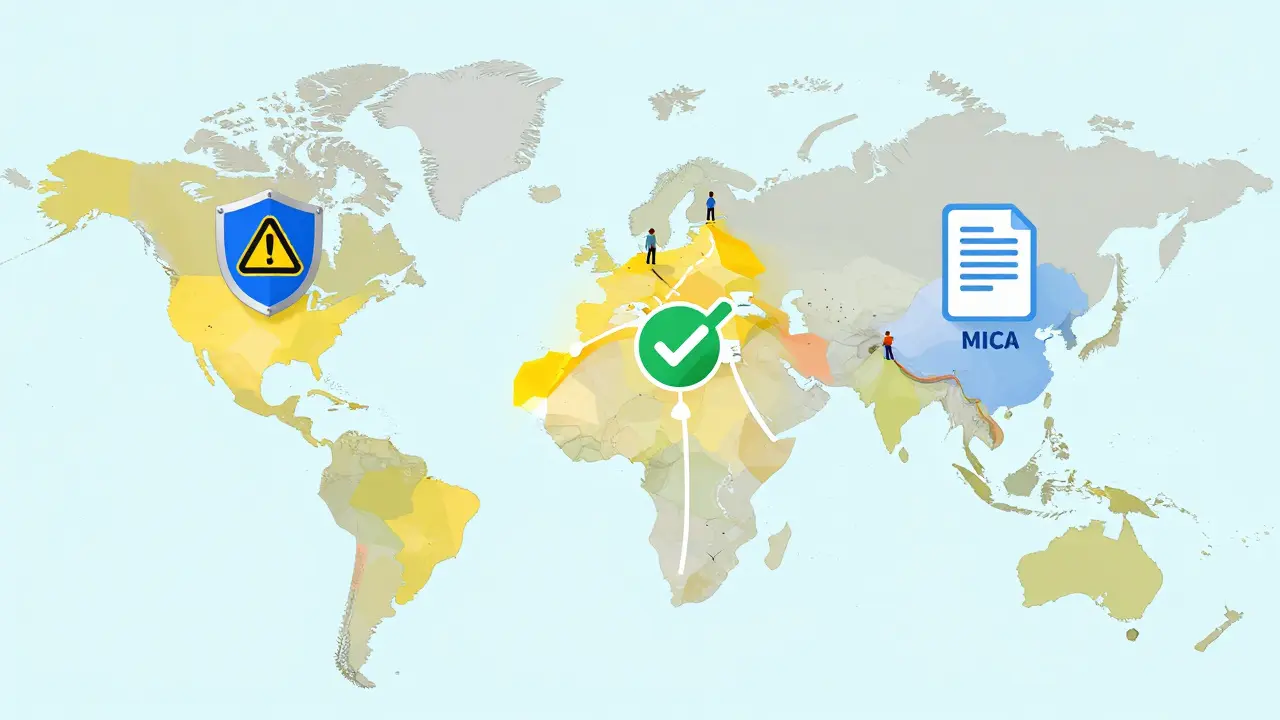
While the U.S. approach is aggressive, other jurisdictions offer clearer paths. Switzerland’s Financial Market Supervisory Authority (FINMA) provides detailed guidelines classifying tokens into payment, utility, and asset tokens. Asset tokens are treated as securities, while utility tokens are exempt if they serve a genuine function. FINMA’s clarity has made Switzerland a hub for compliant blockchain innovation. Similarly, Singapore’s Monetary Authority (MAS) applies a similar framework, focusing on whether the token functions as a capital-raising instrument. Meanwhile, the European Union’s MiCA (Markets in Crypto-Assets) regulation, fully effective by late 2024, establishes a comprehensive regime that distinguishes between crypto-assets serving as means of exchange and those representing financial instruments. The U.S. House of Representatives passed the FIT21 Act in May 2024, aiming to provide clearer exemptions for utility tokens. However, until this becomes law and is implemented, the SEC’s enforcement-based approach remains the de facto standard, creating uncertainty for developers who spend 40-60% of their design budget on legal compliance.
Practical Steps for Compliance
If you are building a blockchain project, here is how to navigate this minefield:
- Consult Specialized Counsel Early: Do not wait until launch. Blockchain attorneys can help structure your tokenomics to avoid triggering the "common enterprise" and "efforts of others" prongs of the Howey Test.
- Decentralize Quickly: The more decentralized a network becomes, the less likely it is to be seen as relying on the "efforts of others." Ethereum’s status shifted once the network became truly distributed.
- Avoid Profit Promises: Never market your token as an investment. Focus on utility, usage metrics, and community governance.
- Implement Vesting Schedules: Time-locked vesting for team and advisor tokens demonstrates a long-term commitment to the project’s utility rather than a quick cash-out scheme.
- Consider Hybrid Models: Some projects, like Avalanche’s subnets, use dual-token systems. One token handles utility and gas fees, while another handles governance or staking, carefully separating functions to mitigate risk.
Future Outlook: Convergence and Clarity
The market is evolving. The global security token market is projected to reach $22.5 billion by 2025, driven by institutional demand for regulated exposure to digital assets. Conversely, utility tokens continue to dominate decentralized finance (DeFi), with over $40 billion locked in protocols. We are seeing a shift toward hybrid models and clearer jurisdictional boundaries. The EU’s MiCA and potential U.S. legislative changes like the Digital Asset Securities Act aim to replace "regulation by enforcement" with bright-line rules. For now, however, the burden of proof lies with the issuer. If you cannot clearly demonstrate that your token’s value is derived from its utility rather than speculation on the team’s efforts, assume it is a security. That assumption alone can save you from costly litigation and reputational damage.
What is the main difference between a utility token and a security token?
The main difference lies in the purpose and expectation. A utility token provides access to a product or service within a blockchain ecosystem, similar to a ticket or coupon. A security token represents ownership in an asset or company and offers the expectation of profit derived from the efforts of others, making it subject to securities laws.
How does the Howey Test apply to cryptocurrency?
The Howey Test determines if an asset is an investment contract (security). It asks if there is an investment of money in a common enterprise with a reasonable expectation of profits derived from the efforts of others. If a crypto token meets all four criteria, it is classified as a security by the SEC.
Is Bitcoin considered a utility or security token?
Bitcoin is generally not considered a security. The SEC has indicated that due to its high level of decentralization and lack of a central developing team whose efforts drive its value, it does not meet the "efforts of others" criterion of the Howey Test. It is often treated as a commodity.
Can a utility token become a security token later?
Yes. Classification is not static. If a project initially launches as a utility token but later markets it with promises of profit or relies heavily on a centralized team to drive value, regulators may reclassify it as a security. This happened with several ICOs from 2017-2018 that faced enforcement actions years later.
Why are security tokens more expensive to issue?
Security tokens require strict compliance with securities laws, including registration with the SEC, extensive legal documentation, audits, and ongoing reporting obligations. This process involves hiring specialized lawyers, accountants, and compliance officers, costing between $100,000 and $500,000+ compared to the lower costs of utility token launches.
mark valmart
29 05 26 / 10:18 AMhonestly this is just the usual crypto bro fear mongering wrapped in legal jargon
Crystal Davis
30 05 26 / 03:17 AMYou clearly haven't read the actual SEC filings or the Howey test case law if you think it's just 'fear mongering.' The distinction is black and white when you look at the economic substance. If you are buying a token because you expect the team to make it go up, it is a security. Period. Stop pretending that 'utility' is a magic shield against securities laws when your marketing materials scream 'investment opportunity.' It’s not complex, it’s basic contract law.
kamal ifrani
30 05 26 / 14:39 PMOh wow, another self-proclaimed expert here acting like they invented compliance. 🙄 You people are so obsessed with rules that you forget why we built blockchain in the first place-to escape this exact kind of bureaucratic nightmare. The SEC is just trying to tax innovation into oblivion. Calling everything a security is lazy regulation for lazy regulators who don't understand code. We don't need their permission to build value. Your moral high ground is showing, but honestly, it’s just pathetic. You’re protecting investors by stifling progress. Typical establishment mindset. Disgusting.
Bill Gunn
31 05 26 / 04:15 AMLook, I get the frustration, Kamal, but ignoring the law doesn't make it go away 😅 The reality is that projects like Kik learned the hard way that marketing matters more than intent. If you want to build freely, decentralize early and often. That’s the only real hack. But yeah, the cost of compliance is insane for small teams 💸
Hadleigh Edwards
31 05 26 / 06:16 AMI have been following the space since the very beginning of the ICO boom back in 2017, and what strikes me most about the current landscape is how the narrative has shifted from pure technological utopianism to a much more grounded, albeit frustrating, reality of regulatory navigation, which forces developers to spend an exorbitant amount of their limited resources on legal counsel rather than actual code development, thereby slowing down the pace of innovation significantly, yet one must acknowledge that the clarity provided by frameworks like MiCA in Europe offers a beacon of hope for those willing to operate within defined boundaries, suggesting that perhaps the chaos we see now is merely the growing pains of a new asset class finding its footing in the traditional financial ecosystem, and while the costs are indeed prohibitive for many, the long-term viability of any project likely depends on its ability to survive these initial hurdles and establish a legitimate foothold in the market.
saradee dee
1 06 26 / 13:51 PMOh my gosh, Hadleigh, you really went there! 😱 It is so dramatic how complicated this all feels right now. I was reading this article and my mind was blown by how much money you actually need just to start something. It feels like such a barrier for normal people who just want to create cool things. I mean, who has half a million dollars just to ask nicely? It makes me feel so helpless and confused about where we are going. But also, maybe that’s good? Maybe it keeps the bad actors out? I don’t know, I’m just so overwhelmed by the legal talk. It’s scary but also fascinating how the rules are changing every day. We need more peace and less fighting over definitions!
Craig Swanson
3 06 26 / 01:48 AMSara, listen to me closely. You are letting the complexity intimidate you when you should be using it as a filter. If you can't afford the compliance, you shouldn't be issuing a security period. It’s that simple. The market needs quality control. Those $500k fees are the price of admission to the big leagues. If you’re building a utility, prove it. Don’t whine about the rules; master them. Most projects fail because they’re lazy, not because the law is too hard. Get it together.
Debbie Lewis
4 06 26 / 11:46 AMI just sit back and watch this circus. Everyone arguing about tokens while the tech barely works half the time. Chill out guys.
Eric Grosso
5 06 26 / 12:26 PMi dont get why everyone is so hung up on the word security vs utility. isnt it just about what u do with it? if i use it to pay for gas its utility right? but if i hold it hoping it goes up is it then a security? thats crazy how the same coin can be both depending on ur mindset lol. the sec seems to think they own everything tho. kinda wild.
Dana Rapoport
6 06 26 / 22:34 PMThe philosophical implication here is profound. We are witnessing the collision of two distinct paradigms: the decentralized ethos of peer-to-peer value exchange and the centralized imperative of investor protection. To view the token solely through the lens of its function ignores the social contract embedded in its distribution. When we ask whether a token is a security, we are truly asking whether we trust the community to govern itself or if we require the state to enforce accountability. The reserved nature of this debate belies its intensity. We must consider that the definition of 'value' itself is shifting. Is value derived from consensus and usage, or from legal entitlement and profit expectation? These are not just legal questions; they are existential questions for the digital age.
Sam Dashti
7 06 26 / 06:24 AMI've always wondered, does the geographical location of the developer change the game entirely? Like, if I'm in Switzerland or Singapore, am I playing by a completely different set of rules compared to someone in New York? It seems like the US is trying to regulate the entire internet while other places are just trying to figure out how to tax it. What's the vibe in those other jurisdictions? Are they actually welcoming or just waiting for the US to slip up?
Edith Mair
8 06 26 / 04:56 AMSam, you're missing the point. The US sets the global standard because of the size of its capital markets. Even if you launch in Switzerland, if you target US investors, you're dead. The extraterritorial reach of the SEC is massive. You aren't safe just because you're offshore. The question isn't about the vibe; it's about enforcement capability. And right now, they have plenty of it. So yes, the rules are different, but the risk profile for anyone touching USD or US citizens remains incredibly high. Don't be naive about jurisdictional arbitrage.