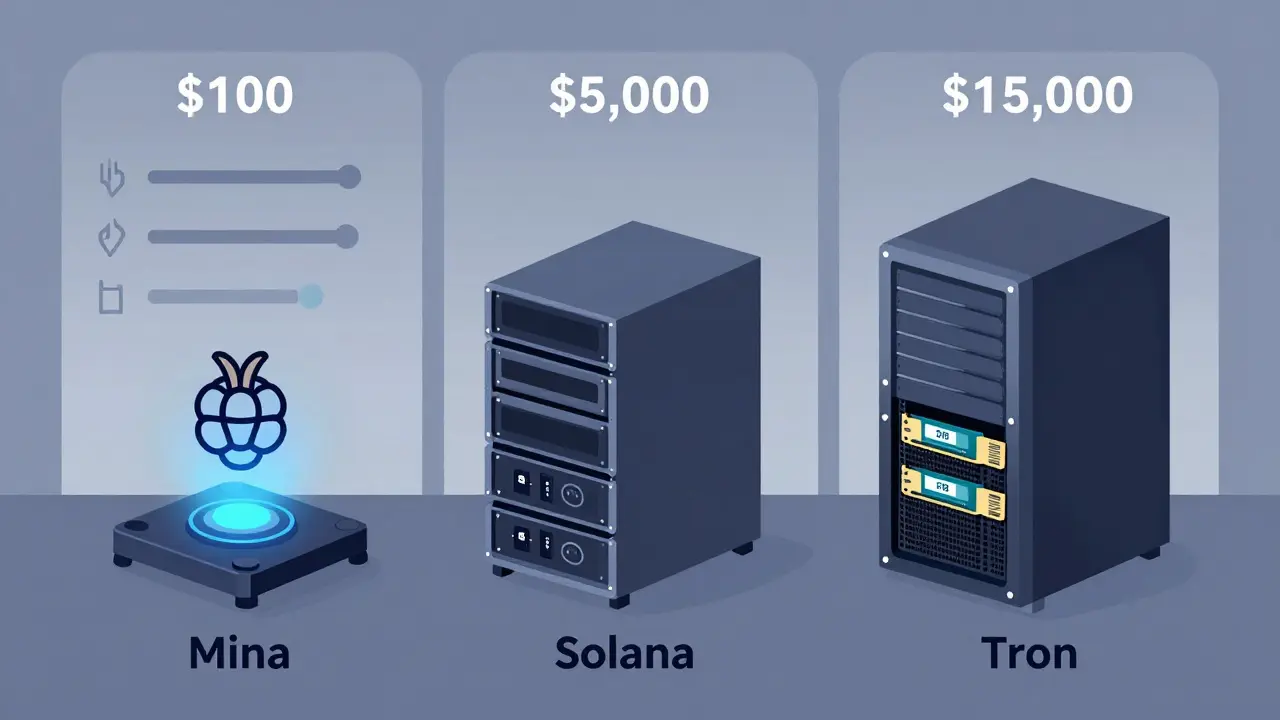
Running a validator on a blockchain isn’t just about having a computer and some crypto. It’s a high-stakes operation that demands serious hardware, deep financial commitment, and constant technical upkeep. What works for Ethereum won’t cut it for Solana or Tron. And if you think you can just stake a few tokens and earn passive income, you’re missing the full picture. The real cost isn’t just the tokens you lock up-it’s the electricity bills, the server failures, the missed votes, and the competition for rewards.
Hardware: Not All Blockchains Are Created Equal
The specs needed to run a validator vary wildly. On Ethereum, you need a machine with at least a quad-core processor, 32 GB of RAM, and a 4 TB NVMe SSD. That’s powerful, but it’s nothing compared to what Solana demands. Solana validators need 12-core CPUs running at 2.8 GHz or faster, with support for SHA and AVX2 instructions. They also require 256 GB of ECC RAM and separate SSDs for accounts (500 GB), ledger (1 TB), and snapshots (250 GB). Total storage? Roughly 2.25 TB. And you need symmetric 1 Gbps internet-no throttling, no caps. Physical setups cost $2,600 to $5,000 just for hardware. Cloud solutions? Around $4,500 a year.
Tron is even more extreme. Regular validators need 16-core CPUs at 3.0 GHz or higher-like the AMD Ryzen 7950x3D. Super Representatives? That’s 32-core AMD EPYC chips, 128 GB of RAM, and at least 3 TB of NVMe storage. These aren’t upgrades. They’re entire new machines built for one purpose: keeping up with Tron’s block speed.
Mina Protocol flips the script. Instead of storing the full blockchain, it uses zk-SNARKs to compress history into tiny proofs. That means validators can run on modest hardware-something like a Raspberry Pi 4 with 8 GB RAM. No massive SSDs. No insane bandwidth. Just lightweight verification. This is why Mina is one of the few blockchains where home validators can still compete.
Staking: The Real Entry Barrier
Hardware is one thing. Staking is another. And here, the numbers get brutal.
Ethereum requires exactly 32 ETH to activate a validator. At current prices, that’s about $84,000. No exceptions. No workarounds. If you don’t have that much, you can’t run your own validator-you can only delegate to someone who does.
Sui Network? It’s worse. You need 30 million SUI tokens just to qualify. That’s over $15 million USD. This isn’t a network for individuals. It’s built for institutions.
On Cosmos, it’s not about the minimum-it’s about the competition. Only the top 180 validators by stake get to produce blocks. Right now, you need roughly 33,052 ATOM to stay in the top tier. That’s about $500,000. And if someone else stakes more, you get pushed out. It’s a constant arms race.
Solana lets you stake as little as 1 SOL. But here’s the catch: you won’t make a profit. According to Cogent Crypto’s calculator, the minimum profitable stake is 5,700 SOL-around $934,000. Why? Because every vote you submit costs you 0.0001 SOL. And you vote every slot. That adds up to 1.1 SOL per day in fees alone. If you’re not staking enough to cover that, you lose money.
Avalanche is more accessible. You can run a validator with 2,500 AVAX, or delegate with just 25 AVAX. That’s about $125,000 and $1,250 respectively. Still not cheap, but it’s the only major chain that offers a real middle ground.
Operational Costs: The Hidden Tax
Most people forget: validators pay transaction fees too. Every time you vote, every time you propose a block, you pay gas. On Solana, that’s 1.1 SOL daily. At $165 per SOL, that’s $185 a day. $5,500 a month. That’s not a fee-it’s a payroll. And if your node goes offline for even 10 minutes, you miss votes. Miss votes? You get slashed. Lose rewards. Lose trust.
Binance Smart Chain (BSC) runs on Proof of Staked Authority. There are only 41 active validators out of 63 candidates. They split 90% of transaction fees, which hit $14.59 million in February 2024. But here’s the twist: BSC’s validators are mostly large operators-exchanges, hedge funds, and infrastructure firms. A solo operator has almost no shot.
On Ethereum, the cost isn’t in fees-it’s in uptime. If your validator is offline for more than 24 hours, your rewards drop. Miss too many attestations? You get slashed. Your stake gets reduced. The penalty isn’t just financial-it’s reputational. Delegators avoid validators with poor uptime.
Consensus Mechanisms: How Validators Are Chosen
Not all validators work the same way. The consensus mechanism determines who gets to participate and how.
Ethereum, Cardano, and Polkadot use pure Proof of Stake. Validators are chosen based on how much they stake and how long they’ve been online. More stake = higher chance of being selected.
Tron and EOS use Delegated Proof of Stake (DPoS). Token holders vote for representatives. In Tron, only 27 validators produce blocks. 127 others sit on standby. To win a seat, you need community trust, marketing, and a solid reputation-not just money.
Solana combines Proof of Stake with Proof of History. This requires validators to timestamp transactions with cryptographic proofs. That’s why you need AVX2 and SHA support. Without it, your node can’t keep up.
Hyperledger Fabric and Ripple use Byzantine Fault Tolerance. These aren’t public chains. They’re enterprise networks where validators are pre-approved. No staking. No competition. Just trust.
Who’s Really Running These Validators?
It’s not hobbyists anymore. It’s companies.
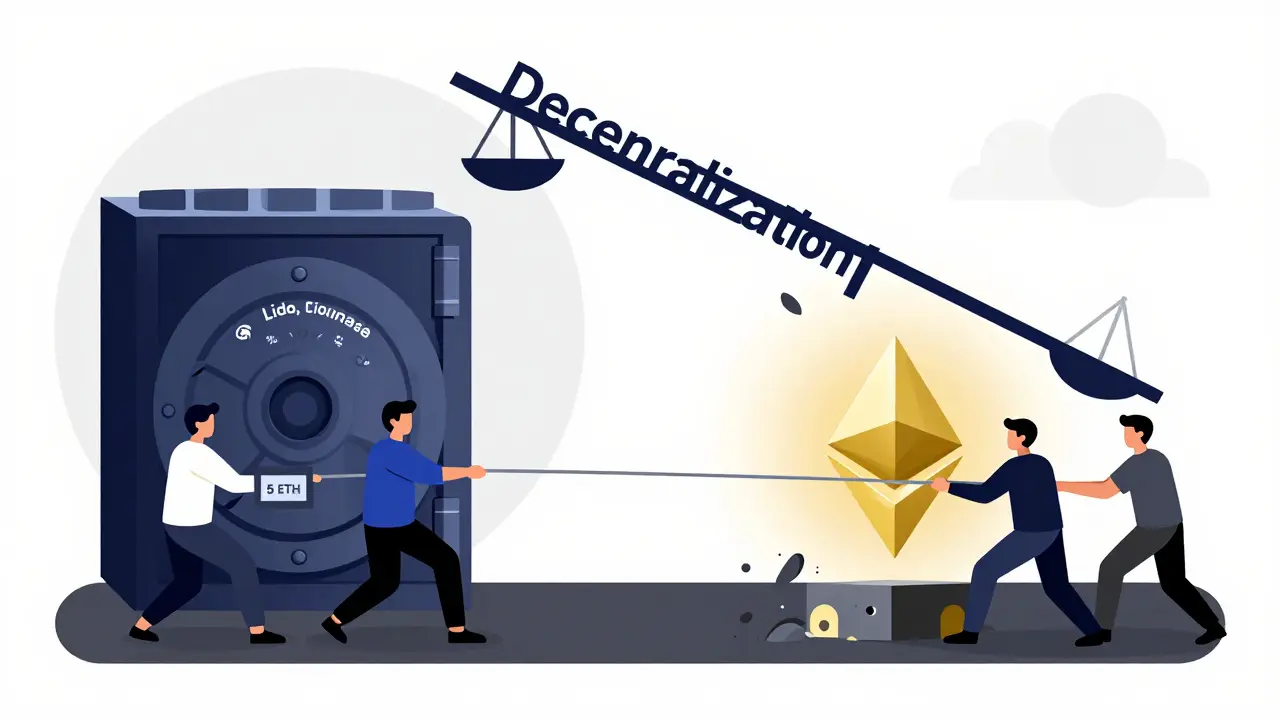
On Ethereum, over 70% of validators are run by professional staking providers like Lido, Coinbase, and Kraken. Individuals who try to run their own often get outcompeted by automated systems with redundant servers, global CDNs, and 24/7 monitoring.
Solana’s ecosystem is similar. The top 10 validators control nearly 40% of the total stake. They’re backed by venture capital, cloud infrastructure teams, and DevOps engineers. A single person with a home server? They’re not just outgunned-they’re obsolete.
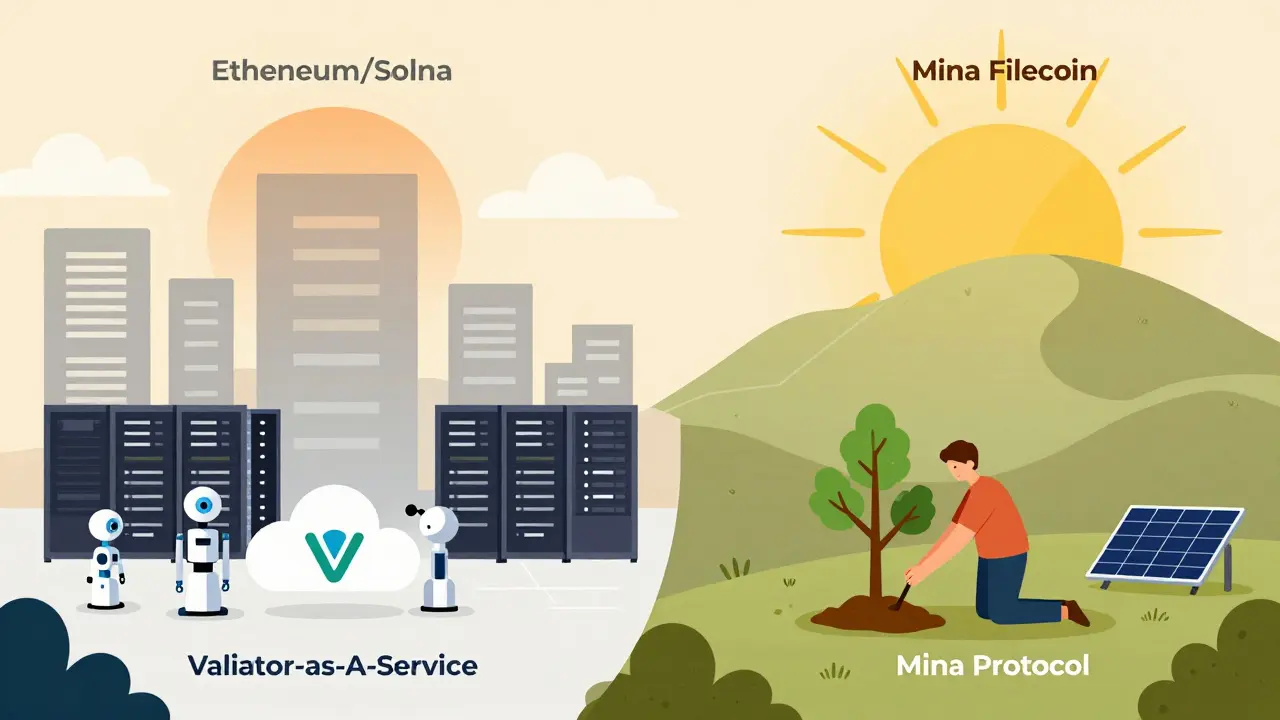
That’s why validator-as-a-service platforms are growing. Companies like Figment, Ankr, and Allnodes let you stake without managing hardware. But here’s the trade-off: you pay 10-20% in fees. Your rewards go down. Your control vanishes. You’re outsourcing your security to someone else.
Future Trends: What’s Changing
Validator requirements are only getting harder. Hardware specs keep rising. Staking thresholds climb. And decentralization is slipping.
On Ethereum, the number of validators has grown past 800,000. Sounds decentralized? Not really. The top 10 staking pools control over 50% of the network. That’s not a democracy-it’s an oligarchy.
Liquid staking is making things worse. Protocols like Lido let you stake 0.1 ETH and get a token (stETH) in return. You can trade it. Use it in DeFi. But you’re not a validator. You’re a passive investor. The real power is still with the big players.
Regulation is coming. In the U.S., the IRS treats staking rewards as taxable income. In the EU, MiCA requires staking providers to be licensed. That means more compliance, more cost, more barriers.
The only path forward for small operators? Specialized networks. Mina. Filecoin. Some newer Layer 2s. These chains are designed for low-resource participation. They’re not the biggest. But they’re the fairest.
So, Should You Run a Validator?
If you have $100,000+ to lock up, access to enterprise-grade hardware, and a team that can monitor uptime 24/7-then yes. Go for it.
If you’re trying to make a few extra bucks by staking 5 ETH on your laptop? You’re not a validator. You’re a target.
The blockchain world doesn’t reward effort. It rewards scale, infrastructure, and capital. The dream of decentralized, individual-run validators? It’s fading. The reality? It’s a corporate race.
What’s the cheapest blockchain to run a validator on?
Mina Protocol is currently the most affordable. Its zk-SNARK design lets validators run on low-end hardware-like a Raspberry Pi-with minimal storage and bandwidth. There’s no massive staking requirement either. You can participate with a few hundred dollars worth of MINA tokens. It’s not profitable in the way Solana or Ethereum are, but it’s the only chain where a home user can still meaningfully contribute.
Can I run multiple validators on one machine?
Technically yes, but it’s risky. Ethereum allows it, but if one validator goes offline, it can affect others on the same machine. Solana and Tron strongly discourage it because of hardware strain. If your CPU overheats or your SSD fails, you lose all validators at once. Most professionals run each validator on a separate server with independent power and network paths. It’s expensive, but it’s the only way to avoid catastrophic downtime.
Do I need to be technical to run a validator?
Absolutely. You need to know how to set up Linux servers, configure firewalls, manage SSH keys, monitor system logs, and troubleshoot network latency. Many validators fail because they didn’t understand how to update their software or how to respond to fork events. If you’re not comfortable with the command line, you shouldn’t run a validator. Use a staking service instead.
What happens if my validator goes offline?
It depends on the blockchain. On Ethereum, you lose a small portion of your staked ETH for each missed attestation. If you’re offline for more than 24 hours, penalties compound. On Solana, you lose vote rewards and get slashed if you submit conflicting votes. On Tron, you drop out of the top 27 and lose block production rights. In all cases, your reputation suffers. Delegators will pull their stake. Recovery takes time.
Is staking on Ethereum worth it anymore?
It depends on your goals. If you’re looking for passive income, Ethereum’s current APY is around 3-5%. That’s lower than some centralized crypto savings accounts. But Ethereum’s value is in its network effect. If ETH’s price rises, your staked ETH grows. It’s not about the rewards-it’s about holding a core piece of the most secure blockchain. For most, it’s a long-term bet, not a short-term profit.
Steven Lefebvre
6 03 26 / 14:53 PMI’ve been running a Solana validator for 8 months now. The hardware costs alone nearly broke me. But honestly? The real kicker is the daily vote fees. You think you’re earning rewards, but you’re just paying to play. If you’re not staking at least 5k SOL, you’re losing money. And don’t even get me started on the bandwidth throttling from your ISP.
Christina Young
7 03 26 / 03:22 AMMina Protocol on a Raspberry Pi? Cute. That’s not validation. That’s a demo. Real validators don’t run on toys. If you can’t afford a $3k server, you shouldn’t be in this game.
nalini jeyapalan
8 03 26 / 07:08 AMYou people are missing the point. The blockchain isn’t meant for you. It’s for institutions. If you’re trying to run a validator with less than $50k, you’re not decentralizing anything-you’re just creating a single point of failure. Stop pretending you’re a node operator. You’re a liability.
Jackson Dambz
9 03 26 / 14:41 PMThe notion that individual validators can meaningfully contribute to network security is a myth perpetuated by blockchain evangelists with no operational experience. The data is unequivocal: over 80% of Ethereum validators are operated by three entities. The rest are noise.
jay baravkar
11 03 26 / 01:18 AMY’all are overcomplicating this. If you want to stake, use Lido. If you want to feel like a real validator, go buy a server. But don’t cry about it. The system works. You’re just not built for it. 💪
Ian Thomas
12 03 26 / 06:17 AMSo we’ve turned the dream of decentralized finance into a corporate arms race where only the wealthiest can afford to play. And we call this innovation? I’m starting to think the real blockchain revolution was when we stopped believing in peer-to-peer and started believing in venture capital.
Bonnie Jenkins-Hodges
12 03 26 / 21:12 PMAmerica built this. You think some guy in Canada with a Raspberry Pi is gonna out-decentralize Coinbase? Get real. The future belongs to the U.S.-based infrastructure providers. Period.
Drago Fila
13 03 26 / 18:28 PMI started with 1 ETH on my old laptop. Got slashed twice. Lost $1,200. Then I switched to Mina. Ran it on a Pi 4. No drama. No overheating. Just quiet, steady participation. Yeah, I don’t get rich. But I sleep well knowing I’m not part of the problem. You don’t need a fortune to be part of the network. Just a little patience and a decent router.
Melissa Ritz
15 03 26 / 11:54 AMI read this whole thing. Honestly? It’s depressing. The only thing more ironic than trying to decentralize finance with $50k minimums is calling it "decentralized" at all. We’ve built a new aristocracy. And it’s wearing crypto bros like a costume.
Jeffrey Dean
16 03 26 / 13:53 PMIf the blockchain is meant to be trustless, why do we need 12-core CPUs and 256GB of ECC RAM to verify a transaction? This isn’t evolution. It’s a corporate power grab dressed up as progress. The more we optimize for performance, the more we abandon the original ethos. We’re not building a network. We’re building a monopoly.
James Burke
16 03 26 / 23:58 PMFor real though-Mina’s the only one that gets it. Lightweight, low barrier, no ego. You don’t need to be a sysadmin to help secure the network. Just a decent internet connection and a willingness to show up. That’s the spirit we lost somewhere between Ethereum 1.0 and Solana 2.0.
Megan Lutz
18 03 26 / 13:09 PMThe hardware specs are irrelevant. The real issue is economic centralization. Even if you could afford the server, you still need to compete with staking pools that have automated failover, multi-region redundancy, and legal teams. The system isn’t broken-it’s designed that way. And it’s working exactly as intended.
Jonathan Chretien
18 03 26 / 21:16 PMI run 3 validators on one machine. No one’s ever said a word. I’ve got 10k SOL, 2k AVAX, and 50 ETH. All on a single 16-core Ryzen with 128GB RAM. It’s stable. It’s efficient. The fearmongering about "single point of failure" is just FUD from people who can’t afford to scale. If you’re scared of a server crash, maybe crypto isn’t for you.