
Imagine a world where your private conversations aren't stored on a corporate server in Silicon Valley or scanned by a government agency. Most of us use apps that claim to be secure, but the reality is that a few big companies hold the keys to our digital lives. ADAMANT Messenger is a decentralized anonymous messaging platform built on blockchain technology designed to operate without any central authority. By removing the middleman, it aims to give users total control over their data and communication.
The Core of the ADM Ecosystem
To understand how the app works, you first need to know about the ADM token. This isn't just a coin you trade on an exchange; it's the fuel for the entire network. The system runs on a delegated Proof of Stake (or dPoS) consensus mechanism. Instead of massive warehouses of computers mining coins and wasting electricity, ADM uses a voting system. Token holders vote for forging pools, and these pools validate transactions and secure the network.
If you're into the technical side, the network is impressively lean. It has a 5-second block time, meaning transactions and messages are confirmed almost instantly. Because the code is open-source, anyone can inspect it to make sure there are no hidden "backdoors" for spies or hackers. This transparency is the bedrock of trust in the crypto world.
Key Features That Set It Apart
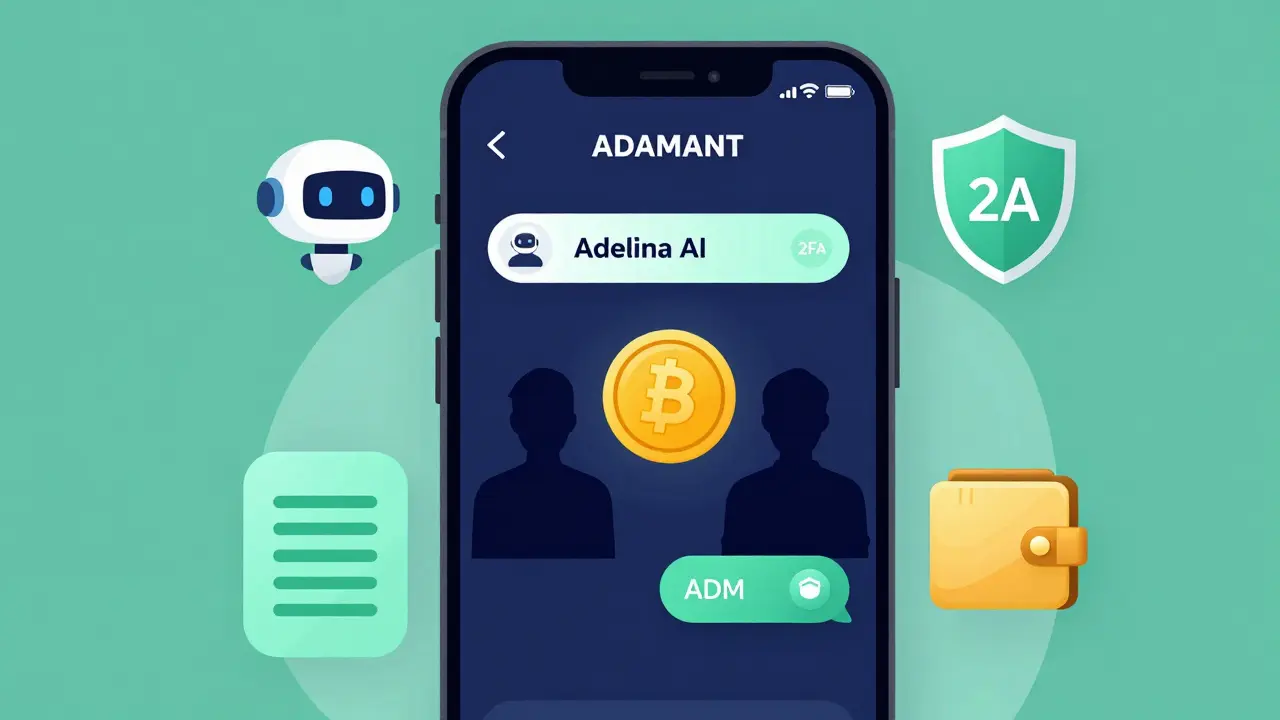
Most messengers just send text. ADAMANT tries to be a Swiss Army knife for privacy. One of the standout features is the integrated cryptocurrency wallet. You don't have to leave the app to send funds; you can transfer crypto directly within the chat interface. It's basically like sending a text message, but the "message" is actual value.
They've also baked in some advanced security tools:
- Blockchain-based 2FA: Standard two-factor authentication often relies on SMS, which can be intercepted. ADAMANT uses the blockchain to verify your identity.
- Internal Exchanger: You can swap other cryptocurrencies for ADM right inside the app, though the platform often prices this as a donation to the ADAMANT Foundation.
- Adelina AI: An integrated chatbot designed to help users navigate the ecosystem.
- Private Blockchains: While the main network is public, businesses can set up their own isolated blockchains for corporate secrets.
How ADM Tokens Actually Gain Value
You might wonder why a messenger needs a coin at all. In a centralized app like WhatsApp, the "cost" is your data. In ADAMANT, the cost is a small fee paid in ADAMANT Messenger tokens. These fees cover the operational costs of the people running the network delegates. This creates a direct link: the more people use the messenger, the more ADM tokens are required to send messages, which theoretically drives up demand.
| Attribute | Value |
|---|---|
| Current Price | $0.01119 - $0.0114676 USD |
| Circulating Supply | 110.37 Million ADM |
| Market Cap | ~$1.21M - $1.3M USD |
| All-Time High (ATH) | $0.060220 |
| Block Time | 5 Seconds |
Accessibility and Anonymity
A privacy tool is useless if it's hard to access. ADAMANT is available on iOS and Android, but the real power lies in its web application and Tor network access. If you're using the Tor browser, you can hide your IP address entirely, making it nearly impossible for anyone to track where your messages are coming from.
This multi-layered approach is designed for people who aren't just "casual" privacy seekers, but those who need absolute censorship resistance-journalists, activists, or businesses handling highly sensitive intellectual property.

The Reality Check: Risks and Challenges
It's not all sunshine and rainbows. If you look at the numbers, ADAMANT is a niche project. With a market cap around $1.3 million, it's a tiny fish in a sea of giants like Bitcoin or Ethereum. The price has dropped significantly from its all-time high, and trading volumes are relatively low. This means the coin is volatile; a few large trades can swing the price wildly.
The biggest hurdle for ADAMANT isn't the tech-it's adoption. For a decentralized network to be truly resilient, it needs thousands of nodes and millions of users. Right now, it serves a dedicated community of privacy enthusiasts, but it hasn't hit the mainstream. If you're looking at ADM as an investment, you're betting on the future of decentralized communication, not on a "safe" blue-chip asset.
Is ADAMANT Messenger really anonymous?
Yes, it is designed for anonymity. By using a decentralized blockchain and offering Tor network access, it removes the need for a central server that logs user IP addresses or personal phone numbers, which are common in traditional apps.
How do I earn ADM tokens?
You can earn ADM through the dPoS mechanism. By voting for forging pools or operating your own delegate node, you can participate in the validation of the network and receive rewards in the form of new tokens.
Can I use ADM for business?
Absolutely. ADAMANT supports the creation of private blockchains. This allows companies to have their own secure, isolated communication network while still benefiting from blockchain's immutable record-keeping.
What is the purpose of the internal exchanger?
The internal exchanger allows users to convert other cryptocurrencies into ADM without leaving the app. This makes it easier for new users to get the tokens they need to pay for message transmission fees.
Is it safe to hold ADM coins?
Like any small-cap cryptocurrency, ADM is high-risk. While the technology is sound, the low liquidity and volatility mean you should only invest what you can afford to lose.
Next Steps for New Users
If you're just starting out, don't buy a mountain of coins immediately. Instead, download the app on your phone or access it via the web to see if the interface fits your needs. Try sending a few messages to a friend to understand how the fee structure works. If you're a developer or a business owner, look into their documentation on private blockchains to see if it solves your confidentiality problems.
For those who are technically inclined, try setting up a node. It's the best way to understand the dPoS system and actually contribute to the network's health while earning a bit of crypto on the side.
Samson Selleck
10 04 26 / 21:07 PMThe architectural paradigm of utilizing a delegated Proof of Stake mechanism here is essentially a redundant attempt to solve the trilemma without addressing the underlying liquidity constraints. We are seeing a classic case of tokenomic inflation where the utility is inversely proportional to the market capitalization, and the so-called internal exchanger is merely a liquidity trap for retail investors. The asymptotic decay of the price from its ATH suggests a fundamental lack of institutional appetite for a niche messaging protocol that lacks a moat. From a quantitative perspective, the volatility is an indicator of poor depth in the order books, making the asset essentially untradeable for anyone with a significant position size. The integration of an AI chatbot is a superficial additive that provides zero marginal utility to the core consensus layer. One must analyze the velocity of the ADM token and realize that the fee-based model is unsustainable unless the user base grows exponentially, which is improbable given the friction of onboarding. This project is a textbook example of over-engineering a solution for a problem that is already solved by Signal or Session. The reliance on Tor is a generic implementation and not a proprietary innovation. The private blockchain feature for enterprises is a buzzword-laden promise that lacks a clear deployment roadmap. Essentially, the value proposition is a mirage constructed from a handful of blockchain tropes. The risk-reward ratio is completely skewed towards the downside. Any serious analyst would see this as a speculative gamble rather than a strategic investment. The low circulating supply is a red flag for future dilution events. The lack of a robust developer ecosystem means the project is effectively stagnant. The entire ecosystem is a closed loop of early adopters clinging to a sinking ship.
Lane Montgomery
12 04 26 / 16:26 PMSend me your wallet address.
Agnessa Dale
12 04 26 / 19:38 PMThis sounds like such a great step toward digital freedom!
Alan Seiden
13 04 26 / 22:28 PMAbsolute rubbish. Why should I trust some obscure blockchain when British engineering has already provided superior secure communications for decades? This is just another pathetic attempt to lure people into a financial pit under the guise of privacy.
Omotola Balogun
14 04 26 / 19:49 PMActually, the dPoS system is way more effecient than you think, though the author forgot to mention that the forging pools can sometimes be lapped by faster nodes. Its basic blockchain stuff really.
Swati Sharma
16 04 26 / 02:38 AMI really appreciate the way the dPoS consensus mechanism optimizes the throughput for a messaging layer, effectively reducing the latency that usually plagues public chains. It would be wonderful to see a more detailed whitepaper on how the private blockchains maintain interoperability with the mainnet while preserving the zero-knowledge properties for the corporate users.
EDOZIEM MICHAEL
16 04 26 / 15:25 PMprivacy is just a mirror we hold up to the void man the coin is just a tool for the journey
Scott Fenton
16 04 26 / 22:39 PMI believe it is prudent to emphasize that users should maintain rigorous custody of their private keys. While the integrated wallet is convenient, the security of the funds remains the sole responsibility of the individual.
Emily H
17 04 26 / 05:50 AMThe inclusion of Tor network access is an excellent technical decision to mitigate the risks associated with IP leakage. It is highly recommended that prospective users utilize the web application first to evaluate the interface before committing capital.
Chidinma Sandra okafor
18 04 26 / 10:33 AMOh sure, because we totally need another coin that loses 90% of its value while promising us the moon. Just brilliant. I'm sure the developers are just thrilled to have our donations via that internal exchanger.
Jonathan Chamma
20 04 26 / 05:46 AMIt's like a little digital hideout for your secrets! I love how it empowers the little guy to keep their thoughts safe from the big corporate eyes.
logan bates
22 04 26 / 04:34 AMWhatever. As long as it keeps the government out of my business, I don't care about the market cap.
Mikayla Murphy
22 04 26 / 06:43 AMIt's really heartwarming to see tools being developed for journalists and activists who are often in very precarious situations. Privacy isn't just a luxury; for some, it's a necessity for survival.
Akshay Gorad
22 04 26 / 13:25 PMI agree that the risks are high, but the technology is quite interesting for those of us in the tech sector.
Stanly Hayes
24 04 26 / 01:27 AMWho cares about the price drop? The tech is what matters and this puts traditional messengers to shame! Get on board or get left behind!