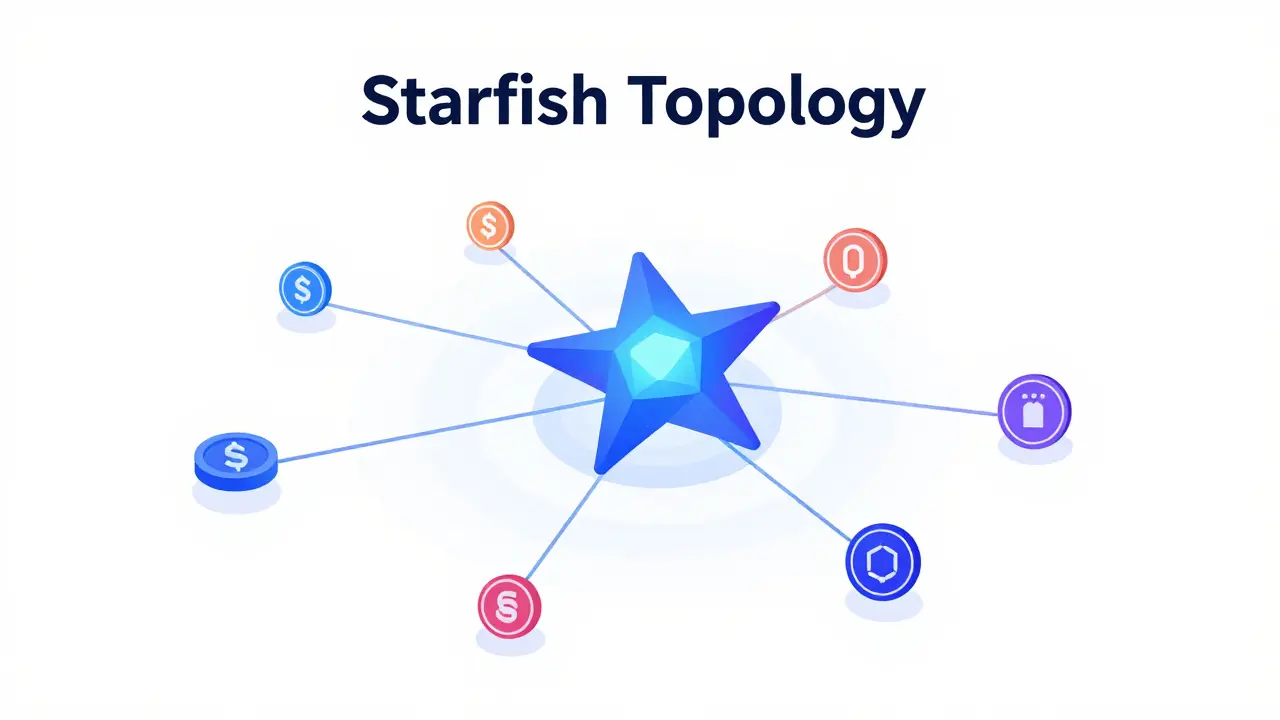
Imagine a world where adding a new token to a trading platform doesn't require mountains of cash or stablecoins to start a liquidity pool. That's the problem BUILD is trying to solve. While most people think of coins as just assets to hold, BUILD crypto coin is actually a functional gear in a complex machine designed to fix how money moves in decentralized finance.
The Quick Rundown on BUILD
- Role: A Tier 3 asset in a Multi-Tier Starfish Topology (MTST) system.
- Purpose: Optimizes how Total Value Locked (TVL) is used and simplifies token onboarding.
- Risk Level: Medium to high (volatile), as it pairs with mid-stage protocol tokens.
- Current Status: Extremely low trading volume, suggesting it's either very niche or currently dormant.
Understanding the Starfish Topology
To understand BUILD, you first have to understand Starfish Topology is a specialized architectural design for decentralized finance (DeFi) that aims to reduce liquidity fragmentation. In a standard Automated Market Maker (AMM), liquidity is often spread thin across dozens of different pools, which leads to slippage and inefficiency. The Starfish model changes this by concentrating liquidity in a way that makes the whole system more efficient.
The real magic here is how it handles new tokens. Usually, if a project wants to list a token, they need to provide a massive amount of USDC or other stablecoins to create a pair. The Starfish system allows for onboarding with zero collateral requirements other than the protocol's own tokens. This removes a huge barrier for smaller projects trying to enter the market.
The Multi-Tier Starfish Topology (MTST) Hierarchy
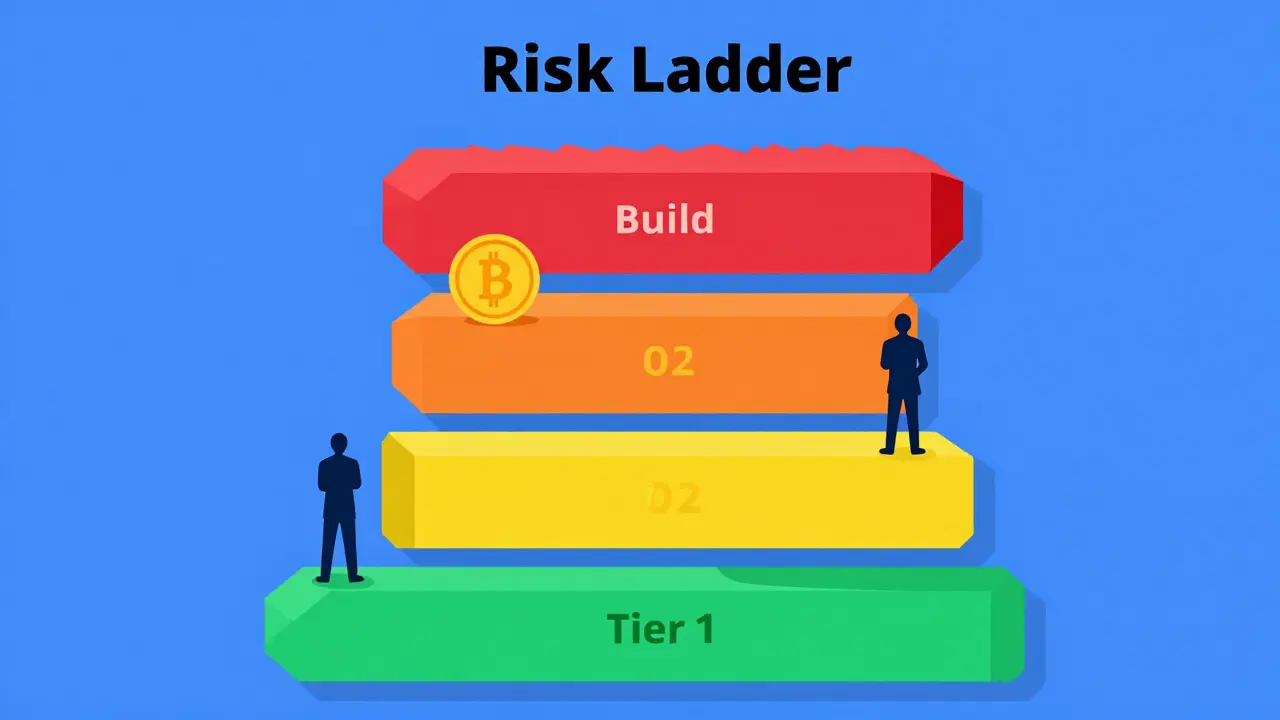
The protocol doesn't treat all assets the same. It uses a four-tier system called Multi-Tier Starfish Topology (MTST), which sorts tokens by their volatility and stability. Think of it like a risk ladder: the higher you go, the bumpier the ride.
BUILD sits right in the middle. It isn't the safest bet, but it isn't the riskiest either. It is designed to pair with "mid-stage" protocols-projects that have proven their concept and survived the initial startup phase but haven't yet become industry giants.
| Tier | Token Name | Pairing Examples | Volatility Level |
|---|---|---|---|
| Tier 1 | RADIO | USDC, DAI, ETH, MATIC | Lowest |
| Tier 2 | SHACK | LINK, LUNA, AAVE | Low-Medium |
| Tier 3 | BUILD | MANA, GRT, ENJ | Medium-High |
| Tier 4 | DREAM | New Startup Tokens | Highest |
Where BUILD Fits into the Ecosystem
Because it operates in Tier 3, BUILD is paired with assets like MANA (the currency of Decentraland), GRT (The Graph), and ENJ (Enjin Coin). These are projects with established communities and actual products, but their prices can still swing wildly based on market trends.
By acting as the bridge for these mid-stage tokens, BUILD helps maintain the flow of liquidity without requiring the protocol to constantly inject new external capital. If you're a user, this means the system can theoretically scale faster than a traditional exchange because it isn't waiting for someone to deposit a million dollars in stablecoins to make a new trading pair viable.
The Red Flags: Liquidity and Transparency
Now, here is where things get tricky. If you look at the current market data, BUILD is trading at around $0.00004394, but the 24-hour trading volume is essentially zero. In the world of crypto, zero volume is a massive warning sign. It means that even if you own the coin, there might not be anyone to buy it from you.
There is also a noticeable lack of public information. We don't have a clear whitepaper, a known founding team, or a detailed roadmap. In a space where "trustless" is the goal, a complete lack of transparency is a contradiction. This suggests that BUILD might be in a very early development phase, or perhaps the project has stalled.

Is BUILD a Good Investment?
Investing in a token like BUILD is less about the coin itself and more about a bet on the Starfish Topology technology. If the MTST system becomes the standard for how DeFi handles liquidity, the tokens powering that system (like BUILD) would naturally become more valuable.
However, you have to weigh that potential against the current reality. You're dealing with an asset that has almost no liquidity and very little public documentation. For most people, this puts BUILD in the "extremely high risk" category, regardless of where it sits on the protocol's internal tier list. It's more of a technical experiment than a stable financial asset at this stage.
What exactly does BUILD do in the DeFi ecosystem?
BUILD serves as the Tier 3 utility token within a Multi-Tier Starfish Topology (MTST) system. Its main job is to provide liquidity for mid-stage protocol tokens (like MANA or GRT), allowing the system to onboard these tokens without needing external stablecoin collateral.
Is BUILD a stablecoin?
No, BUILD is not a stablecoin. In fact, it is explicitly designed to be a medium-risk asset that is "quite volatile over time," as it is paired with other volatile mid-stage cryptocurrencies.
What is the difference between BUILD and DREAM tokens?
The difference is the risk tier. BUILD (Tier 3) is for established mid-stage projects, while DREAM (Tier 4) is used for the most volatile, early-stage startup tokens. DREAM is significantly riskier than BUILD.
Why is the trading volume for BUILD so low?
Low trading volume typically indicates a lack of market interest, limited exchange listings, or that the project is in a dormant/early phase. In BUILD's case, it suggests the token has not yet gained mainstream adoption despite its innovative technical structure.
How does Starfish Topology help DeFi?
It solves "liquidity fragmentation." Instead of spreading money across many different pools, it organizes them into a hierarchy. This makes the Total Value Locked (TVL) more efficient and lets the protocol add new tokens without needing new piles of USDC to start a pair.
Next Steps and Troubleshooting
If you're looking to interact with BUILD or the Starfish Topology system, keep these scenarios in mind:
- For the Curious Researcher: Look for the original protocol documentation or GitHub repositories associated with "Multi-Tier Starfish Topology." Since market data is thin, technical docs are your only reliable source.
- For Potential Traders: Check if the token is listed on any decentralized exchanges (DEXs) and look at the "Slippage" settings. With near-zero volume, a small trade could move the price significantly.
- For DeFi Developers: Analyze the MTST model to see if the zero-collateral onboarding can be applied to other liquidity layers to solve the "cold start" problem for new tokens.
Aaron Zeiler
28 04 26 / 16:53 PMzero volume is basically a death sentence in defi. doesnt matter how cool the architecture is if nobody is trading it. most of these 'topology' projects are just fancy words for liquidity traps
Emily A
28 04 26 / 22:34 PMThe lack of a whitepaper is an absolute disqualifier for any serious investor. It is profoundly naive to suggest that the "technical experiment" aspect outweighs the absence of fundamental transparency. If the founding team remains anonymous and the documentation is nonexistent, you are not investing in technology; you are gambling on a ghost.
Abhishek Verma
29 04 26 / 03:11 AMOh look, another "revolutionary" way to lose money faster than a casino. I love how we call it a 'risk ladder' instead of just admitting it's a pyramid scheme with extra steps. Truly groundbreaking stuff.
Brendan Thraxton
29 04 26 / 12:46 PMthe zero collateral onboarding actually sounds like a game changer for devs who dont have deep pockets to start pools. could really lower the entry barrier for innovative projects if they get the trust part right
Tracy McBurney
29 04 26 / 18:04 PMLet's be honest here: this is a textbook pump-and-dump setup. The
Tracy McBurney
29 04 26 / 20:24 PMLet's be honest here: this is a textbook pump-and-dump setup. The tiered structure is just a psychological trick to make people feel like they're managing risk when they're actually just buying into a vacuum. There is no organic demand for BUILD, and the pairing with MANA or GRT is a desperate attempt to borrow legitimacy from established projects. Look at the order books if they even exist. The slippage would be catastrophic. You're not "betting on technology," you're providing an exit strategy for whoever launched this. It's an architectural fantasy designed to mask a total lack of liquidity. Anyone claiming this is a viable DeFi innovation is either delusional or paid to shill. The math on zero-collateral onboarding usually results in a systemic collapse once the first major whale decides to pull out. This isn't a a functional gear in a machine; it's a broken spoke in a rusty wheel. Don't let the fancy terminology fool you into thinking this is a legitimate financial instrument. It's a gamble with odds stacked heavily against the retail user. The absence of a roadmap is the biggest red flag of all. Why would a team with a working product hide their plan? Because there is no plan. It's just a shell. Absolute garbage.
Michael Repak
1 05 26 / 06:06 AMI totally agree with the caution here!!! It's always better to be safe than sorry when it comes to new tokens... especially with zero volume!!!
Kathleen Warren
2 05 26 / 23:31 PMIt sounds really scary for people who are new to this. Just remember to only put in what you are okay with losing, okay? We are all learning together!
Barbara Jones
3 05 26 / 07:36 AMidk man... sounds like a lot of math for somethng that isnt even tradable lol
Janis Naglis
3 05 26 / 15:30 PMThe synergistic potential of a Multi-Tier Starfish Topology is actually quite fascinating!!! Despite the current liquidity constraints, the conceptual framework for mitigating fragmentation is top-tier... we just need a catalyst for adoption!!!
Chloe Fletcher
4 05 26 / 10:16 AMWait, so you can actually list tokens without USDC? That is a HUGE deal for small creators! 🚀✨ Just hope the devs actually show up soon! 🤞
Rain Richardsson
5 05 26 / 02:54 AMSeems risky.
debra hoskins
5 05 26 / 03:30 AMTypical DeFi buzzword salad. "Starfish Topology" sounds like something a toddler came up with after eating too many crayons. I'll stick to coins that actually have a heartbeat.
Iestyn Lloyd
6 05 26 / 09:24 AMOne might consider the technical merits of the MTST if the transparency issues were resolved. It is a curious approach to the cold start problem.
edie rosa
7 05 26 / 09:08 AMI've seen so many people lose their life savings to "innovative" DeFi models. It's honestly exhausting how the industry keeps repeating the same mistakes while pretending it's progress. This is just another vacuum for capital.
Pramendra Singh
7 05 26 / 11:12 AMIt is an interesting concept, though perhaps we should wait for more data before jumping in.
Amanda Macy
8 05 26 / 17:19 PMThe intersection of volatility and stability in a tiered system reflects a desire for order in a chaotic market. Perhaps the lack of volume is simply a reflection of the world not being ready for this specific architecture.
Mitali Rajvanshi
9 05 26 / 10:07 AMAgreeing with the need for caution. Very niche.
Ralph Espinosa
10 05 26 / 09:23 AMIf anyone is looking for the GitHub, I suggest searching for the topology terms specifically... the official links seem to be missing, but the code might be out there!!!