
Imagine you have money in one bank, but you need to pay someone who uses a completely different bank. You can’t just send it directly-you need to transfer it through a middleman, wait for processing, pay fees, and hope nothing goes wrong. Now picture that happening across dozens of banks, each with its own rules, languages, and security systems. That’s what blockchain was like before cross-chain interoperability.
Today, there are hundreds of blockchains. Ethereum handles smart contracts. Solana moves fast. Cosmos is built for connection. Bitcoin is the original store of value. But until recently, they couldn’t talk to each other. If you owned Bitcoin and wanted to use it on a DeFi app on Ethereum, you were stuck. You had to trade it, wait for confirmation, pay gas fees twice, and trust a bridge that could get hacked. That’s where cross-chain interoperability comes in-it’s the system that lets blockchains exchange data and value without needing a central authority to mediate.
How Cross-Chain Interoperability Actually Works
At its core, cross-chain interoperability means two or more blockchains can send messages or assets to each other and know those messages were received and verified. It’s not just about moving tokens. It’s about letting a smart contract on one chain trigger an action on another. For example: a user on the Cosmos chain could lock up their ATOM tokens, and a smart contract on the Osmosis DEX could automatically issue equivalent STARS tokens on the Stargaze chain-all in under two minutes, with no middleman.
There are three main ways this happens:
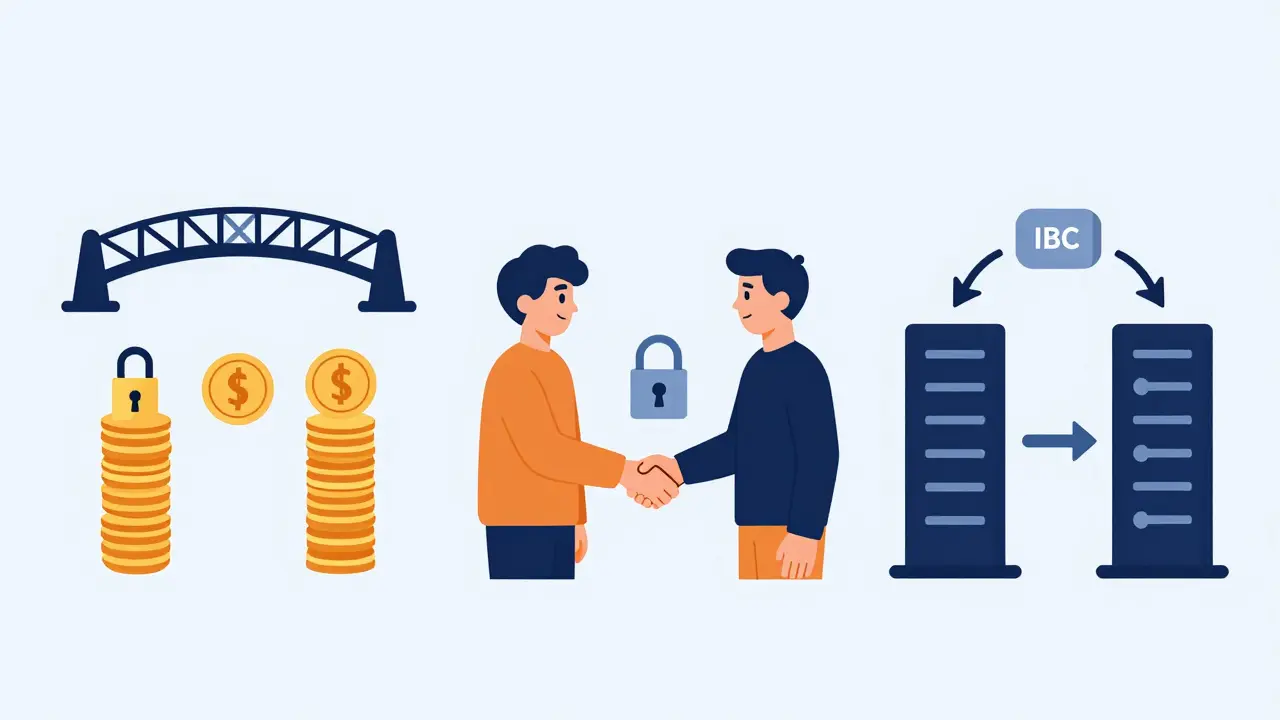
- Blockchain bridges lock your asset on the source chain and mint a wrapped version on the destination chain. Think of it like a voucher system. Wormhole and Portal Bridge use this method. They’re fast and support many chains-but if the bridge’s security is broken, your funds are gone. That’s what happened in 2022 when Wormhole lost $325 million due to a signature exploit.
- Atomic swaps let you trade directly with someone else using smart contracts called HTLCs (Hash Time-Locked Contracts). These ensure that either both sides get their tokens, or neither does. Platforms like AtomicDEX and Liquality use this. No custodians. No trust. But it’s slower and needs someone on the other side willing to trade.
- Protocol-level standards like Cosmos’ IBC (Inter-Blockchain Communication) define a common language for chains to communicate. Chains using IBC must run Tendermint consensus, but once they do, they can send messages like “I sent 100 ATOMs” and the other chain verifies it using cryptographic proofs, not just trusting a third party. This is how Osmosis moved $4.2 billion in cross-chain swaps in 2024.
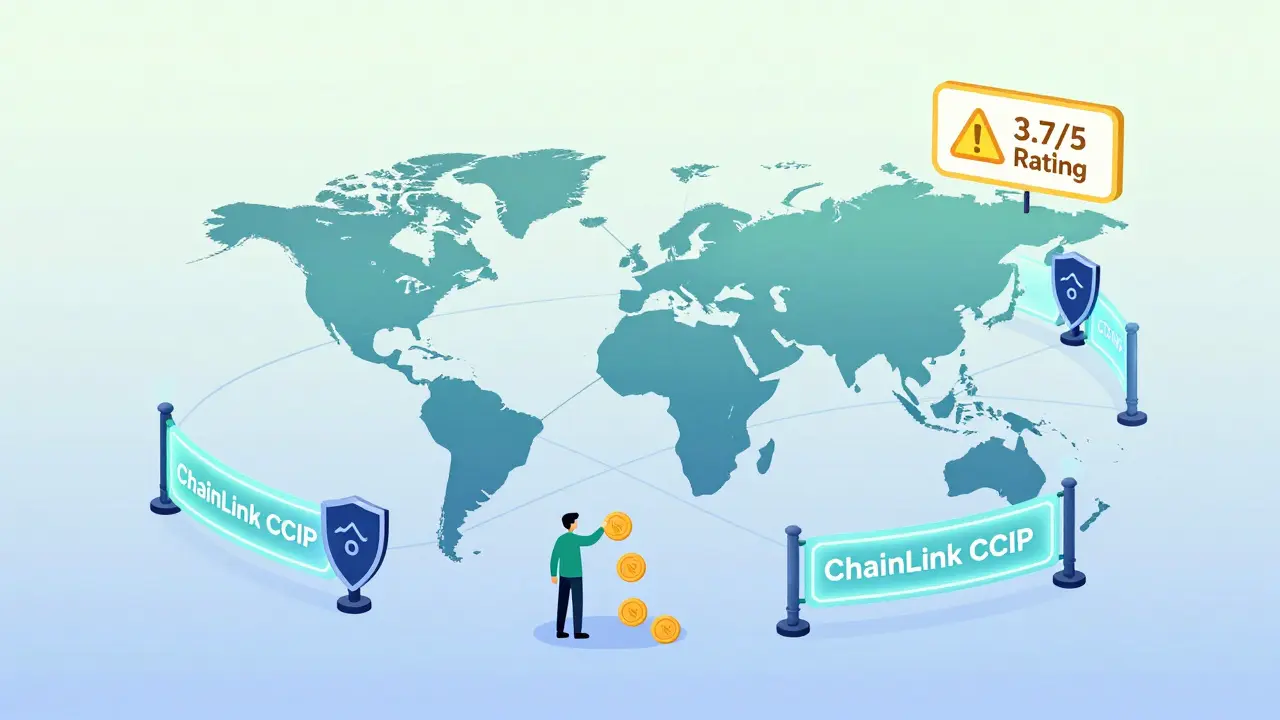
Chainlink’s CCIP is another major player. Unlike bridges, CCIP doesn’t rely on locking assets. Instead, it uses a decentralized network of oracles to verify events across chains and relay messages. It’s designed for enterprises-Swift, the global banking network, is testing it for cross-border token settlements. CCIP handles about 8,500 verified messages per day, with built-in safety features like rate limits and circuit breakers to stop bad actors.
Why It Matters: Solving the Fragmentation Problem
Before interoperability, blockchain was like a city with 50 separate subway systems. Each had its own map, tickets, and rules. You couldn’t take your MetroCard from New York to Tokyo. That’s what we called “liquidity fragmentation.”
DeFi apps were stuck on one chain. If you wanted to lend on Aave but earn yield on Curve, you had to move your assets manually. That meant higher fees, longer waits, and more risk. In 2024, Aave deployed CCIP to connect its lending pools across Ethereum, Polygon, and Arbitrum. The result? $1.2 billion in additional total value locked within three months.
Users noticed. On Reddit, one user wrote: “Swapping ATOM to STARS on Stargaze takes 90 seconds with one click-this is how it should work.” That’s the dream: seamless, fast, safe movement of value.
But it’s not perfect. A Trustpilot review from January 2025 said: “Lost $2,300 when my Solana-to-Ethereum transfer got stuck for three days.” That’s the reality. Cross-chain tools still have a 3.7/5 average rating. The top complaints? Transaction failures (18.7%) and confusing error messages (63.2%).
Security: The Biggest Weak Link
Security is the Achilles’ heel of cross-chain tech. Every bridge is a target. Wormhole’s $325 million hack wasn’t an anomaly-it was predictable. Bridges rely on centralized validators or multisigs. If those are compromised, the whole system collapses.
IBC avoids this by using light client verification. Instead of trusting a group of validators, the receiving chain independently checks the proof that a transaction happened on the sending chain. It’s like verifying a passport stamp by checking the issuing country’s official database-not just trusting the traveler’s word. According to UC Berkeley’s January 2025 study, IBC-based systems have 97.3% reliability. Oracle-based systems like CCIP? 82.1%.
But IBC has limits. It only works with Tendermint-based chains. Bitcoin and Ethereum can’t use it without major changes. That’s why CCIP and other oracle models are growing. They’re more flexible, but they introduce new risks: what if the oracle nodes are corrupted? What if they get hacked? Chainlink’s three-layer verification helps, but it’s not foolproof.
Even the most secure systems can fail. In July 2024, THORChain lost $4.8 million because of a flaw in its cross-chain message system. The lesson? No solution is perfect. Security must be baked in from day one-not added as an afterthought.
Performance and Speed: What’s Fastest?
Speed varies wildly. Solana confirms transactions in 2.6 seconds. Bitcoin takes 10 minutes. Ethereum takes 12-15 seconds. Cross-chain communication has to wait for the slowest chain to finalize.
IBC processes about 1,200 cross-chain transactions per hour across Cosmos. CCIP handles 8,500 messages per day. That sounds low, but each message can represent a complex interaction-like triggering a loan repayment on one chain based on a price feed from another.
Enter shared sequencers. Launched in March 2025, this new approach lets multiple Layer-1 and Layer-2 chains share a single order of transactions. Think of it like a global traffic light system for blockchains. If you send a swap from Ethereum to Solana, the sequencer ensures both chains process it in the exact same order. That’s called atomicity-no partial success. It’s still early, but projects like Espresso Systems and Astria are building it.
Another emerging solution? Zero-knowledge bridges. Stanford researchers found that zk-proofs reduce verification costs by 89% compared to traditional light clients. That means faster, cheaper, and more secure cross-chain transfers in the future.
Who’s Using It-and Why
Right now, DeFi drives 74% of cross-chain activity. DEXs like Osmosis, Curve, and Uniswap are the biggest users. They need liquidity across chains to offer better rates and lower slippage.
Enterprises are catching up. In 2025, 43 Fortune 500 companies started using cross-chain solutions-up from 17 in 2024. Swift is testing CCIP to settle tokenized payments between banks. JPMorgan, Microsoft, and Intel are part of the EEA Crosschain Interoperability Working Group, trying to build enterprise standards.
But adoption is uneven. While DeFi uses it daily, most businesses still treat blockchain as a siloed database. The EU’s MiCA 2.0 regulation, effective June 2025, now requires “minimum 99.95% uptime” for institutional-grade interoperability. That’s forcing companies to take it seriously.
The Future: Consolidation or Chaos?
The market is crowded. In 2023, there were 52 interoperability projects. By early 2025, that jumped to 87. But most are small, underfunded, or poorly documented. GitBook’s survey found that newer protocols like LayerZero have developer satisfaction scores of just 2.9/5. Cosmos IBC? 4.3/5.
Analysts predict 62% of these projects will shut down or merge by 2027. The winners? Those with strong security, clear standards, and real-world use cases. IBC, CCIP, and shared sequencers are leading. The rest are racing to catch up.
Some experts, like Ethereum co-founder Gavin Wood, argue that interoperability is a band-aid. He believes modular blockchains-where chains specialize in execution, settlement, or data availability-will make cross-chain bridges obsolete by 2028. Others, like Cosmos co-founder Jae Kwon, say IBC is the “internet protocol of blockchains.” It’s not a fix. It’s the foundation.
One thing’s clear: the future isn’t one chain to rule them all. It’s many chains, working together. Cross-chain interoperability isn’t a feature anymore. It’s a requirement.
Getting Started: What You Need to Know
If you’re a developer looking to build on cross-chain systems:
- Start with IBC if you’re building on Cosmos or want native, secure messaging.
- Use CCIP if you’re targeting enterprises or need to connect to Ethereum, Polygon, or other EVM chains.
- Avoid bridge-based solutions unless you’re building a simple token swap and can accept the risk.
Expect a learning curve. Basic bridge integration takes 2-4 weeks. Building on IBC or CCIP? 3-6 months. Documentation matters. Cosmos’ docs are top-notch. Others? Not so much.
For users: stick to well-established platforms. Osmosis, Aave, and Chainlink’s own apps have proven track records. Avoid new bridges with no audit history. And always check the status of your transfer-don’t assume it’s done until you see it confirmed on both chains.
The market is growing fast. Valued at $1.27 billion in 2024, cross-chain interoperability is projected to hit $8.43 billion by 2029. That’s not hype-it’s necessity. As more assets move on-chain, the ability to move them freely will become as essential as the internet’s ability to connect networks.
What is cross-chain interoperability in simple terms?
Cross-chain interoperability lets different blockchains send data and value to each other without needing a middleman. Think of it like texting someone on a different phone network-no need to switch carriers. You can move your Bitcoin to Ethereum, trigger a smart contract on Solana, or use your Cosmos tokens in a DeFi app on Polygon-all in one smooth step.
Is cross-chain interoperability safe?
It depends on the method. Protocol-level systems like Cosmos’ IBC are the safest-they use cryptographic proofs to verify transactions without trusting third parties. Bridge-based solutions are riskier; over $1.5 billion has been lost to bridge hacks since 2021. Oracle-based systems like Chainlink CCIP add security layers but still rely on external validators. Always choose audited, widely-used protocols over new, untested ones.
What’s the difference between a blockchain bridge and IBC?
A bridge locks your asset on one chain and mints a wrapped version on another. You’re trusting a group of validators to hold your funds. IBC doesn’t move assets-it sends messages. Each chain verifies the other’s state independently using light clients. IBC is more secure but only works with chains that use Tendermint consensus. Bridges work with almost any chain but are more vulnerable to hacks.
Why do some cross-chain transfers fail?
Failures happen due to network congestion, gas price spikes, chain reorganizations, or bugs in the smart contract. CertiK’s 2025 report found that 31.7% of cross-chain failures are caused by chain reorgs-when a blockchain temporarily reverses a transaction. Poor error messages make it hard to know what went wrong. Always check the status on both chains and wait for finality before assuming the transfer is complete.
Will cross-chain interoperability replace single-chain blockchains?
No. Single chains like Bitcoin and Ethereum will still exist for their specific strengths-security, decentralization, or smart contract power. But the future is multi-chain. Most applications will use multiple chains for different tasks: one for payments, one for speed, one for privacy. Interoperability connects them. It’s not about replacing chains-it’s about connecting them.
What’s the most promising new technology in cross-chain?
Shared sequencers and zero-knowledge bridges are the most promising. Shared sequencers let multiple chains agree on transaction order in real time, enabling truly atomic cross-chain swaps. Zero-knowledge bridges use zk-proofs to verify transactions with far less data, cutting costs by 89% compared to older methods. Both are still in early stages but could become the standard by 2027.
Will Pimblett
30 01 26 / 01:50 AMSo let me get this straight-we’re glorifying bridges that got hacked for $325M and calling it ‘interoperability’? If your solution requires trusting a group of devs with a multisig, you’re not building the future-you’re building a 2021 meme with a whitepaper.
Parth Makwana
30 01 26 / 08:46 AMThe architectural elegance of IBC cannot be overstated-its light-client verification paradigm eliminates single points of failure inherent in centralized oracle models. The economic implications for sovereign chains are profound, especially when juxtaposed against the fragile trust assumptions of Wormhole-style bridges.
christal Rodriguez
31 01 26 / 18:49 PMInteroperability is just capitalism’s way of forcing chains to marry each other.
Elle M
2 02 26 / 14:39 PMYou call that ‘seamless’? A 3.7/5 rating and 63% of users get confused by error messages? That’s not innovation-that’s a UX dumpster fire with a blockchain sticker on it.
Crystal Underwood
3 02 26 / 10:46 AMPeople are LOSING MONEY like it’s confetti and you’re acting like this is some noble tech revolution? No. It’s a casino where the house writes the code and the players are too lazy to read the audit. I’ve seen 18-year-olds with Discord links ‘deploying bridges’ and you’re seriously calling this progress?
Raymond Pute
3 02 26 / 22:54 PMLook, I get it. IBC is ‘secure.’ CCIP is ‘enterprise.’ But let’s be real-nobody actually cares about the cryptography. They care about whether their swap works before their coffee gets cold. The fact that you need a PhD in Tendermint consensus just to send ETH to Solana is the problem, not the solution. We’re building a spaceship when we still can’t get the toilet paper to stop rolling.
Freddy Wiryadi
4 02 26 / 15:18 PMI mean… I’ve used IBC and it’s slick as hell. Like, 90 seconds from ATOM to STARS? 🤯 But then I tried a random bridge and lost $80 because the UI said ‘confirming’ for 3 hours and then just… vanished. I’m just glad I didn’t use my rent money. 😅
Brianne Hurley
6 02 26 / 10:54 AMYou think this is about tech? It’s about power. The same people who ran the banks are now running the bridges. They just swapped suits for hoodies. CCIP? That’s JPMorgan’s blockchain Trojan horse. They’re not building for you-they’re building to control the rails. Wake up.
Rico Romano
6 02 26 / 12:35 PMThe fact that you’re still talking about IBC like it’s the only legitimate solution shows how out of touch you are. IBC only works on Tendermint chains-that’s 12% of the market. The rest of us are living in the real world, where Bitcoin and Ethereum still dominate. If you can’t connect to them, you’re not interoperable-you’re irrelevant.
Andrea Demontis
6 02 26 / 13:16 PMThere’s something deeply human about this entire endeavor-this desperate, almost poetic attempt to reconcile isolated systems that were never meant to speak. We built blockchains as utopian islands, each with its own ethos, its own gods, its own laws. And now we’re trying to stitch them together with cryptographic duct tape, not because we must, but because we’re lonely. We want to believe that value, like meaning, can flow freely across boundaries without betrayal. But the more we build these bridges, the more we see: trust isn’t a protocol. It’s a choice. And every time a bridge collapses, we’re reminded that we chose poorly.
Calvin Tucker
7 02 26 / 10:37 AMThe notion that shared sequencers will solve atomicity is naive. They introduce a new centralized bottleneck-the sequencer itself. If the sequencer is compromised, you don’t just lose cross-chain swaps-you lose temporal consistency across entire ecosystems. It’s not a fix. It’s a re-centralization with better marketing.
Gustavo Gonzalez
9 02 26 / 05:20 AMYou mentioned $1.5B lost to bridge hacks. That’s not a bug-it’s a feature. Every hack is a market correction. The weak projects die. The strong ones adapt. If you’re not comfortable with that, you shouldn’t be in crypto. This isn’t a bank. It’s a frontier. And frontier justice doesn’t come with a refund policy.
Christopher Michael
9 02 26 / 07:11 AMFor developers: if you're building on Ethereum, use CCIP. It’s audited, enterprise-grade, and integrates with existing EVM tooling. IBC? Only if you’re starting from scratch on Cosmos. And please-don’t use a bridge unless you’ve read the code, verified the multisig, and checked the last 12 months of GitHub commits. If it hasn’t been audited by CertiK or OpenZeppelin, it’s a roulette wheel with a blockchain logo. Also, always check both chains. Always. I lost $200 once because I assumed ‘confirmed’ meant ‘done.’ It didn’t. It meant ‘pending on the other side.’ Don’t be me.