Crypto Sentiment Dashboard
Fear & Greed Index
Current Action:
Consider watching for confirmation signals before acting. This is a neutral zone where market indecision is common.
How to Use This Tool
- Extreme Fear (0-20): Potential buying opportunity - watch for volume confirmation
- Neutral (21-49): Market indecision - wait for stronger signals
- Extreme Greed (81-100): Consider taking profits or reducing exposure
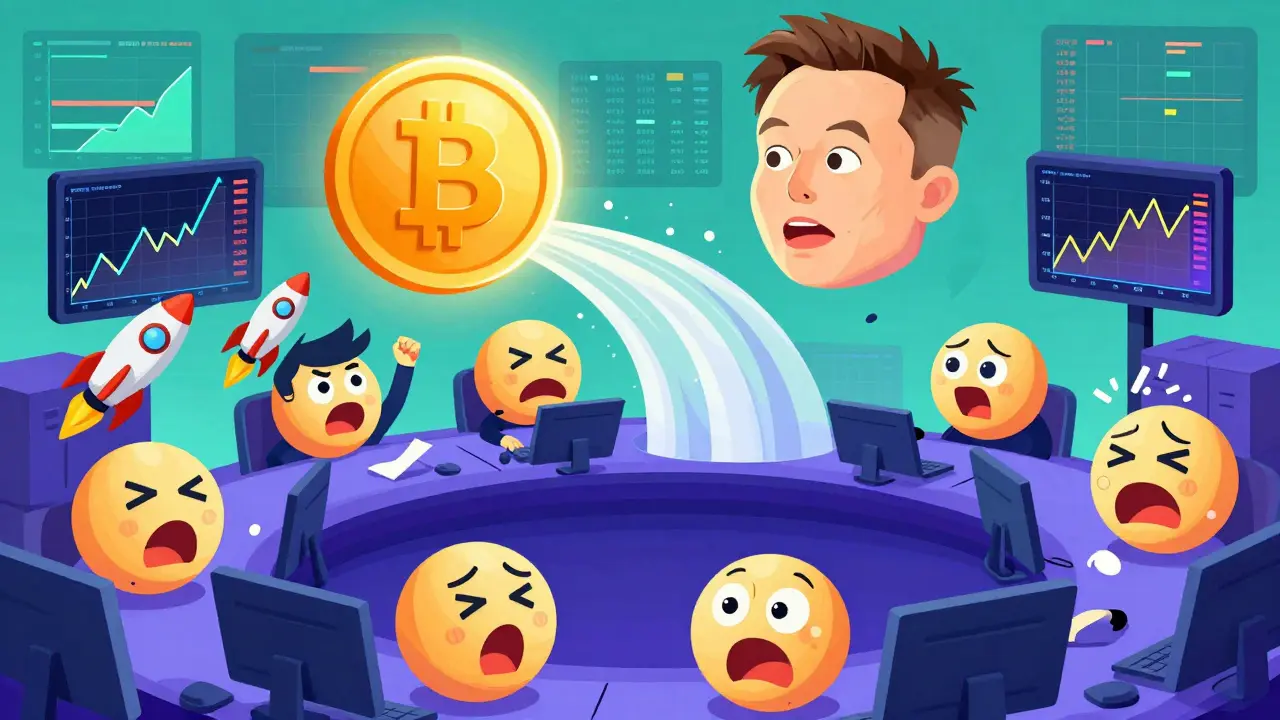
Bitcoin doesn’t move because of earnings reports or interest rates alone. It moves because thousands of people wake up, see a meme, tweet ‘to the moon,’ and start buying. That’s crypto market sentiment analysis in action.
Unlike stocks, crypto has no central bank, no board of directors, and no balance sheets that tell the full story. Instead, price swings are often driven by fear, hype, FOMO, and panic - all things you can measure. Sentiment analysis doesn’t predict the future. It reads the mood of the crowd right now, and that mood often becomes the future.
What Exactly Is Crypto Market Sentiment Analysis?
Crypto market sentiment analysis is the process of measuring the emotional state of traders and investors. Are they excited? Afraid? Indifferent? That feeling - whether it’s bubbling up from Reddit threads, Twitter rants, or whale wallet movements - directly affects buying and selling pressure.
It’s not about charts or fundamentals. It’s about people. A single tweet from Elon Musk adding #Bitcoin to his bio sent Bitcoin from $32,000 to $38,000 in hours. No new technology. No upgrade. Just a shift in public feeling.
Unlike traditional finance, where sentiment is just one of many signals, in crypto it’s often the main driver. With no regulatory safety nets and 24/7 trading, emotions run hotter and faster. Sentiment analysis gives you a real-time window into that chaos.
How Do You Measure Sentiment in Crypto?
You don’t guess. You measure. And there are five main ways to do it.
- Social media monitoring: Tools like LunarCrush track over a million mentions daily across Twitter, Reddit, Telegram, and more. They don’t just count how often a coin is mentioned - they analyze whether the tone is positive or negative using natural language processing. Scores range from -10 (extreme hate) to +10 (pure hype).
- News analysis: Platforms scan 500+ crypto news sites like CoinDesk and CoinTelegraph. If headlines are full of “crash,” “scam,” or “regulation,” sentiment drops. If you see “adoption,” “breakout,” or “institutional buy,” it rises. Accuracy hits 82.7% in real-world testing.
- On-chain data: This is where things get deep. Glassnode tracks actual wallet behavior. Are whales moving large amounts? Are small holders dumping? Are new addresses popping up? In Q1 2024, addresses holding over 1,000 BTC accounted for 96.3% of all Bitcoin transactions over $100,000. That’s not noise - that’s power.
- The Fear & Greed Index: Developed in 2018, this single number tells you the market’s emotional state on a 0-100 scale. Below 30? Extreme fear. Above 75? Extreme greed. It combines five factors: volatility (40%), market momentum (25%), social volume (15%), dominance (10%), and trends (10%). When the index hit 8 in March 2024, it signaled a massive buying opportunity - and many traders caught the bottom.
- Funding rates: On futures exchanges, funding rates show whether traders are paying to hold long or short positions. Persistent negative funding rates (people paying to short) often mean the market is oversold and due for a bounce.
Why Sentiment Analysis Beats Traditional Methods in Crypto
Technical analysis looks at past price patterns. Fundamental analysis looks at whitepapers and team backgrounds. Both are useful - but they’re slow.
Sentiment analysis is fast. It gives you a 3-7 day heads-up before price moves. For example, when social chatter spikes on a coin while price is flat, it often means a breakout is coming. That’s a leading indicator.
Compare that to a Golden Cross (when the 50-day moving average crosses above the 200-day). That signal can take 20-30 days to form. By then, the move is already halfway done.
And here’s the kicker: 38% of professional crypto traders now use sentiment tools as part of their core strategy, according to a 2024 Koinpark survey. That’s up from just 12% in 2020. Institutional players aren’t ignoring this anymore.

The Dark Side: Manipulation and False Signals
Here’s the problem: sentiment can be faked.
Bots, paid shills, and coordinated pump-and-dump groups can inflate sentiment scores by 35-60% in hours. One Reddit user lost $1,200 following Whale Alert signals that turned out to be wash trading - fake transactions designed to look like big money was moving.
Research shows 31% of Twitter sentiment during the 2021 bull run was artificially generated. The SEC warned in January 2024 that manipulating social sentiment could violate securities laws. That’s how serious it’s become.
And false positives? They’re common. Backtesting from 2017 to 2023 shows sentiment indicators give false signals about 22% of the time. That’s why no serious trader relies on just one tool.
How to Use Sentiment Analysis Without Getting Scammed
You don’t need to be a data scientist. But you do need to be smart.
Here’s how real traders do it:
- Never trust one signal. If social media is bullish but on-chain data shows whales are selling, believe the chain. Always cross-check.
- Wait for confirmation. If sentiment spikes and price doesn’t move for 24 hours, it’s probably noise. Wait for volume to confirm.
- Use the Fear & Greed Index as a contrarian tool. When it hits 10 (extreme fear), look for buying opportunities. When it hits 90 (extreme greed), consider taking profits.
- Combine with technicals. Traders who mix sentiment with simple support/resistance levels have a 68.2% success rate - much higher than sentiment alone (54.7%).
- Watch the time frame. Most sentiment-driven trades are short-term (under 72 hours). If you’re holding for months, sentiment is a warning sign, not a buy signal.
One trader on Reddit tracked 12 trades using LunarCrush sentiment scores + Glassnode whale alerts. He got 87% accuracy. His secret? He only traded when both tools agreed.

Tools You Can Actually Use (Free and Paid)
You don’t need a $2,500/month API to get started.
- Free: The Fear & Greed Index (alternative.me) is free, easy, and updated hourly. LunarCrush has a free tier with basic social scores. Glassnode’s public dashboard shows whale activity without a login.
- Mid-tier ($10-50/month): Santiment offers clean charts and alerts. Many users rate it 4.1/5 on Trustpilot, though some complain about the cost.
- Professional ($200-2,500/month): Firms like CoinMetrics and Chainalysis offer APIs that integrate sentiment into trading bots. These are for hedge funds, not hobbyists.
Beginners can learn the basics in 3-4 weeks. The biggest mistake? Trusting a single tweet. The second biggest? Ignoring on-chain data because it looks complicated.
The Future of Sentiment Analysis in Crypto
The market is growing fast. The global crypto market cap hit $2.5 trillion in early 2024. Daily trading volume exceeds $150 billion. With that kind of money moving, sentiment tools are becoming essential.
AI is accelerating this. In 2024, there was a 200% increase in Python libraries for custom sentiment models. Exchanges like Bitstamp plan to embed sentiment scores directly into their trading interfaces by late 2024.
But the biggest shift? Regulatory scrutiny. The SEC’s warning wasn’t a threat - it was a sign that sentiment analysis is now too powerful to ignore. That means better tools, better fraud detection, and more reliable data - eventually.
For now, the best advice is simple: use sentiment as a compass, not a map. It won’t tell you exactly where to go, but it’ll show you if you’re walking into a storm - or toward a golden sunrise.
Is crypto market sentiment analysis reliable?
It’s reliable when used correctly - but not on its own. Sentiment analysis gives you a real-time pulse of the market, but it’s prone to manipulation and false signals. The most successful traders combine it with on-chain data, technical indicators, and volume confirmation. Used alone, it’s like driving with only a rearview mirror.
Can sentiment analysis predict Bitcoin’s next big move?
It can hint at it, but not guarantee it. For example, when the Fear & Greed Index dropped below 20 in March 2024, it signaled extreme fear - and Bitcoin bounced 30% in the following weeks. But the same signal in 2022 led to a 40% drop. Context matters. Look for confirmation: rising transaction volume, whale accumulation, and breaking resistance levels.
How do I start using sentiment analysis as a beginner?
Start with the Fear & Greed Index on alternative.me. Check it once a day. Then, open LunarCrush and look at the social score for Bitcoin or Ethereum. If the index is below 30 and social sentiment is rising, that’s a potential buy signal. Wait 24 hours. If price starts moving up with volume, you might have a real opportunity. Don’t trade on impulse. Track your results for two weeks.
Are sentiment tools worth the money?
For casual traders, no. Free tools like the Fear & Greed Index and basic LunarCrush data are enough. For active traders making multiple trades a week, paid tools like Santiment or Glassnode’s premium dashboards save time and reduce risk. But even the best tools won’t make you money if you ignore confirmation signals. Spend on education first, then tools.
Why do some people lose money using sentiment analysis?
They treat it like a crystal ball. Sentiment tools show what people are saying - not what will happen. Many buy when everyone’s excited, just before the crowd exits. Others follow whale alerts without checking if the transaction is real or wash trading. The biggest mistake? Not combining sentiment with other data. Always ask: Is the price moving with the sentiment? Is volume increasing? Is this a trend or a flash in the pan?
Alex Warren
16 12 25 / 09:17 AMSentiment analysis isn't magic. It's a mirror. And mirrors lie when the room's full of smoke.
amar zeid
17 12 25 / 09:23 AMInteresting breakdown, but I wonder how much of this is just confirmation bias dressed up as data. If I see a spike in Twitter chatter about DOGE, am I reacting to real sentiment or just the echo chamber I’ve chosen to live in?
Also, why do we treat social media volume as a proxy for value? People tweet about pizza more than Bitcoin. Does that mean pizza is the next asset class?
The tools are useful, but the underlying assumption-that crowd emotion = market direction-is dangerously simplistic. Emotions are chaotic. Markets are not. They just pretend to be.
Steven Ellis
18 12 25 / 03:44 AMThere’s a quiet truth here that gets buried under the hype: sentiment analysis works best as a filter, not a signal. It doesn’t tell you what to buy-it tells you what not to buy. When the Fear & Greed Index hits 90, and every Telegram group is screaming ‘MOON,’ that’s your cue to step back, not leap in.
The real edge isn’t in catching the top. It’s in avoiding the trap.
I’ve seen traders lose fortunes chasing sentiment peaks. The ones who survive? They wait for the noise to fade. Then they look at the chain.
Lois Glavin
18 12 25 / 19:52 PMI started checking the Fear & Greed Index every morning like a weather report. Turns out, when it’s below 20, my anxiety drops too. Weird how market mood mirrors your own.
Also, no one talks about how exhausting it is to constantly monitor sentiment. I used to check LunarCrush five times a day. Now I check once. Life’s better.
Claire Zapanta
20 12 25 / 11:58 AMLet’s be real-this whole ‘sentiment analysis’ thing is just Wall Street’s new way of gaslighting retail. They know the bots are fake, the whales are washing, and the ‘data’ is cooked. But they sell you the illusion so you keep feeding the machine.
SEC warning? Please. They’ve been asleep at the wheel while hedge funds rigged the entire game with AI-generated tweets and fake whale alerts. You think they care about you? You’re the bait.
They don’t want you to understand sentiment. They want you to chase it. So you hand over your money while they quietly short the pump.
Toni Marucco
22 12 25 / 07:03 AMThere is, perhaps, a deeper philosophical inquiry hidden beneath the surface of this discourse: if market sentiment is the collective unconscious of capital, then what does it reveal about the psyche of our age? We have traded the certainty of balance sheets for the volatility of viral memes-this is not merely financial evolution, but cultural regression masked as innovation.
The blockchain was meant to decentralize power. Instead, we’ve built a new temple of influence, where Elon’s typo holds more sway than a Fed statement. Is this liberation-or the commodification of human emotion on an unprecedented scale?
When we reduce human fear and greed to a 0–100 index, we do not quantify emotion. We sanitize it. And in doing so, we absolve ourselves of responsibility. The market does not move because of sentiment. It moves because we choose, again and again, to believe in stories that are not true.
Perhaps the most dangerous tool is not the algorithm, but our willingness to trust it.
JoAnne Geigner
23 12 25 / 19:44 PMHey everyone-I just want to say how much I appreciate how thoughtful this thread is. It’s rare to see people actually engaging with the nuance instead of just yelling ‘TO THE MOON’ or ‘IT’S A SCAM.’
For those new to this: don’t feel overwhelmed. Start small. One tool. One metric. Just observe. Don’t trade yet. Let the data become familiar, like a new language.
And if you’re feeling anxious about missing out? That’s normal. But the market will still be here tomorrow. So will you. And that’s the real edge.
Kelly Burn
24 12 25 / 00:22 AMBrooo 😎 I just use LunarCrush + Fear & Greed + a little bit of vibes 🌈✨ and I’m good to go. Why overcomplicate? Sentiment is energy, man. Feel the wave. Ride it. Don’t analyze it to death. 💫
Also, if you’re not using crypto memes as indicators, you’re literally leaving money on the table. That Dogecoin tweet from 2021? Pure emotional alchemy. 🚀
Anselmo Buffet
25 12 25 / 18:21 PMI’ve been trading crypto for six years. I’ve used every tool. The only thing that’s kept me solvent? Patience. And ignoring 90% of what’s online.
Sentiment tools? Fine. But I check them once a week. If I’m spending more time reading Reddit than watching price action, I’m already losing.
Sue Gallaher
26 12 25 / 09:01 AMWhy are we even talking about this like it’s science? Crypto isn’t a market. It’s a cult with APIs. You think these tools are neutral? They’re coded by people who own tokens. The ‘data’ is rigged. You’re just the sheep counting grass.
And don’t get me started on ‘whale alerts.’ Those are mostly bots paid by devs to pump their shitcoins. I’ve seen the same wallet ‘move’ 200 BTC in 12 hours-same address, same IP, same fake transaction. It’s theater.
Ike McMahon
27 12 25 / 17:41 PMBeginners think sentiment means ‘buy when everyone’s excited.’ The pros know it means ‘sell when everyone’s excited.’
It’s not about reading the crowd. It’s about knowing when the crowd is wrong.
Eunice Chook
28 12 25 / 23:34 PM38% of pros use sentiment tools? That’s a red flag. If half the room is using the same signal, it’s no longer an edge. It’s a herd.
Also, 22% false signals? That’s worse than a coin toss. Why are we treating this like a strategy and not a gamble?
Abhishek Bansal
30 12 25 / 09:04 AMOf course sentiment works. But only because the market is full of idiots. The smarter you are, the more you exploit the dumb ones. That’s not analysis. That’s predation.
Stop pretending this is about data. It’s about who’s faster at manipulating the narrative.
Kurt Chambers
1 01 26 / 03:50 AMYall act like sentiment is some deep science but its just rich people paying bots to make you feel something so you buy their rugpull tokens. Elon says bitcoin and suddenly everyone’s a genius? Nah. He’s just the puppet master and we’re the puppets with wallets.
And the Fear & Greed Index? That’s just a marketing tool made by a guy who sells newsletters. Don’t trust the guy who’s selling you the mirror.
Bridget Suhr
1 01 26 / 10:36 AMI love how people treat sentiment like it’s new. It’s not. It’s just the same old crowd psychology from 1841, but now with Python scripts and emojis.
Manias don’t change. Just the tools we use to fool ourselves do.
Jeremy Eugene
2 01 26 / 15:30 PMThere’s a difference between using sentiment as a tool and letting it dictate your decisions. One is strategy. The other is surrender.
Know your boundaries. Know your limits. And never confuse noise for signal.
John Sebastian
3 01 26 / 17:49 PMIf you’re relying on sentiment to make money, you’re already behind. The people who profit from crypto aren’t analyzing tweets. They’re writing them.
And you’re just the audience.