
Infinaeon (INF) isn't just another crypto coin. It’s a blockchain built on Ethereum with a bold goal: to fix the broken cycle of crypto projects that launch with hype, get early profits, then crash when everyone sells off. Most tokens have no real system to keep their value alive after the initial rush. Infinaeon tries to change that by tying the value of its native token, INF, directly to how much activity happens on its network.
How Infinaeon works as a Layer 2 blockchain
Infinaeon is a Layer 2 solution for Ethereum. That means it sits on top of Ethereum’s main network, using its security but making transactions faster and cheaper. Think of it like a toll road built next to a crowded highway. You still use the same road system, but you avoid the traffic. Infinaeon does this for Ethereum users who want lower fees and quicker confirmations.
Unlike other Layer 2s like Arbitrum or Base, Infinaeon doesn’t just move transactions off-chain. It uses a smart contract to take a small portion of every gas fee paid on the network and redirects it to a value-boosting mechanism. This is the core of its innovation. Every time someone swaps tokens, sends INF, or uses the bridge, a fraction of the fee helps increase the value of the ecosystem’s key asset: Infinaeon Plus.
What is Infinaeon Plus?
Infinaeon Plus isn’t a coin you buy. It’s a wrapped ETH token that starts at a 1:1 ratio with Ethereum but doesn’t stay there. As more people use the network, Infinaeon Plus automatically appreciates. Each transaction adds a tiny bit of value to it. That means if you hold Infinaeon Plus, your token gets more valuable over time-not because someone bought it, but because the network is being used.
This creates a chain reaction. Projects that list their tokens on Infinaeon’s native DEX, InfiNITY SWAP, are backed by Infinaeon Plus. So as Infinaeon Plus grows, so does the value of everything else on the exchange. It’s not just a liquidity pool-it’s a living asset that grows with usage.
The INF token: supply, price, and market status
The INF token is the native currency of the Infinaeon network. It’s used for staking, paying fees, and participating in governance. The total supply is fixed at 420 million tokens. That’s it. No more will ever be created.
As of February 2026, the circulating supply varies between exchanges. CoinGecko reports around 340 million INF in circulation, while Binance shows about 260 million. This difference likely comes from locked or unclaimed tokens still in the ecosystem.
Price data is messy right now. On CoinMarketCap, INF was listed at $0.0003507 with almost no trading volume. On Binance, it was trading at $0.001192 with $46,732 in 24-hour volume. This gap shows the token is still in early adoption. Market cap figures range from $310,000 to $660,000 depending on the source. It’s ranked around #2955 on CoinMarketCap and #4471 on CoinGecko-meaning it’s still small, but that also means it’s not saturated yet.
How staking works on Infinaeon
Staking INF doesn’t mean printing new coins to pay rewards. Many blockchains inflate supply to give stakers returns. Infinaeon does something different. Its staking rewards come from real revenue generated by the network.
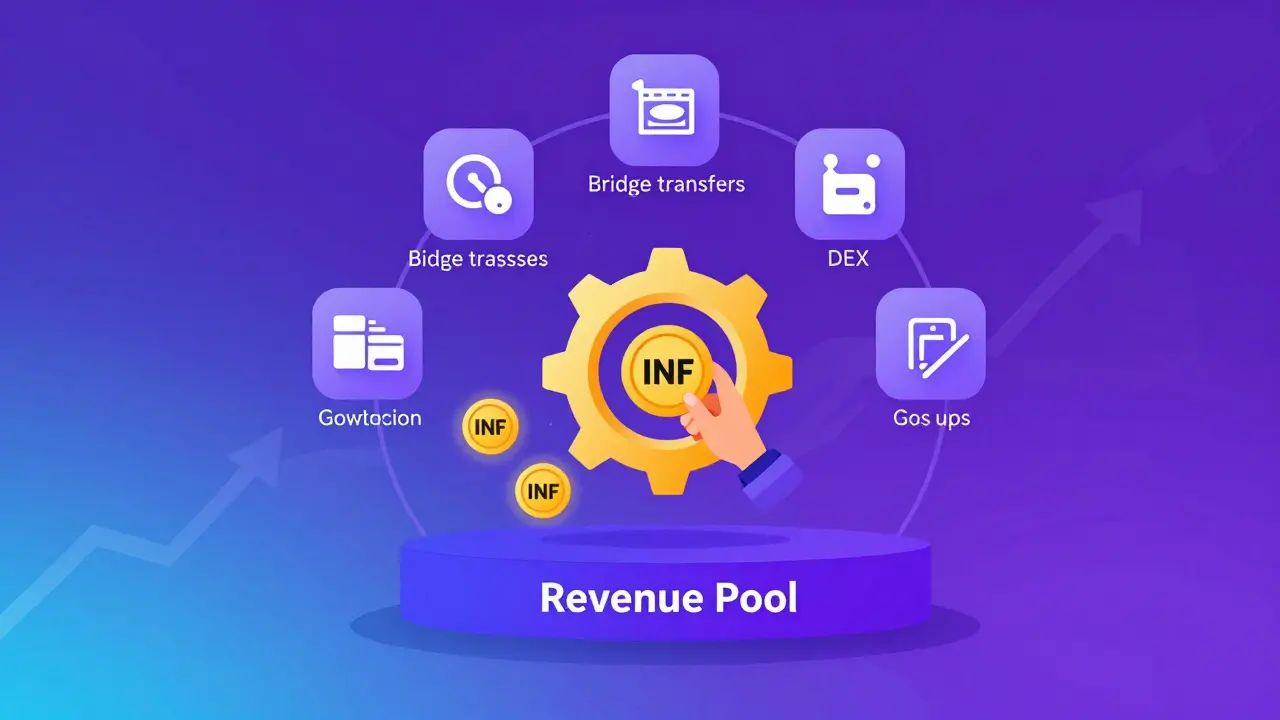
If you stake INF for one month, you earn 5% APY. For three months, you get 10%. These rewards aren’t pulled from new token issuance. They’re funded by bridge fees, DEX trading fees, and gas fee redistribution. This means the system rewards loyalty without diluting the token’s value. It’s a cleaner, more sustainable model.
The cross-chain bridge and ecosystem tools
Infinaeon isn’t isolated. It has a bridge that connects to Ethereum, BASE, BNB Chain, and Arbitrum. This lets users move assets between chains without leaving the ecosystem. Every bridge transfer generates a fee, and those fees feed back into the value-boosting smart contract.
The team is also building tools to support adoption. They’re developing Lunar Pump Fun (LPF), a utility that works across EVM chains to help users track tokens, scan for volume spikes, and avoid scams. Buy bots, DEX screeners, and wallet integrations are in progress. These aren’t just add-ons-they’re meant to make Infinaeon the go-to chain for traders and developers who want real value growth, not just speculation.
Why Infinaeon might succeed where others failed
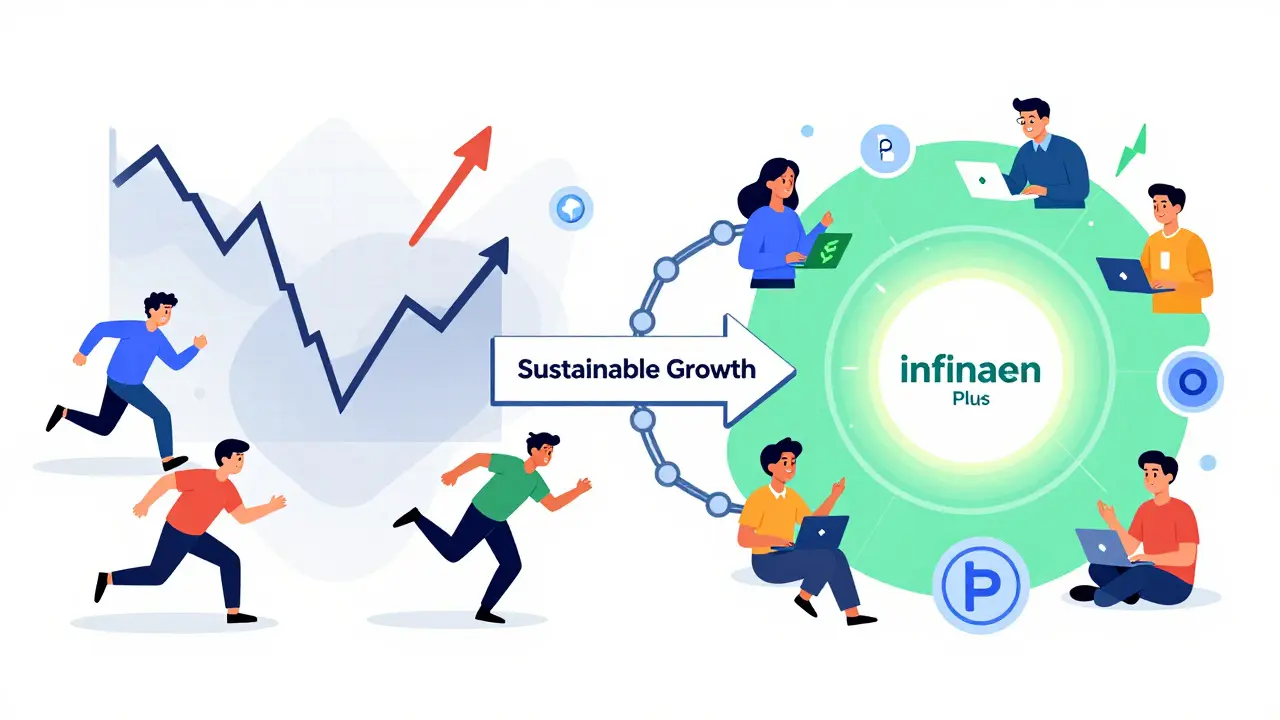
Most crypto projects burn through their marketing budgets fast. Early investors cash out, the price crashes, and the project dies. Infinaeon’s design tries to stop that loop. By linking value growth to real usage-not hype-it creates a reason for people to hold, not just flip.
If more users start swapping, staking, and bridging on Infinaeon, Infinaeon Plus grows. That makes everything on the network more valuable. It’s a positive feedback loop built into the code. No one has to convince you to hold-you just benefit by using the network.
The presale raised nearly $1 million in just a few weeks, with support for ETH, BSC, ARB, BASE, and POL. Bank card purchases were also available, making entry easier for newcomers. The mainnet is live. Testnet has been running for months. The infrastructure is being built. The question isn’t whether the idea works-it’s whether enough people will use it to make the mechanism powerful enough to matter.
What to watch for next
Infinaeon is still early. Its trading volume is low. Its price is volatile across exchanges. But its architecture is different. If the team delivers on its roadmap-especially with LPF, wallet integrations, and DEX growth-it could become a quiet leader in sustainable DeFi.
Watch these three things:
- Does INF trading volume grow on Binance and other major exchanges?
- Does Infinaeon Plus show consistent appreciation over weeks, not just days?
- Are more projects launching on InfiNITY SWAP with real utility, not just memes?
If the answer to all three is yes, Infinaeon might not just be another crypto project. It could be one of the first to solve the value decay problem that’s haunted DeFi for over a decade.
Is Infinaeon (INF) a good investment?
There’s no guarantee Infinaeon will succeed. It’s still early, with low trading volume and a small market cap. The idea is innovative-tying value growth to network usage-but it’s unproven at scale. If you believe in sustainable DeFi models over hype-driven tokens, INF could be worth watching. But treat it like a high-risk, long-term bet, not a quick profit.
How is INF different from ETH or other Layer 2 tokens?
ETH is the base layer. Layer 2 tokens like MATIC or ARB are used for fees and governance, but their value doesn’t automatically grow with usage. INF is unique because it’s tied to Infinaeon Plus, a wrapped ETH asset that appreciates with every transaction. So unlike other tokens, INF’s value isn’t just driven by speculation-it’s backed by real network activity.
Can I stake INF right now?
Yes. The staking system is live on the Infinaeon mainnet. You can stake INF for 1 month at 5% APY or 3 months at 10% APY. Rewards are paid in INF and funded by real network revenue, not inflation. You’ll need a compatible wallet like MetaMask connected to the Infinaeon network to participate.
Where can I buy INF tokens?
INF is currently listed on Binance and a few smaller DEXs. You can trade it for ETH, USDT, or other major cryptocurrencies. The presale ended, so you can’t buy directly from the project anymore. Always check the official Infinaeon website for the latest exchange listings before trading.
Is Infinaeon safe to use?
Infinaeon is built on Ethereum’s security layer, so it inherits its reliability. The smart contracts have been audited, and the bridge and staking systems are live on mainnet. However, like all crypto projects, there are risks: smart contract bugs, low liquidity, and regulatory uncertainty. Never invest more than you can afford to lose. Use trusted wallets and verify contract addresses before interacting.
McKenna Becker
22 02 26 / 22:34 PMThis is the first time I've seen a token that doesn't just rely on hype. Real usage = real value. Finally.
Samantha Stultz
24 02 26 / 04:00 AMInfinaeon's value accrual mechanism via Infinaeon Plus is essentially a deflationary feedback loop anchored to on-chain activity metrics. The gas fee redistribution smart contract creates an endogenous pricing signal that bypasses traditional liquidity mining incentives. This isn't just Layer 2 - it's a paradigm shift in tokenomics architecture. The 5-10% APY staking model is particularly elegant because it's revenue-backed, not supply-inflated. Most projects still think in terms of emission curves; this one thinks in terms of network entropy reduction.
George Suggs
24 02 26 / 06:44 AMLooks solid. Staking is live. Bridge works. Let's see if people actually use it.
Dianna Bethea
25 02 26 / 01:50 AMI've been watching this for months. The real test is whether projects start building on InfiNITY SWAP with real utility. Not memes. Not pump-and-dumps. Actual tools. If that happens, this could be huge. The architecture is clean and the incentives align. Most chains just chase volume. This one tries to build depth. I'm cautiously optimistic.
Shannon Holliday
26 02 26 / 10:58 AMThis is 🔥🔥🔥 I've never seen a token that rewards usage instead of speculation. Infinaeon Plus = the future. 🚀
Vishakha Singh
28 02 26 / 08:42 AMThe economic model presented here is commendable. By tethering appreciation to network activity rather than speculative demand, Infinaeon demonstrates a sophisticated understanding of sustainable value creation in decentralized ecosystems. The absence of inflationary staking rewards further reinforces its long-term viability. This is a model worthy of academic study.
Andrew Hadder
1 03 26 / 07:39 AMinfinaeon sounds cool but i dont trust anythin with 420 million supply lol
Molley Spencer
1 03 26 / 10:08 AMAnother 'value accrual' buzzword salad. The price discrepancy between Binance and CoinMarketCap is a red flag - either the data is manipulated or the liquidity is a ghost town. And 'Infinaeon Plus appreciates with usage'? That's not a feature, it's a mathematical impossibility without a centralized oracle. This smells like a rebranded rug pull with fancy whitepaper jargon.
Cameron Pearce Macfarlane
2 03 26 / 01:22 AMWhy does this exist? We already have Arbitrum, Optimism, Base. What problem does this solve that those don't? Oh right - nothing. It's just another vanity project with a fancy name and a 420M supply. The 'value boost' thing is just a fancy way of saying 'we're gonna pump it until we cash out'.
Carl Gaard
2 03 26 / 22:29 PMI just staked my INF for 3 months and I'm already seeing the value creep up 😭😭😭 I never thought I'd feel this way about a crypto project - this feels real. The bridge is smooth, the UI is clean, and I actually believe in what they're building. If this keeps growing, I'm telling everyone I know.
Paul Reinhart
4 03 26 / 09:51 AMI've spent weeks digging into the whitepaper, the contract audits, the fee distribution logs, and the DEX liquidity trends. What makes Infinaeon different isn't just the technical design - it's the philosophical shift. Most Layer 2s are built to extract value from Ethereum. Infinaeon is built to elevate Ethereum. The fact that rewards come from real revenue, not token inflation, means the incentives are aligned with long-term health. And Infinaeon Plus isn't a token - it's a metric. A living, breathing indicator of network health. If we can get enough adoption, this could become the first true example of a self-sustaining crypto economy. I'm not saying it's guaranteed. But the design? It's the closest thing I've seen to a working solution to the value decay problem.
Amita Pandey
5 03 26 / 16:53 PMThe concept of value appreciation tied to network activity is commendable from an economic standpoint. However, one must consider the moral hazard inherent in incentivizing usage through token appreciation. This model may inadvertently encourage transactional spam to inflate the value of Infinaeon Plus, thereby undermining the very integrity of the network. Furthermore, the absence of regulatory oversight in jurisdictions such as the United States presents significant compliance risks that are not adequately addressed in the documentation.
Jan Czuchaj
6 03 26 / 16:18 PMI've been in crypto since 2017. Seen dozens of 'revolutionary' projects. Most die. But this one? There's something different here. It's not flashy. No celebrity endorsements. No Telegram hype groups. Just clean code and a simple idea: if people use it, it gets better. That’s radical in a space built on speculation. The staking rewards being funded by fees instead of new tokens? That’s not just smart - it’s the first time I’ve seen a project think like a real economy. I don’t know if it’ll work. But I’ve never seen a project with this much integrity.
KingDesigners &Co
8 03 26 / 13:20 PMIf you're not holding INF you're missing the next big thing. This isn't crypto - it's evolution. 🧠💎
Shannon Black
9 03 26 / 16:18 PMThe structural design of Infinaeon presents a compelling case for sustainable blockchain innovation. The integration of fee redistribution mechanisms with native asset appreciation demonstrates a sophisticated grasp of economic equilibrium. However, the current market data inconsistencies across exchanges raise questions regarding data integrity and liquidity transparency. Further clarification on the distribution of the 420 million token supply is necessary to validate the project's long-term credibility.
Trenton White
9 03 26 / 19:19 PMI like how they didn't go for the usual '1000x' nonsense. This feels like a real system. Not a casino.
Cheryl Fenner Brown
10 03 26 / 07:38 AMinfinaeon plus is the real gem here 😍 i staked my inf and now my eth is worth more just for using the chain. mind blown.
Michael Teague
11 03 26 / 12:58 PMSo you're telling me this is just another way to make people think they're earning money by doing stuff they were gonna do anyway? Cool. I'll stick with ETH.