Have you seen the ticker KEKIUS popping up on your feed lately? If you’ve been scrolling through crypto charts or following internet culture trends in mid-2026, you’ve likely encountered this peculiar asset. It isn’t a utility token promising to revolutionize supply chains, nor is it a stablecoin designed for everyday payments. Instead, it belongs to the wild west of digital assets: the meme coin sector.
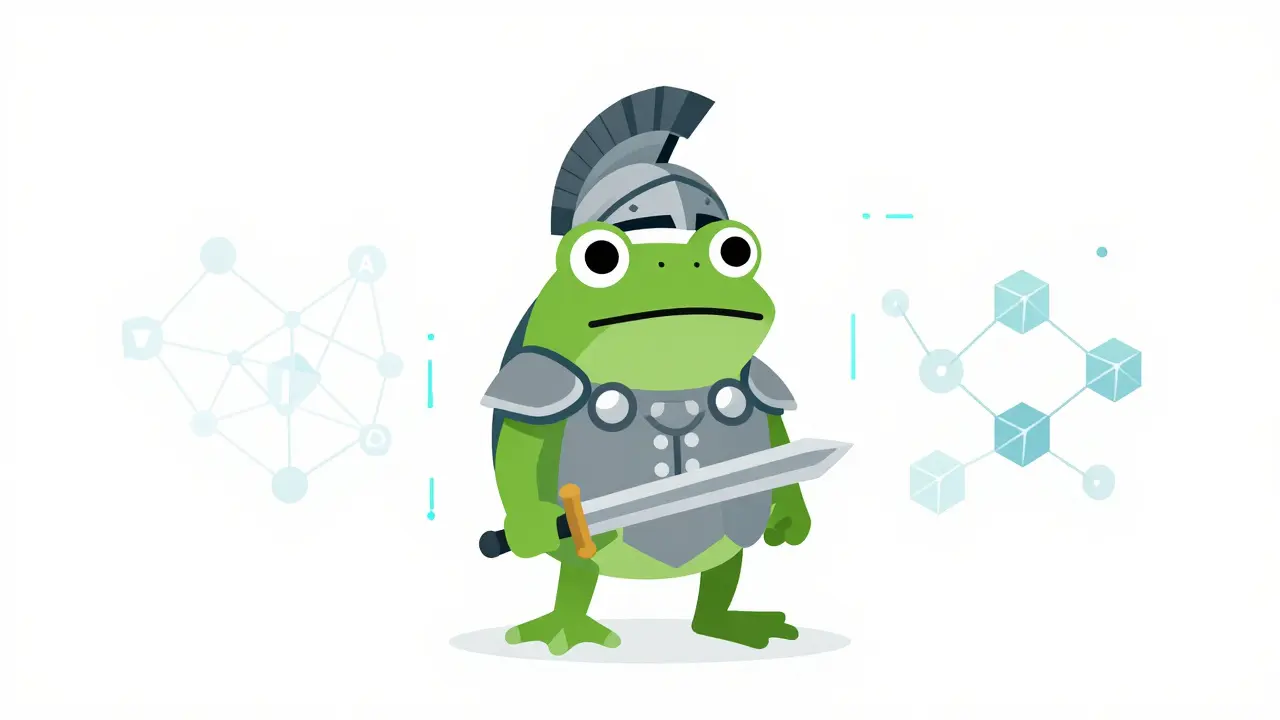
Kekius Maximus is a cryptocurrency that blends high-concept internet humor with blockchain technology. Specifically, it merges the viral imagery of Pepe the Frog with the stoic warrior character Maximus from the film *Gladiator*. But what makes it particularly interesting right now is its origin story. Unlike most meme coins created by anonymous developers in Discord chats, KEKIUS was reportedly generated by Grok, an artificial intelligence model developed by xAI. This connection to AI-generated content has sparked debates about authenticity, value, and the future of decentralized finance.
The Origin Story: AI Meets Meme Culture
To understand why people are buying KEKIUS, you have to look at where it came from. In the world of cryptocurrency, narrative often drives price more than technology. The project draws its identity from two massive cultural touchstones. First, there is Pepe the Frog, the cartoon amphibian that became the face of online irony and later inspired the billion-dollar PEPE token. Second, there is Maximus Decimus Meridius, the protagonist of Ridley Scott’s 2000 epic Gladiator.
The fusion creates a brand that appeals to both crypto natives who love memes and mainstream audiences familiar with blockbuster cinema. However, the twist here is the creator. Sources indicate that Grok, the AI chatbot, played a central role in the token's conception. This raises immediate questions for investors: Who owns the smart contract? Is there a team behind the scenes, or is this purely an algorithmic experiment? While detailed information about the development team remains scarce-a common trait in meme projects-the association with Grok gives it a unique "tech-forward" aura compared to older meme coins like Dogecoin or Shiba Inu.
How KEKIUS Works on the Ethereum Blockchain
Technically, Kekius Maximus operates as an ERC-20 token on the Ethereum blockchain. This means it relies on Ethereum’s security infrastructure and network effects. To interact with KEKIUS, users need a compatible wallet, such as MetaMask or Trust Wallet, and some ETH to pay for gas fees-transaction costs required to process actions on the Ethereum network.
There is no centralized exchange listing that dictates the official price. Instead, trading happens primarily on decentralized exchanges (DEXs). The most prominent platform for this activity is Uniswap. When you want to buy or sell KEKIUS, you connect your wallet to Uniswap and paste the specific contract address for the token. This method offers direct peer-to-peer trading but comes with higher risks regarding slippage and liquidity depth compared to traditional exchanges.
Because it lives on Ethereum, KEKIUS benefits from the vast ecosystem of tools available for tracking balances, analyzing transactions, and securing assets. However, it also inherits Ethereum’s volatility in transaction fees. During periods of high network congestion, swapping KEKIUS can become expensive, which might deter small-scale traders.
Supply Mechanics and Tokenomics
When evaluating any cryptocurrency, understanding the supply is crucial. For Kekius Maximus, the numbers are straightforward but significant. The total circulating supply is fixed at 1,000,000,000 tokens (one billion KEKIUS). There is no mention of inflationary mechanisms or minting functions that would increase this number over time. This fixed supply model mimics Bitcoin’s scarcity principle, although on a much smaller scale.
With only one billion tokens in circulation, each individual token carries more weight than those with quadrillions in supply, like Shiba Inu. This affects how prices are perceived. A price of $0.01 for KEKIUS represents a different market capitalization than a price of $0.000001 for another meme coin. Investors should always calculate the fully diluted valuation (FDV) by multiplying the current price by the total supply to get a realistic sense of the project’s size.
Market Performance and Price Volatility (May 2026)
If you’re looking to trade KEKIUS, you need to be prepared for extreme volatility. As of May 2026, the token exhibits significant price discrepancies across different platforms, highlighting the fragmented nature of its liquidity. This is a critical detail for anyone considering entry or exit strategies.
| Platform | Price (USD) | 24h Volume (USD) | Market Cap (USD) |
|---|---|---|---|
| Coinbase | $0.0241 | N/A | ~$24.1M |
| Binance | $0.0129 | $2.41M | $12.92M |
| Crypto.com | $0.0095 | $568,901 | ~$9.5M |
| CoinMarketCap (Agg.) | $0.0086 | $725,849 | $8.69M |
| Coinpedia | $0.0051 | $814,956 | ~$5.1M |
Notice the spread? On Coinbase, the token trades at roughly $0.024, while on Coinpedia, it sits near $0.005. This five-fold difference within the same day is not unusual for low-cap meme coins but poses serious arbitrage opportunities and risks. If you buy on a cheaper DEX and sell on a more liquid CEX, you might profit-but if the market crashes while you’re transferring funds, you could lose everything.
Historical data shows that KEKIUS has experienced dramatic swings. Some sources report an all-time high near $0.39, while others cite a more conservative peak of $0.0636 reached in May 2025. The all-time low is recorded around $0.044. These figures suggest that the token has already undergone multiple boom-and-bust cycles. Recent movements show mixed signals, with some platforms reporting slight declines over 24 hours while others show modest gains.
The Role of Social Sentiment and Influencers
In the meme coin economy, social sentiment is king. KEKIUS has seen spikes in interest correlated with mentions by high-profile figures. Reports indicate that endorsements or casual references by individuals like Elon Musk have historically triggered substantial volume increases. Musk’s influence on crypto markets is well-documented; his tweets have previously sent Dogecoin and Shiba Inu soaring.
However, relying on influencer hype is dangerous. Prices often pump rapidly after such announcements and then dump just as quickly as early buyers take profits. This pattern, known as "buy the rumor, sell the news," is prevalent in KEKIUS trading. Community-driven momentum keeps the token alive, but without fundamental utility, the price depends entirely on whether new participants continue to believe in the joke.
Risks and Considerations for Investors
Before connecting your wallet, consider the risks involved. First, there is the issue of transparency. Detailed smart contract audits are not readily available in public sources. Without a verified audit from a reputable firm, there is no guarantee that the code doesn’t contain hidden vulnerabilities or malicious functions, such as a rug pull mechanism where developers can drain liquidity.
Second, liquidity fragmentation is a major hurdle. Because KEKIUS trades on various DEXs and CEXs with differing volumes, executing large orders can cause significant slippage. You might intend to sell $10,000 worth of KEKIUS, but due to thin order books, you might only receive $8,000. Always check the depth chart before making large trades.
Third, regulatory uncertainty looms over all meme coins. Governments worldwide are scrutinizing cryptocurrencies, particularly those lacking clear utility. While KEKIUS operates on Ethereum, which is generally viewed favorably, the speculative nature of the token could make it a target for stricter regulations in the future.
How to Buy KEKIUS Safely
If you decide to proceed, follow these steps to minimize risk:
- Set up a secure wallet: Use a non-custodial wallet like MetaMask. Never store private keys on a computer connected to unsecured networks.
- Acquire ETH: Since KEKIUS is an ERC-20 token, you need Ethereum to pay for gas fees. Purchase ETH on a reputable exchange and transfer it to your wallet.
- Find the correct contract address: Verify the KEKIUS contract address on official channels or trusted aggregators like CoinMarketCap. Copying the wrong address could lead to losing your funds to a scam token.
- Use a DEX: Connect your wallet to Uniswap or another supported DEX. Paste the contract address and set your slippage tolerance appropriately (usually 1-5% for volatile tokens).
- Execute the swap: Review the transaction details carefully, including the estimated gas fee, before confirming the swap.
Always start with a small amount to test the process. Remember, in the world of meme coins, preserving capital is more important than chasing gains.
Who created Kekius Maximus (KEKIUS)?
Kekius Maximus was reportedly created by Grok, an AI model developed by xAI. The project combines elements of the Pepe the Frog meme and the character Maximus from the movie Gladiator. Unlike many meme coins with anonymous teams, its AI origins make it a unique case study in automated content generation and community adoption.
Is KEKIUS listed on Binance or Coinbase?
Yes, KEKIUS appears on several major exchanges including Binance, Coinbase, and Crypto.com, as well as decentralized platforms like Uniswap. However, prices vary significantly between these venues. Coinbase has shown higher valuations compared to aggregated data on CoinMarketCap, indicating potential arbitrage opportunities but also execution risks.
What is the total supply of KEKIUS?
The total circulating supply of Kekius Maximus is 1,000,000,000 (one billion) tokens. This fixed supply means there is no inflation, similar to Bitcoin, but the smaller total supply results in a higher per-token price compared to coins with quadrillion supplies.
Why does the price of KEKIUS differ so much across exchanges?
Price differences arise due to varying liquidity levels and trading volumes on each platform. Centralized exchanges like Binance may have deeper order books, supporting higher prices, while smaller DEXs or less liquid venues might show lower prices. This fragmentation allows for arbitrage but increases the risk of slippage for traders.
Is KEKIUS a safe investment?
Like all meme coins, KEKIUS is highly speculative and risky. It lacks fundamental utility, and its value is driven primarily by social sentiment and hype. Additionally, the lack of publicly available smart contract audits adds technical risk. Investors should only allocate funds they can afford to lose entirely.
Leave a comments