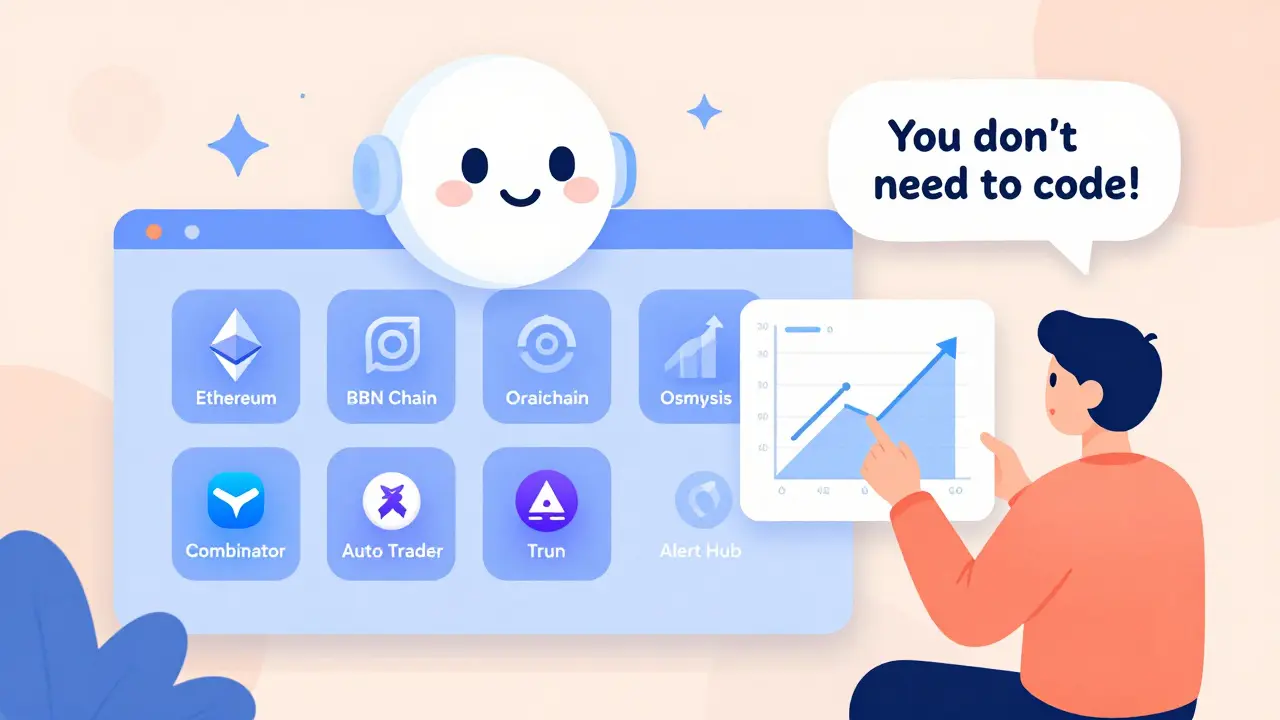
Orchai (OCH) isn’t another meme coin. It’s a utility token built for a very specific purpose: making decentralized finance easier for people who don’t want to code. Launched on February 22, 2024, Orchai tries to solve one real problem in DeFi - it’s too complicated. Most DeFi platforms assume you know what liquidity pools are, how to stake, and how to read blockchain analytics. Orchai says: you don’t need to. Instead, it uses AI to do the heavy lifting.
What Does Orchai Actually Do?
Orchai is a low-code platform that connects to six blockchains: Ethereum, BNB Chain, Oraichain, Osmosis, Tron, and Cosmos Hub. It doesn’t just let you swap tokens. It gives you tools to manage your crypto like a pro - without being a pro. There are three main AI-powered features:- Combinator: Suggests portfolio mixes based on market trends. Claims up to 900% APR - but that’s the best-case scenario, not what most users get.
- Auto Trader: Automatically executes trades when certain conditions are met, like price drops or volume spikes.
- Alert Hub: Sends real-time notifications about market moves, protocol updates, or gas fee changes.
On top of that, Orchai runs two core protocols:
- Liquid Staking: You stake your ETH or other assets and get a tokenized version (sAsset) that you can use as collateral to borrow USDT.
- Money Market: Deposit stablecoins like USDT and earn interest, or borrow against your staked assets.
Think of it like a financial assistant that runs on blockchain. You set your goals - “I want steady income” or “I want to grow my portfolio” - and the AI picks the best DeFi strategies for you.
The OCH Token: How It Works
The OCH token is the engine behind all this. It’s an ERC-20 token on Ethereum with the contract address0x19373ecbb4b8cc2253d70f2a246fa299303227ba. There are only 20 million OCH tokens total. When it launched, each one sold for $0.40. Today, it trades around $0.0177 - down 95% from its peak.
OCH has four uses:
- Co-Harvest: Buy discounted stablecoins through auctions.
- Reward: Earn xOCH, a reward token you can convert 1:1 back to OCH.
- Payment: Pay for platform fees, like using Auto Trader or accessing premium alerts.
- DAO Governance: Vote on future upgrades or changes to the platform.
That last one is important. It means OCH holders can influence where the project goes. But here’s the catch: the top 10 wallets hold 47.3% of all OCH tokens. That’s a huge concentration of power. If a few big holders decide to sell, the price can crash fast.
How Much Is Orchai Worth? The Hard Numbers
As of January 2026, Orchai’s market cap is just $77,870. That puts it at #7868 on CoinMarketCap - way below even the smallest active tokens. Compare that to Uniswap ($3.2 billion) or Aave ($1.1 billion). Orchai isn’t just small - it’s microscopic in the DeFi world.Trading volume? Barely any. On most days, less than $50 worth of OCH changes hands. That’s not a market. That’s a garage sale. You can only buy OCH on Uniswap v3. No Binance, no KuCoin, no Coinbase. If you want to trade it, you need to use a decentralized exchange - which means you need a crypto wallet, ETH for gas, and some experience navigating UIs that aren’t always intuitive.
The platform’s Total Value Locked (TVL) is $720,000. That sounds like a lot until you realize the entire DeFi ecosystem holds $55 billion. Orchai controls 0.0013% of it. That’s like trying to fill a swimming pool with a teaspoon.
Who’s Using It? Real User Feedback
There are about 1,600 wallet holders of OCH. That’s not a community. That’s a small group of early believers - and a lot of people stuck with tokens they can’t sell.On Reddit, users are blunt:
“Tried using their platform but the UI felt unfinished and the promised 900% APR is clearly marketing hype - actual yields were closer to 5%.” - u/DeFi_Detective, December 2025
One person on Telegram said they made 3x during the April 2024 pump - then watched it drop 98%. Now they’re stuck with tokens nobody wants to buy.
On Twitter, 68% of mentions about OCH are negative. The main complaints? Price crashes, no liquidity, and a platform that feels buggy. Customer support? Average response time is 72 hours. On Discord, 68% of questions go unanswered.
Even the documentation - usually a saving grace for small projects - gets mixed reviews. GitHub users rate it 3.2/5 for clarity. That’s not bad, but for something this complex, it’s not good enough.
Why Is This So Risky?
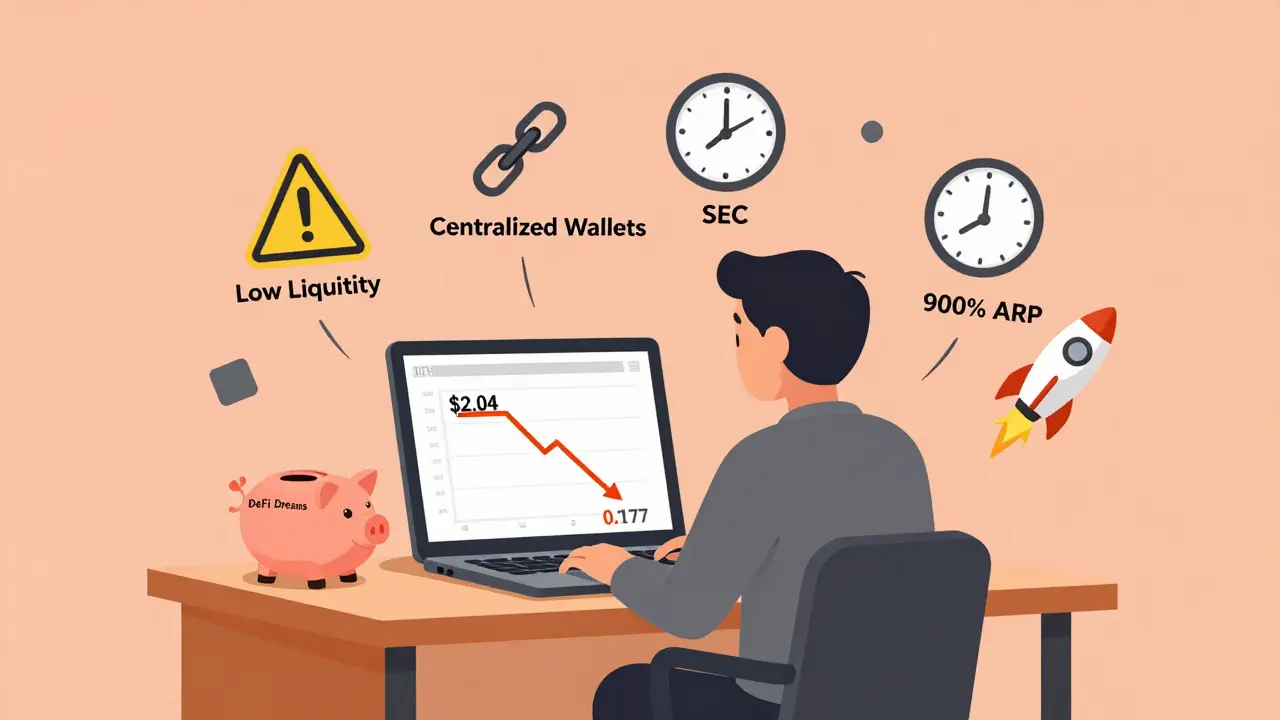
Here’s the reality: Orchai is a high-risk, low-liquidity project. The risks aren’t theoretical. They’re happening right now.- Price Volatility: OCH dropped from $2.04 in April 2024 to $0.0177 in January 2026. That’s a 98.88% loss. If you bought at launch, you’re down 95%.
- Liquidity Crunch: With $4.20 in daily volume, even a $100 trade can move the price 15-20%. You’ll pay huge slippage.
- Centralization: Almost half the supply is in 10 wallets. That’s not decentralized. That’s a cartel.
- Regulatory Risk: The SEC’s 2025 guidance on utility tokens could classify OCH as a security because of its governance and reward functions. No action yet - but it’s a ticking clock.
- Competition: Big DeFi platforms like Aave, Compound, and Curve offer better security, more liquidity, and real audits. Orchai offers AI and low-code - but if the AI doesn’t work and the platform crashes, you lose everything.
Some experts see potential. Blockchain consultant David Rodriguez said in December 2025: “The concept of AI-assisted portfolio management through a low-code interface could appeal to retail investors if execution improves.” But “if” is the key word. So far, execution has been shaky.

Should You Buy Orchai (OCH)?
If you’re looking for a safe investment - no. Don’t touch it.If you’re a crypto enthusiast who likes to experiment with bleeding-edge projects - maybe. But only with money you can afford to lose completely.
Here’s who it might work for:
- Someone who bought at $0.40 and is holding for a moonshot recovery.
- A developer who wants to test AI-DeFi integrations.
- A trader who bets on low-volume tokens hoping for a pump.
Here’s who should stay away:
- Anyone seeking stable returns.
- People who don’t understand slippage or impermanent loss.
- Investors who rely on exchange listings for liquidity.
The platform’s roadmap for 2026 includes adding Polygon, Avalanche, and Solana, plus a full UI overhaul. But past performance suggests delays are likely. And even if they deliver, they’re competing against giants with billions in funding.
How to Get Started (If You Still Want To)
If you’re determined to try Orchai, here’s how:- Get a Web3 wallet: MetaMask or Trust Wallet.
- Buy ETH to pay for gas fees.
- Go to Uniswap v3.
- Search for OCH using the contract address:
0x19373ecbb4b8cc2253d70f2a246fa299303227ba. - Swap ETH for OCH. Expect high slippage - set it to at least 10%.
- Connect your wallet to the Orchai platform and start exploring tools.
Don’t deposit more than you’re willing to lose. And never trust the 900% APR claims. That’s a theoretical max under perfect conditions - not reality.
Final Verdict
Orchai (OCH) is an interesting idea that’s struggling to survive. It’s not a scam - the team is still working on it. But it’s also not a viable investment. The market doesn’t care. The liquidity is gone. The users are leaving. The price is collapsing.It’s a cautionary tale. AI-powered DeFi isn’t the problem. The problem is launching a project with no liquidity, no exchange support, and unrealistic promises - then expecting the market to reward you.
For now, Orchai is a lab experiment, not a financial tool. Watch it. Learn from it. But unless you’re prepared to lose everything, don’t put money in it.
Hailey Bug
17 01 26 / 14:19 PMOrchai’s AI tools sound promising in theory, but the execution is a mess. Low liquidity, no exchange listings, and a UI that feels like it was built by a grad student on caffeine - it’s not a financial tool, it’s a beta test with real money at stake. If you’re not prepared to lose it all, walk away.
Dustin Secrest
18 01 26 / 05:26 AMThe real tragedy here isn’t the price collapse - it’s the wasted potential. The concept of AI-driven DeFi simplification is elegant, even noble. But without liquidity, governance decentralization, or functional infrastructure, it’s like building a cathedral in a desert and then complaining no one comes to worship.
Stephen Gaskell
18 01 26 / 13:03 PMUS investors should avoid this. No exchange listing? No liquidity? This isn’t innovation - it’s gambling with a fake name.
CHISOM UCHE
20 01 26 / 04:34 AMThe OCH token’s utility stack is structurally sound - Co-Harvest, xOCH reward mechanics, DAO governance - but the liquidity asymmetry and centralization of supply (47.3% in top 10 wallets) introduce systemic fragility. The TVL-to-market-cap ratio is pathological, and the slippage dynamics render arbitrage impossible. This isn’t DeFi; it’s a liquidity trap with a front-end.
Chris Evans
20 01 26 / 23:06 PMThey built a spaceship out of duct tape and hope and called it the future of finance. And now? The rocket’s on fire, the crew’s panic-booking tickets on the next shuttle to Solana, and the launchpad is just a Reddit thread with 1,600 people staring at their losses like they’re waiting for a miracle. The AI doesn’t save you. The market does. And the market walked away.
Sarah Baker
21 01 26 / 12:58 PMI know it’s painful to watch something you believed in crash - I’ve been there. But this isn’t the end. It’s a lesson. The team’s still working. The roadmap’s still there. Maybe this is the quiet before the storm. Don’t give up on the idea - just don’t bet your rent money on it. Keep learning. Keep watching. And if they ship the UI overhaul? Maybe, just maybe, it’ll rise again. But for now? Hold lightly.
Pramod Sharma
21 01 26 / 15:44 PMAI in DeFi is the future. But this? Too early. Too small. Too broken. Wait for the next version.
nathan yeung
22 01 26 / 18:19 PMLook, I get why people are mad. But the team didn’t scam anyone. They just built something nobody wanted yet. Maybe they need more time. Maybe they need better marketing. Or maybe the whole AI-DeFi thing is just hype. Either way, I’m not throwing stones. I’m just watching.
Chris O'Carroll
22 01 26 / 20:02 PM900% APR? More like 900% B.S. The whole thing smells like a Discord influencer’s side hustle with a whitepaper and a prayer. I’ve seen this movie. The credits roll with a ‘thank you for your support’ and a 98% loss. Don’t be the extra who dies in the first act.
ASHISH SINGH
24 01 26 / 02:03 AMLet’s be real - this isn’t a project. It’s a honey trap. The top 10 wallets? Probably the dev team and their cousins. The ‘AI’? A bot that flips between three pre-set strategies. The ‘DAO’? A voting system where your vote only matters if you hold more than $10k. This is a rug pull with a PhD. They didn’t fail - they succeeded. They got the dumb money in, and now they’re sipping margaritas while you check your wallet every 17 minutes.