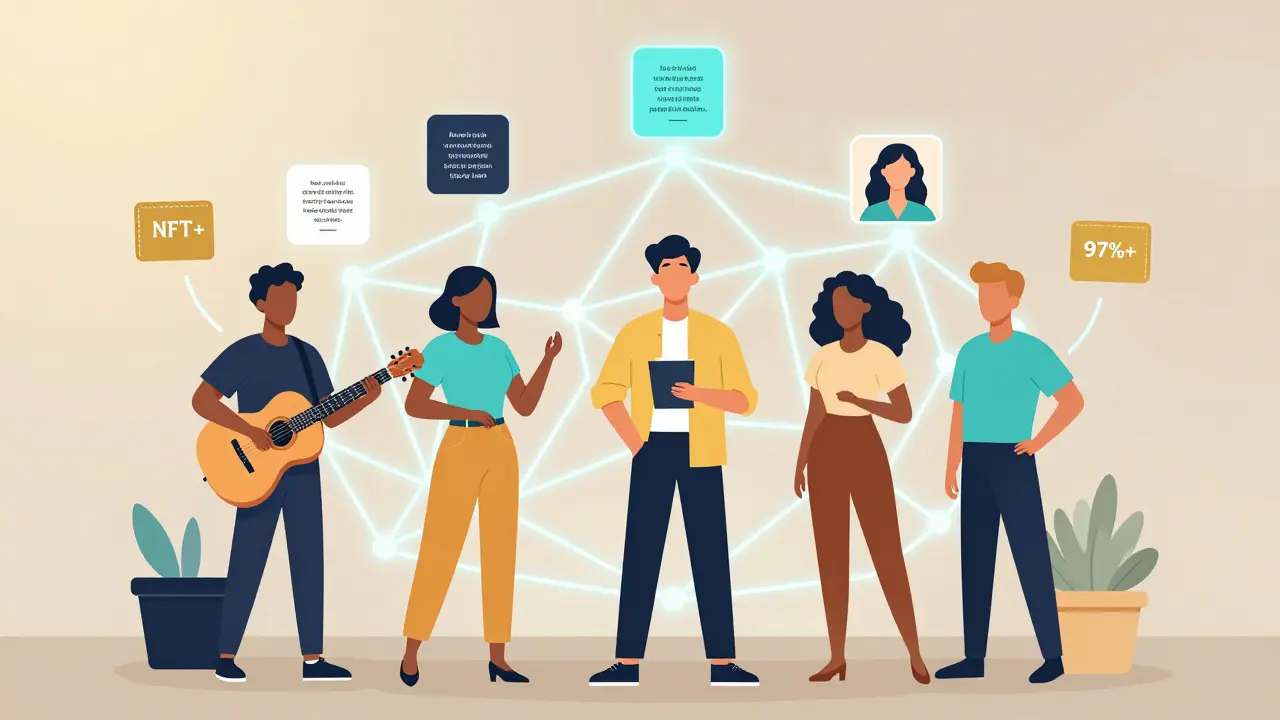
For years, creators have been told to build audiences, post daily, and trust platforms to pay them fairly. But the truth is, if you’re on YouTube, Instagram, or TikTok, you’re not really in control. You don’t own your audience. You don’t own your content. And you rarely see more than half of what you earn. That’s where the blockchain creator economy changes everything.
It’s Not Just Another Platform - It’s a New System
The blockchain creator economy isn’t another app you download. It’s a whole new way for artists, writers, musicians, and content makers to get paid. Instead of relying on companies like YouTube or Patreon to decide how much you earn and when you get paid, blockchain lets you connect directly with your fans. And it does it using technology that can’t be changed or shut down - the blockchain.Here’s how it works in practice: when you upload a song, a drawing, or even a blog post, you turn it into a unique digital asset called an NFT. That NFT lives on a blockchain, which means anyone can see who made it, who owns it, and how much money it’s earned. No middleman. No hidden rules. Just proof.
Smart contracts - self-executing pieces of code - handle the money. If someone buys your NFT, the payment goes straight to your wallet. If your song gets sampled by another artist, you get paid automatically. If your NFT gets resold later, you still earn a cut - maybe 10%, maybe 20%. That’s built in from day one. No chasing invoices. No waiting 45 days for a payout.
Why This Matters More Than You Think
Think about how much you’ve lost over the years. Maybe you spent months making a video that got 500,000 views. YouTube took 45% of the ad revenue. Then Instagram promoted a similar video from someone else and you got nothing. Or maybe you sold digital art on Etsy, but after fees, you made $12 from a $50 sale.On blockchain platforms, creators keep 97.5% to 99% of what’s earned. That’s not a rumor. It’s built into the system. Platforms like Foundation, Zora, or Mirror charge only 1% to 2.5% in fees - not because they’re being generous, but because they don’t need to. They make money from token growth, not by taking a cut of your sales.
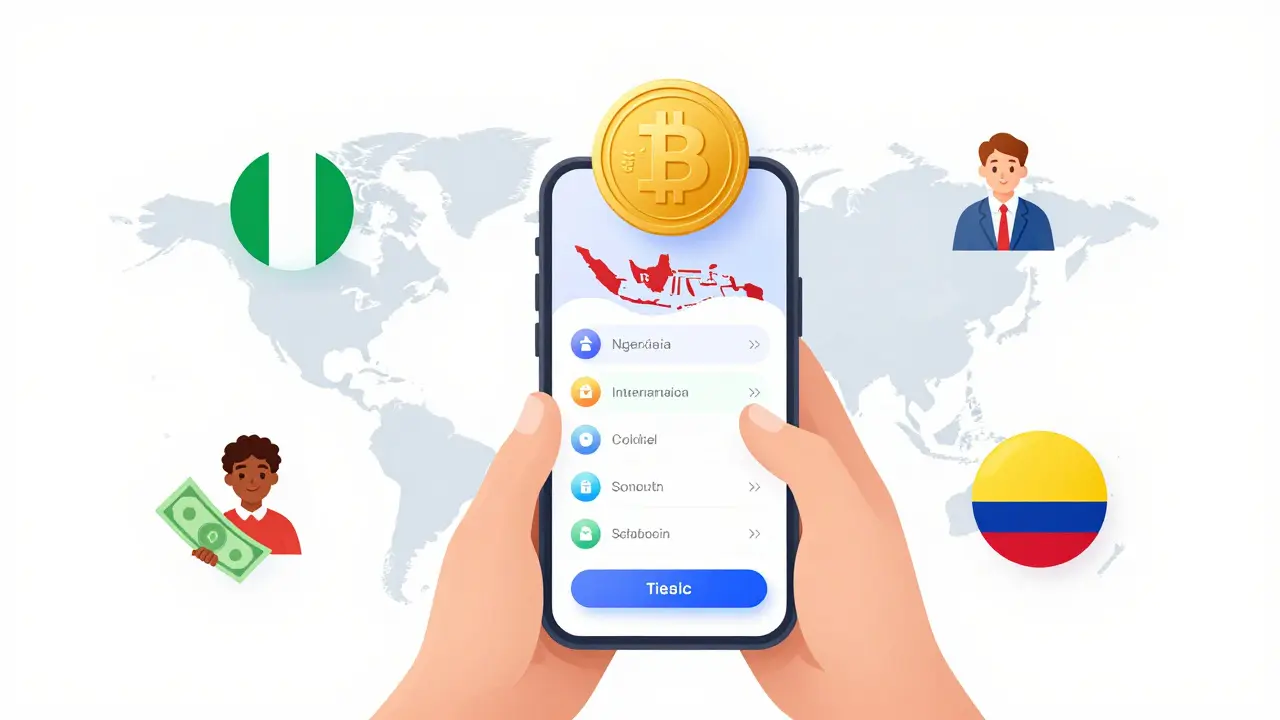
This matters most for creators outside the U.S. or Europe. In Nigeria, Indonesia, or Colombia, many people can’t open a bank account. Or if they can, international payments take weeks and cost 15% in fees. With a smartphone and a crypto wallet, they can sell their art, music, or writing to anyone in the world - and get paid in minutes. Stablecoins like USDC, which are tied to the U.S. dollar, help avoid wild crypto price swings. One musician in Lagos told a reporter he made more in one week on a blockchain platform than he had in six months on Spotify.
What You Actually Need to Get Started
You don’t need to be a tech expert. You don’t need to understand mining or consensus algorithms. Here’s what you actually need:- A smartphone or computer with internet
- A crypto wallet (like MetaMask or Phantom)
- A blockchain creator platform (like Mirror for writing, Sound.xyz for music, or Foundation for art)
- Some small amount of cryptocurrency to pay transaction fees (usually under $5)
Setting up your wallet takes 15 to 30 minutes. Most platforms walk you through it. You’ll get a recovery phrase - write it down on paper, never store it online. That’s your key to everything. If you lose it, you lose access forever. Treat it like your passport.
Once your wallet is ready, you connect it to a platform. Then you upload your work. Click a button to mint it as an NFT. That’s it. Your content is now on the blockchain. You can sell it outright, auction it, or offer it as a limited edition. You can even set up royalties so you earn every time it changes hands.
Real Examples - Not Theory
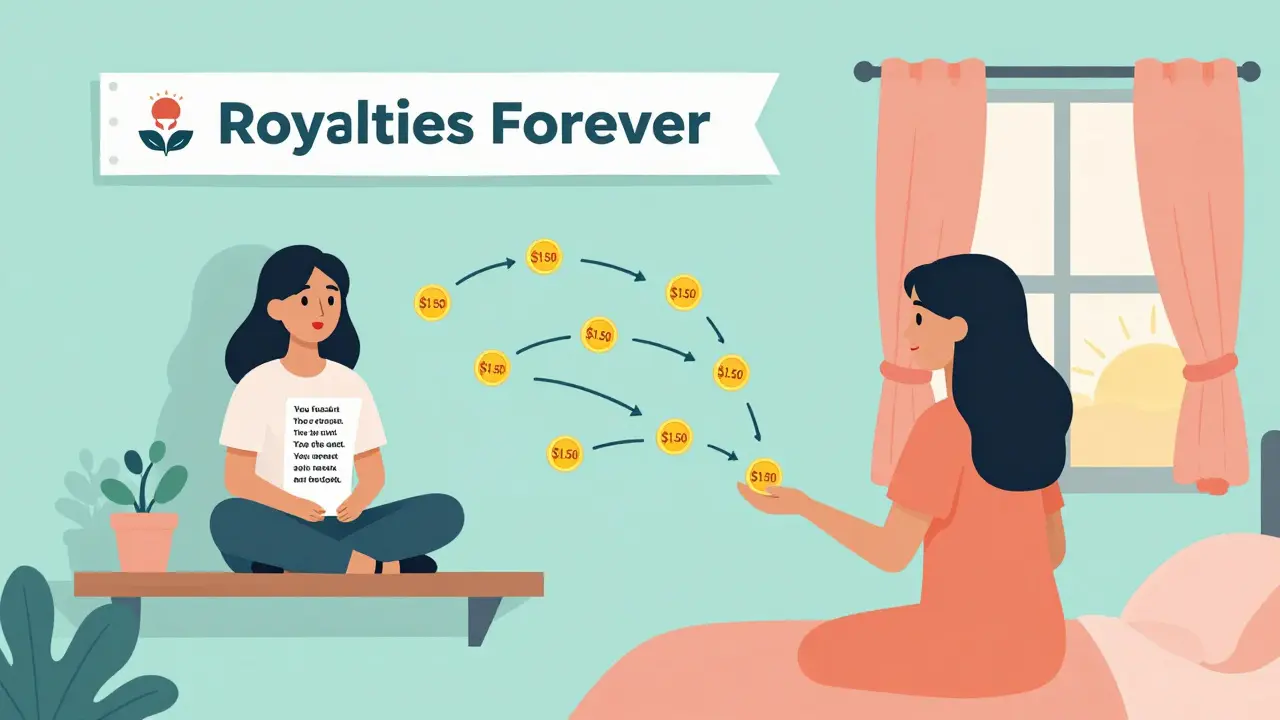
In 2024, a poet from Manila sold 50 limited-edition digital poems as NFTs. Each one cost $10. She made $500. Because she set a 15% royalty, every time someone resold one, she got $1.50. Within six months, 32 resales happened. She earned another $48 - just for creating something once.A band in Brazil released an album as NFTs. Instead of giving 80% of sales to a label, they kept 98%. Fans who bought the NFTs got exclusive access to live streams, unreleased tracks, and voting rights on future releases. The band didn’t need a distributor. No record label. No advance they had to pay back. Just direct sales.
Even journalists are using this. On Mirror, writers publish long-form stories and let readers tip them in ETH or USDC. Some have earned $10,000+ in a year - without ads, without sponsors, without a publisher.
The Downsides - And How to Handle Them
This isn’t magic. There are real challenges.Learning curve: About 68% of new creators struggle with their first wallet setup. Transaction errors happen. You might send funds to the wrong address. That’s irreversible. That’s why YouTube tutorials and Discord communities are essential. There are over 12,000 step-by-step videos online. Find one that matches your platform.
Volatility: If you’re paid in ETH and its price crashes, you lose value. That’s why most creators now use stablecoins like USDC. They’re worth $1, always. No guessing.
Adoption: Your fans might not know what a wallet is. You’ll need to explain it. Some will say no. But those who do understand? They become loyal. They’re not just buyers - they’re investors in your work.
Regulation: Some countries are still figuring out how to treat NFTs and crypto. The EU has clear rules. The U.S. doesn’t. If you’re based in a restrictive region, stick to platforms that comply with local laws. Use stablecoins. Keep records.
Who’s Winning Right Now?
As of late 2024, around 8.7 million creators are active in the blockchain creator economy. That’s only 4.35% of the estimated 200 million creators worldwide. But growth is explosive. In regions without strong banking systems, creator participation jumped 227% in one year.Big companies are watching. Warner Music Group now uses blockchain to pay artists. Royalty payments that used to take 90 days now happen in minutes. Artists got 32% more money. No more waiting for quarterly statements. No more disputes over streaming numbers.
AI is starting to mix in too. Some platforms now let you create music or art with AI, then automatically split royalties between you and the AI model. It’s new, but it’s happening.
Where This Is Headed
By 2028, experts predict blockchain creator platforms will handle 18% to 22% of all creator income. That’s not the whole pie - but it’s a huge slice. The real shift isn’t just about money. It’s about power. Creators are no longer begging platforms for visibility. They’re building their own economies.Imagine a world where your podcast, your paintings, your code, your writing - all of it - belongs to you. Where every person who supports you gets a share of your future success. Where you’re not a user. You’re a stakeholder.
That’s the blockchain creator economy. It’s not perfect. It’s not easy. But it’s real. And it’s growing faster than any platform ever has.
Is the blockchain creator economy only for artists and musicians?
No. Anyone who creates digital content can use it. Writers, podcasters, photographers, game developers, educators, even coders who build open-source tools are using blockchain to monetize their work. If you make something that people value, you can turn it into an NFT and sell it directly.
Do I need to buy cryptocurrency to start?
You don’t need to buy crypto to begin learning, but you’ll need a small amount - usually under $5 - to pay for transaction fees when you mint your first NFT. These fees, called gas fees, vary by network. Many platforms let you pay with USDC, a stablecoin tied to the U.S. dollar, so you avoid price swings.
Can I still use YouTube or Instagram while using blockchain?
Yes, absolutely. Most creators use both. You post teasers on Instagram or TikTok to drive traffic to your blockchain store. You link your NFT collection in your bio. Blockchain isn’t meant to replace your social media - it’s meant to give you control over your income.
Are NFTs just digital collectibles?
They can be - but in the creator economy, they’re more like ownership certificates. When you buy an NFT of a song, you’re not just getting a file. You’re getting proof that you own a piece of that creation. You might get access to exclusive content, voting rights, or future royalties. It’s not about trading cards - it’s about building a relationship.
Is the blockchain creator economy safe?
The blockchain itself is secure - once something is recorded, it can’t be changed. But your wallet is your responsibility. If you lose your recovery phrase, you lose everything. Scammers will try to trick you into giving it away. Never share it. Never enter it on a website. Use hardware wallets if you’re selling high-value items. And always double-check addresses before sending money.
What happens if a blockchain platform shuts down?
Your NFTs and your money stay safe. They’re stored on the blockchain, not on the platform. Even if Mirror or Sound.xyz disappears, you can still access your NFTs through any other wallet or marketplace that supports the same blockchain. Your content is yours - not theirs.
How long does it take to make money?
There’s no guaranteed timeline. Some creators earn their first $100 in a week. Others take months. Success depends on your audience, your consistency, and how well you explain the value. Don’t treat it like a get-rich-quick scheme. Treat it like building a business - one piece of content at a time.
Can I earn passive income with this?
Yes. That’s one of the biggest advantages. Set a royalty percentage when you mint your NFT, and you’ll earn every time someone resells it - forever. A song you uploaded in 2025 could still pay you in 2030. That’s the power of smart contracts: automation that works without you lifting a finger.
Harshal Parmar
26 01 26 / 20:00 PMbro i just tried this last week and honestly it changed my life. i’m a freelance illustrator in india and before this i was making like $20 a month on etsy after fees. now i minted 10 pieces on foundation, sold them all for 0.1 eth each (about $250), and i’m still getting $3 every time someone resells one. no bank, no waiting, no middlemen. my mom still doesn’t get it but my fans? they’re obsessed. this isn’t hype, it’s survival now.
Brenda Platt
27 01 26 / 16:28 PMOMG YES!! 🙌 I started last month and I’ve already made more from 3 NFT poems than I did in 6 months on Substack. The royalties? I’m literally sleeping on money now. 🤫✨ If you’re hesitating because you think it’s ‘too techy’-nope. Just download MetaMask, watch a 10-min YouTube video, and go. Your art deserves to be owned by YOU, not some ad algorithm. You got this!! 💪🎨
Jen Allanson
28 01 26 / 17:03 PMWhile I appreciate the enthusiasm, this narrative is dangerously naive. The blockchain creator economy is a speculative bubble dressed in ethical clothing. The environmental cost of Ethereum’s proof-of-work legacy alone should give pause. Moreover, the claim that creators ‘keep 97.5%’ ignores gas fees, exchange rate volatility, and the hidden tax implications of crypto income. In the U.S., the IRS treats NFT sales as capital gains-often at 20%+ rates. And let’s not pretend that ‘ownership’ means anything when 90% of buyers are speculators, not supporters. This is financialization masquerading as liberation.
Adam Lewkovitz
29 01 26 / 19:23 PMall this crypto nonsense is why america is falling behind. we got real jobs, real paychecks, real banks. now some guy in nigeria is getting paid in usdc because he drew a cat? that’s not empowerment, that’s delusion. if you want to make money, work hard. don’t trade your soul for a wallet address. and who the hell needs a ‘recovery phrase’? sounds like a scam waiting to happen. i’d rather get paid in cash than some digital ghost money
Clark Dilworth
30 01 26 / 00:28 AMIt’s worth noting that the underlying infrastructure relies on ERC-721 and ERC-1155 token standards, which enable atomic, non-fungible representation of intellectual property on-chain. The smart contract layer, typically deployed via Solidity on EVM-compatible chains, automates royalty enforcement through the transfer() function with embedded fee structures. This is a paradigm shift from centralized gatekeeping to decentralized provenance-essentially, a trustless, permissionless licensing layer for creative labor. The real disruption isn’t monetization-it’s the re-architecting of creator-audience value exchange via cryptographic accountability.
Mark Estareja
30 01 26 / 20:04 PMokay but have you seen the gas fees on polygon? i spent $18 trying to mint one thing and it failed. then i tried again and it went through but my wallet got flagged by metamask as ‘suspicious activity’. now i’m locked out for 72 hours. this isn’t freedom, it’s a glitchy nightmare. and the ‘community’? everyone’s just trying to flip. nobody cares about the art. it’s just another casino with better graphics.
David Zinger
1 02 26 / 15:07 PMyou guys are all so naive. america thinks it invented everything but the real revolution is happening in nigeria and indonesia where people have zero banking access. blockchain isn’t about ‘making money’-it’s about survival. you think a 20-year-old in Jakarta can open a paypal account? no. but she can get a crypto wallet in 5 minutes. and yeah maybe 90% of nfts are trash but the 10% that survive? they’re the future. you hate it because you don’t understand it. and yes i used emojis because i’m not a robot
Barbara Rousseau-Osborn
1 02 26 / 15:53 PMso you’re telling me a poet from manila made $500 and then $48 more later? wow. what a miracle. meanwhile, my cousin who works at a real company makes $65k a year and has health insurance. you’re romanticizing poverty. if you need blockchain to make $500, maybe you should’ve gone to college. and don’t even get me started on ‘royalties’-those are just gambling chips with extra steps. this isn’t art, it’s a pyramid scheme with a blockchain sticker on it. 🙄
george haris
2 02 26 / 02:20 AMwait-so if i make a podcast and turn it into an nft, i can still post it on spotify? and people who buy the nft get bonus episodes? that’s wild. i’ve been trying to monetize my show for years and this sounds like the first thing that actually makes sense. i’m gonna try it this weekend. anyone have a super simple guide for beginners? like, ‘click this, then this, don’t click that’? i’m not techy but i wanna try. thanks for the hope.
steven sun
3 02 26 / 17:13 PMbro i just minted my first song on sound.xyz and i got paid in usdc in 12 mins. no bank. no wait. no bs. i was scared but it was easier than setting up my netflix account. you dont need to be a genius. just do it. and if you mess up? its fine. everyone does. just try again. the future is here and its not waiting for you
Dave Ellender
3 02 26 / 21:04 PMI’ve been on both sides-the traditional platform grind and the blockchain experiment. I won’t pretend it’s perfect. But the moment I saw my royalty payments auto-deposit into my wallet every time someone resold my photo, I knew this wasn’t just a trend. It’s a quiet revolution. The tech is messy, yes. The learning curve is real. But the power shift? That’s irreversible. I don’t need to convince anyone. I just need to keep creating.
Darrell Cole
5 02 26 / 07:05 AMyou all are delusional. the blockchain creator economy is a marketing scam cooked up by venture capitalists who want to turn art into crypto gambling. the so called ‘97.5% retention’ ignores that 95% of creators earn less than $100 total. the ‘ownership’ narrative is laughable-your nft is just a jpeg linked to a url that could vanish tomorrow. and the ‘royalties’? they’re only enforced if the buyer uses the same platform. if someone downloads your art and sells it on ebay? you get nothing. this isn’t liberation. it’s a digital tulip bubble with extra steps and worse customer service