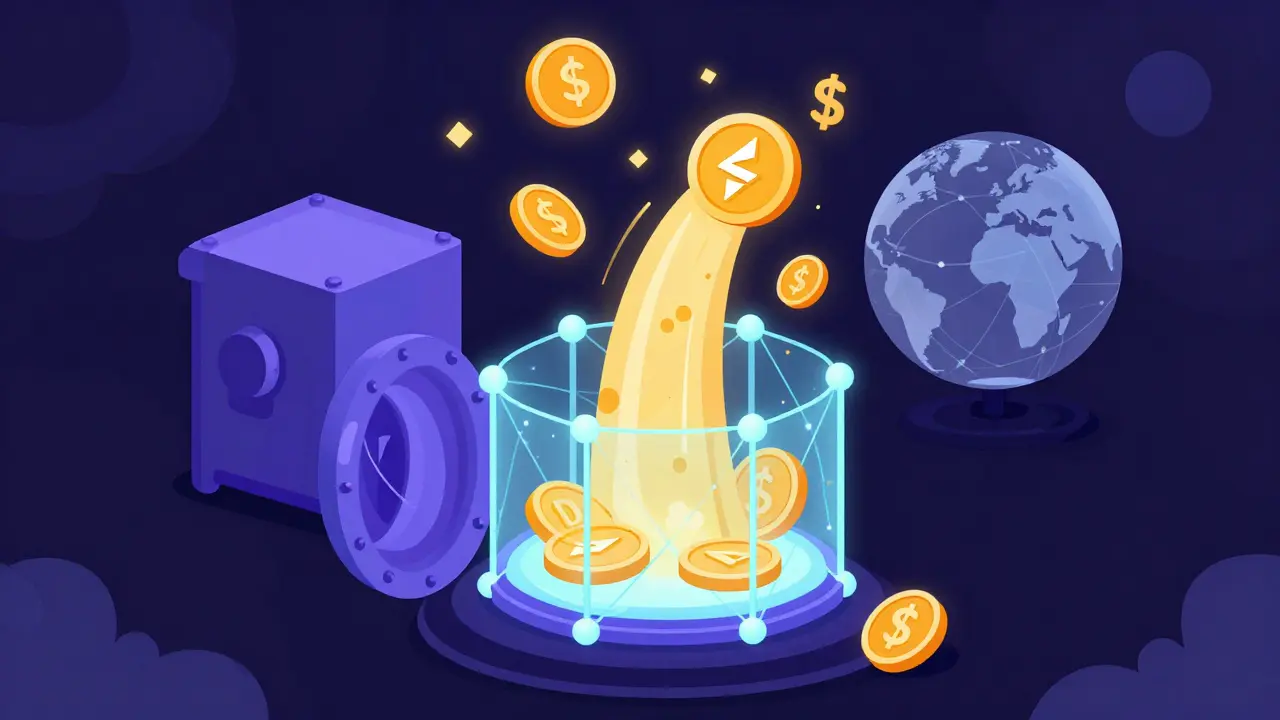
When you hear someone talk about DeFi, they often mention TVL-but what does that actually mean? Total Value Locked, or TVL, is the simplest way to answer one question: How much real money is actually working in these decentralized apps? It’s not about how many people are talking about a project. It’s not about how many followers it has on Twitter. It’s about the real cash, crypto, and stablecoins that real people have locked up because they believe in the system.
What Exactly Is TVL?
Total Value Locked is the total amount of cryptocurrency deposited into a DeFi protocol at any given time. Think of it like a bank vault, but instead of a building with guards, it’s a smart contract on a blockchain. When you lend your ETH on Aave, stake your USDC on Compound, or add liquidity to a trading pair on Uniswap, your funds go into these contracts. TVL adds up all those deposits across every protocol, chain, and token.
The value is always shown in US dollars. Why? Because comparing 10,000 ETH to 5 million DAI doesn’t make sense unless you convert both to something stable. So if you lock 10 ETH when each is worth $2,000, that’s $20,000. If you also lock 5,000 USDC (each worth $1), that’s another $5,000. Your TVL contribution? $25,000. Add up everyone else’s, and you get the protocol’s total TVL.
As of early 2026, the entire DeFi ecosystem has around $127 billion locked up. That’s not a small number. It’s more than the market cap of many public companies. And it’s growing-not because of hype, but because people keep putting their money in.
How Is TVL Calculated?
It’s not magic. It’s math. Here’s how it works in four steps:
- Identify all assets locked in the protocol: ETH, BTC, USDT, DAI, LINK, etc.
- Count how many of each are locked. For example, 87,000 ETH, 2.1 million USDC, 450,000 DAI.
- Multiply each amount by its current market price. If ETH is $2,100, then 87,000 ETH = $182.7 million.
- Add all the dollar values together. That’s the TVL.
Here’s a real-world example: A lending platform has:
- 10,000 DAI at $1.00 each → $10,000
- 5,000 USDC at $1.00 each → $5,000
- 10 ETH at $2,000 each → $20,000
- 0.5 BTC at $40,000 each → $20,000
Total TVL? $55,000.
Platforms like DefiLlama a leading DeFi analytics platform that tracks TVL across blockchains in real time, CoinGecko a cryptocurrency data aggregator that includes TVL as a core metric, and L2BEAT a platform focused on tracking Layer 2 solutions and their TVL do this automatically. They scan every smart contract, pull token balances, match them to live prices, and update the numbers every few minutes.
Why TVL Matters More Than Market Cap
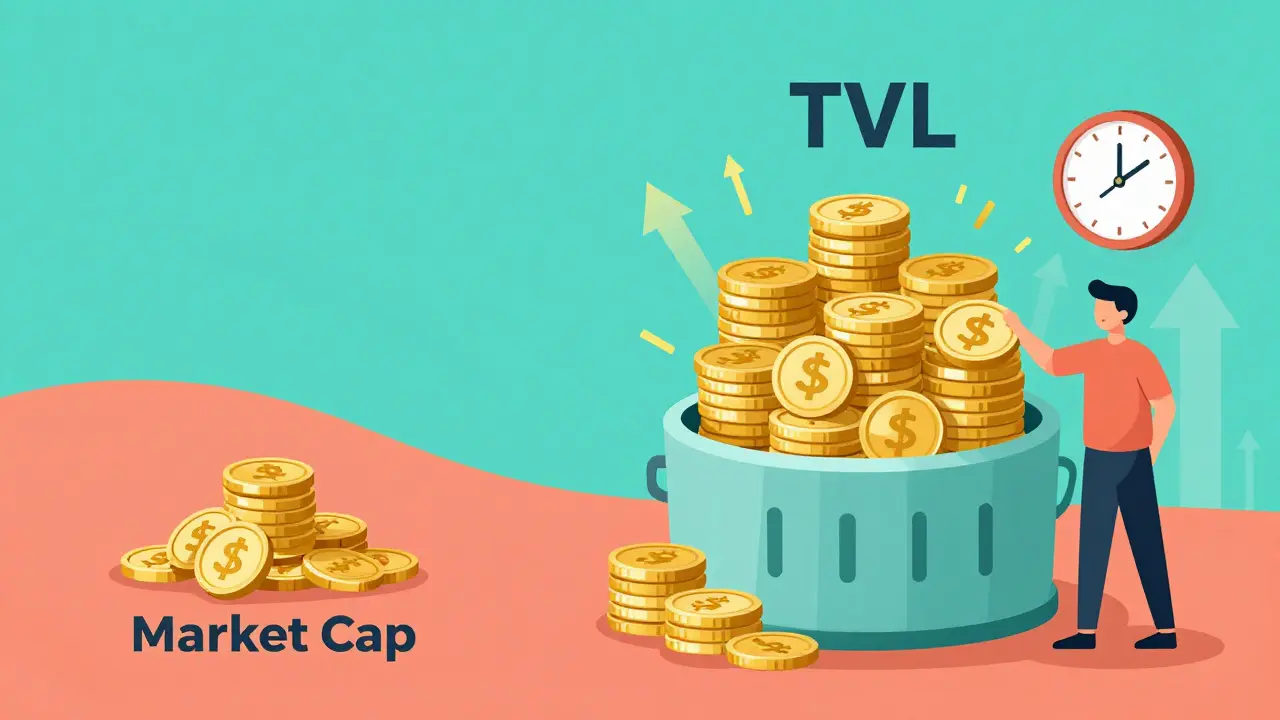
Most people look at market cap-the total value of all coins in circulation. But market cap can be misleading. A project might have 1 billion tokens, but if no one is using them, it’s just paper. TVL tells you what’s actually in use.
Take a DeFi protocol with a $500 million market cap but only $20 million in TVL. That means 96% of its tokens are sitting in wallets, not working. That’s not a healthy system. Now compare that to a protocol with a $100 million market cap and $80 million in TVL. That’s 80% of its supply actively deployed. That’s real adoption.
TVL shows:
- Trust-People are locking up money because they believe the system won’t fail.
- Liquidity-More TVL means more funds available for lending, borrowing, and trading with low slippage.
- Adoption-Growing TVL means more users are joining and staying.
- Comparison-You can see which chains (Ethereum, Solana, Base) or protocols (Uniswap, Aave, Curve) are winning.
For example, in 2025, Ethereum still held over 60% of all DeFi TVL, even as newer chains like Solana and Arbitrum grew fast. That didn’t mean they were better-it meant Ethereum had more capital, more users, and more trust.
What Makes TVL Go Up or Down?
TVL isn’t static. It moves every second. Three things change it:
- User deposits and withdrawals-If people start adding more ETH to a lending pool, TVL rises. If they pull it out to sell, TVL drops.
- Price changes-If ETH goes from $2,000 to $2,500, your TVL goes up-even if no one touched their funds. The same assets are now worth more.
- Incentives-Many protocols offer rewards (like extra tokens) to users who lock funds. When a new reward program launches, TVL spikes. When it ends, TVL often crashes.
This is why you can’t just look at one number. A sudden jump in TVL might mean a new reward program, not real growth. A drop might mean a price crash, not a loss of trust. You need to look at the trend over weeks or months.
TVL as a Tool for Investors
If you’re thinking about investing in DeFi, TVL is your first filter. Here’s how:
- Look for consistency-A protocol with steady TVL growth over 6 months is more reliable than one that spikes and crashes.
- Compare across chains-Which blockchain has the most stable TVL? That’s likely the safest bet.
- Watch for outliers-If a protocol has $100 million TVL but only $5 million in revenue, something’s off. It might be relying on fake incentives.
- Check historical data-DefiLlama lets you see TVL trends over the last year. If it’s been flat or falling, ask why.
Top DeFi projects like Uniswap, Aave, and Compound have maintained high TVL for years-not because they’re flashy, but because they’re reliable. They work. People keep using them. That’s the real signal.

Limitations of TVL
TVL isn’t perfect. It has blind spots:
- It doesn’t measure risk-A protocol with $1 billion TVL might be using untested smart contracts. High TVL doesn’t mean safe.
- It can be manipulated-Some projects use fake liquidity or bribe users with high rewards just to inflate TVL temporarily.
- It ignores revenue-A protocol might have high TVL but charge no fees. That’s not sustainable.
That’s why smart investors don’t rely on TVL alone. They combine it with other metrics: protocol revenue, user count, transaction volume, and audit reports. But TVL? It’s still the starting point.
The Bigger Picture
TVL is more than a number. It’s a heartbeat. Every dollar locked in a DeFi protocol is a vote of confidence. It says: I believe this system works better than banks. It says: I trust code over a CEO. It says: I’m not just speculating-I’m building.
As of 2026, DeFi isn’t a niche experiment anymore. It’s a $127 billion financial system running on open networks, accessible to anyone with an internet connection. And TVL is the clearest sign that it’s here to stay.
Is TVL the same as market cap?
No. Market cap is the total value of all coins ever created, even if they’re sitting idle in wallets. TVL only counts the coins that are actively being used in DeFi protocols-like lending, staking, or trading. TVL shows real usage; market cap shows potential supply.
Why does TVL change even if no one deposits or withdraws?
Because prices change. If you lock 10 ETH and ETH’s price rises from $2,000 to $2,500, your locked value jumps from $20,000 to $25,000-even though you didn’t touch anything. TVL reflects current market prices, not just deposit amounts.
Can TVL be faked?
Yes. Some projects pay users with extra tokens to deposit funds temporarily, inflating TVL. This is called "liquidity mining" and often ends when rewards stop. Smart investors look at long-term trends, not one-day spikes.
Which DeFi platform has the highest TVL?
As of early 2026, Ethereum-based protocols still lead with over 60% of total DeFi TVL. Uniswap, Aave, and Lido are among the top individual protocols. However, newer chains like Base and Solana are gaining fast, especially in areas like spot trading and liquid staking.
Should I only invest in protocols with high TVL?
High TVL is a good sign, but not a guarantee. Always check if the protocol has real revenue, strong audits, and a history of uptime. Some low-TVL projects are innovative and risky-but worth exploring. Use TVL as a filter, not a rule.
Where to Track TVL Today
You don’t need to calculate it yourself. Just visit:
- DefiLlama the most widely used TVL tracker with real-time data across 50+ blockchains
- CoinGecko offers TVL charts and comparisons between protocols
- L2BEAT specializes in Layer 2 networks like Arbitrum and Optimism
These sites show you which protocols are growing, which are losing traction, and which chains are gaining adoption. Use them weekly. It’s the easiest way to understand where the real money is moving.
Ace Crystal
12 02 26 / 22:34 PMTVL is the real deal. It's not about hype, it's about who's actually putting skin in the game. I've seen projects with million-dollar market caps and $20k in TVL - that's just a ghost town. But when you see a protocol with steady TVL growth over months? That's the real MVP. I'm not just talking - I've got my ETH locked in Aave and I sleep easy knowing it's working for me. 💪
Brittany Meadows
14 02 26 / 22:08 PMOkay but let’s be real 🤨... TVL is just the crypto version of 'likes' on TikTok. Everyone’s inflating it with fake liquidity mining. I’ve seen protocols spike to $500M in 48 hours… then crash to $50M when the rewards stop. It’s a rigged game. The ‘real money’? Nah. It’s the same whales moving funds between chains like a shell game. And don’t get me started on DefiLlama - they’re probably owned by Binance. 🤫💸
krista muzer
16 02 26 / 20:40 PMi mean… tvl is kinda cool but i think people forget that it’s not the whole story. like, sure, ethereum has 60% of the tvl but what if that’s just because it’s the oldest? what about the new chains that are building real utility? i’ve been using base for swaps and the fees are like 10x lower than eth. tvl might be high on eth but the user experience? not always. also… sometimes the numbers just feel… off? like, why does one protocol have 200M tvl but only 50k transactions a day? something’s weird. 🤔
Joe Osowski
16 02 26 / 20:58 PMI find it profoundly disturbing that the entire DeFi ecosystem - a system supposedly built on decentralization - is being measured by a metric that is entirely dependent on American dollar valuation. The very notion that we must convert ETH, DAI, and BTC into USD to assess 'value' is a capitalist farce. This is not financial innovation. This is Wall Street with a blockchain tattoo. And yet, the global community nods along as if this is enlightenment. I am not impressed.
Gaurav Mathur
18 02 26 / 04:02 AMTVL is fake. All of it. The numbers are manipulated by bots. Every chain has a few wallets that control 80% of the locked funds. The rest are just zombies. You think Uniswap is popular? No. It's one group with 100 wallets moving money between themselves. The system is broken. No audits. No transparency. Just numbers on a screen. Trust the code? Ha. The code is written by people. And people cheat.
Jeremy Lim
18 02 26 / 21:37 PMUgh. Another TVL deep dive. I swear, every week someone posts this. I read the first paragraph and thought 'ok cool'... then I saw the 12 subheadings. I'm out. 🙄 Also, DefiLlama? I don't trust any site that updates every 5 minutes. That's not data - that's panic. And why do people care so much about $127B? That's less than my student loan. I'm just here for the memes.
John Doyle
19 02 26 / 14:20 PMI’ve been in crypto since 2021 and I can tell you - TVL is the most honest metric out there. I used to chase moonshots with 1000x potential. Now? I look at TVL trends. If a protocol’s TVL is climbing steadily for 6 months? That’s the signal. Not the tweet. Not the influencer. Not the airdrop. Real people are locking their money in. That’s trust. And trust? That’s worth more than any token. I’ve moved 90% of my portfolio to projects with consistent TVL. Best decision I ever made.
kelvin joseph-kanyin
20 02 26 / 03:45 AMTVL is the heartbeat of DeFi 🫀🔥 I love that we can watch real money move in real time. No banks. No brokers. Just smart contracts and people believing in something better. I started with $500 in Lido and now I’m watching it grow week after week. It’s not about getting rich overnight - it’s about building something that lasts. This isn’t gambling. It’s a revolution. And I’m all in. 🚀💎
Elizabeth Choe
21 02 26 / 23:04 PMOkay so I just wanna say - if you’re new to DeFi and you’re scared of all this jargon? You’re not alone. I was too. But TVL? It’s actually kind of beautiful. It’s like a scoreboard for trust. People aren’t just holding coins - they’re betting on a future where money isn’t controlled by some guy in a suit. I started by locking my USDC on Curve. I didn’t even know what APY meant. Now? I check TVL like it’s my daily horoscope. And honestly? It’s the most empowering thing I’ve done with my money. You got this. 💕
Grace Mugambi
22 02 26 / 05:36 AMI think we need to step back and ask: what does TVL really represent? Is it a measure of utility? Or is it a mirror of collective belief? Because at its core, TVL isn’t about dollars - it’s about psychology. When people lock their assets, they’re not just providing liquidity - they’re expressing faith. Faith that code can replace institutions. Faith that transparency can overcome corruption. Faith that a decentralized system can outlast centralized ones. That’s not financial engineering - that’s cultural evolution. And if we’re going to measure anything, we should measure the depth of that faith - not just its dollar value.
Crystal McCoun
22 02 26 / 07:36 AMI just want to add - please, please, PLEASE don’t use TVL alone. I’ve seen so many people get burned because they saw a $200M TVL and thought 'safe'. But then they found out the protocol had zero revenue, no audits, and the devs vanished in March. Always cross-check: look at the contract audits, check the fee structure, see how long the team has been active. And if TVL spiked 300% in a day? That’s a red flag. Not a green light. I’ve been in this space too long - I’ve seen the patterns. You can’t just chase numbers. You have to dig. And I’m happy to help if you need it. 💬🔒
Ace Crystal
23 02 26 / 09:55 AM^^^ this. Crystal McCoun nailed it. I’ve been burned before too - bought into a 'high TVL' project that turned out to be a honeypot. Now I check L2BEAT and DefiLlama side by side. If the TVL looks good but the transaction volume is flat? That’s a zombie protocol. Also - if the team isn’t on Twitter/X or Discord? Run. Real projects have skin in the game. And they talk to their users. I’ve been in a few communities where devs reply to every comment. That’s the kind of trust you can’t fake.