
When you think of crypto hubs, places like Miami, Singapore, or Dubai might come to mind. But the real powerhouse behind today’s most serious blockchain projects? It’s a quiet Swiss canton with a population of just 30,000 - Zug. Since 2016, Zug has quietly built the world’s most stable, legally secure environment for blockchain companies. Not because it’s the cheapest, or the flashiest, but because it’s the most predictable.
Why Zug? It’s Not Just About Bitcoin
Zug didn’t become Crypto Valley by accident. It started when the local government began accepting Bitcoin for tax payments in 2016 - a move so bold it made headlines. But that was just the beginning. What followed was a deliberate, step-by-step effort to create a legal framework where blockchain businesses could operate without fear of sudden rule changes.
Switzerland’s Distributed Ledger Technology (DLT) Act a 2021 Swiss law that legally recognizes blockchain-based assets and creates clear rules for tokenized securities, custody services, and decentralized networks was the game-changer. Unlike other countries that treated crypto as a gray area, Switzerland said: ‘If it’s a digital asset, here’s exactly how it’s treated under the law.’ That meant companies could finally build long-term business models without wondering if next year’s regulator would shut them down.
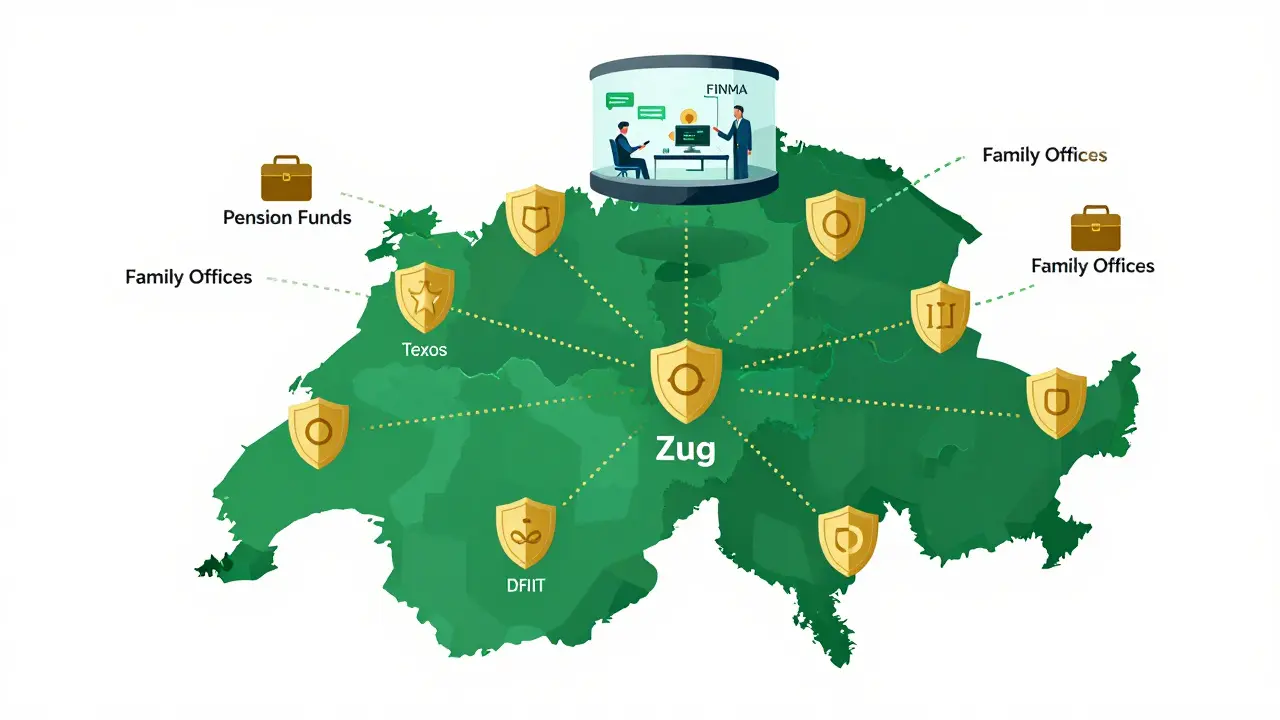
Today, the Crypto Valley the informal name for Switzerland’s concentrated blockchain ecosystem centered in Zug, extending to Zurich, Geneva, and other regions includes over 1,000 blockchain companies. About 300 of them are physically based in Zug. That’s more than any other single city in Europe. And it’s not just startups - the foundations for Tezos, Solana, Cardano, and DFINITY are all legally registered in Zug.
Tax Advantages That Actually Work
People often assume crypto hubs thrive because they offer zero taxes. Zug doesn’t do that. But it does something smarter: it offers targeted, predictable tax relief.
While Switzerland’s federal corporate tax rate is around 21%, Zug’s cantonal rate sits between 12% and 15% for blockchain firms - far below the global average of 20-25%. Some cantons even offer 10-year tax deductions for new companies. That’s not a loophole. It’s a structured incentive, written into law.
And then there’s the tax payment system. Since 2021, you can pay your local taxes in Bitcoin, Ethereum, or over a dozen other cryptocurrencies. No conversion needed. No exchange fees. The government uses Bitcoin Suisse as its official partner to handle the transactions. That means a company can earn crypto, spend crypto, and pay taxes in crypto - all within the same legal system.
For a startup that raised funds in ETH, this isn’t just convenient - it’s a massive operational simplification. No need to liquidate assets, no volatile exchange timing, no tax penalties from price swings. That kind of integration doesn’t exist anywhere else in the world.
Regulatory Clarity Over Hype
Zug doesn’t promise ‘no regulation.’ It promises clear regulation.
The Swiss Financial Market Supervisory Authority (FINMA) Switzerland’s federal financial regulator that provides licensing and oversight for crypto businesses, including exchanges, custody providers, and token issuers doesn’t block innovation - it defines it. In 2017, FINMA released its first guidelines for Initial Coin Offerings (ICOs). By 2022, it had expanded those into 47 specific interpretations covering everything from utility tokens to security tokens. That’s not vague policy. That’s a manual.
Want to launch a security token? FINMA has a checklist. Want to set up a crypto custody service? There’s a licensing path. Want to operate a decentralized exchange? There’s a legal category for that now. Most countries still treat DeFi as a legal gray zone. In Zug, it’s a regulated activity with defined rules.
And it works. Companies report that getting a FINMA license takes 3-6 months - longer than some places, but with far more certainty. You know what you’re signing up for. No surprises. No last-minute regulatory shifts. That’s why institutional investors, pension funds, and family offices all prefer Zug over jurisdictions that promise speed but deliver uncertainty.

Costs and Trade-offs
Zug isn’t cheap. And that’s intentional.
Office space in Zug averages CHF 1,200-1,500 per square meter per year. In Singapore, it’s closer to SGD 800-1,000. Salaries for blockchain engineers and compliance officers are among the highest in Europe. The cost to set up a blockchain foundation? CHF 15,000-25,000. Add FINMA registration, and you’re looking at CHF 25,000-40,000 total.
That’s a lot. But here’s the trade-off: you’re not paying for buzz. You’re paying for stability. A company in Zug doesn’t need a legal team just to interpret changing rules. It doesn’t need to hedge against regulatory shutdowns. It doesn’t need to relocate because a government changed its mind.
One founder on Reddit summed it up: ‘We moved from Lisbon because we were spending 40% of our time on compliance uncertainty. In Zug, we spend 40% of our time building the product.’
Who’s Winning in Zug?
The ecosystem isn’t just about Bitcoin startups. The real power lies in infrastructure.
According to the Crypto Valley Association’s 2024 report, 65% of projects in Zug are enterprise blockchain solutions - things like tokenized real estate, supply chain tracking, and digital identity systems. Only 20% are exchanges or wallets. And just 15% are DeFi apps.
Why? Because institutions don’t play with DeFi. They play with legal certainty. They want custody solutions that meet Basel standards. They want asset tokenization that complies with EU MiCA regulations. Zug delivers that. Liechtenstein handles institutional custody. Zurich handles venture funding. But Zug? Zug handles the legal backbone.
That’s why venture capital in Zug hit CHF 2.3 billion in 2023 - a 37% jump from the year before. Investors aren’t betting on hype. They’re betting on a system that’s been battle-tested for eight years.
What’s Next? The Roadmap
Zug isn’t resting. In 2024, it expanded tax payment options to include more cryptocurrencies. In early 2025, the Swiss federal government proposed a new Crypto Tax Reform Package to clarify capital gains rules for long-term holders.
The biggest development? The Regulatory Sandbox 2.0 a pilot program launched by the Crypto Valley Association in Q2 2025 to test decentralized finance protocols under controlled regulatory conditions, announced in June 2024. This isn’t a free-for-all. It’s a controlled environment where DeFi protocols can operate under FINMA supervision - with clear boundaries, reporting requirements, and exit paths.
That’s the Zug way: innovation, but with guardrails. No bans. No panic. Just structured testing.
Analysts from McKinsey and Gartner agree: Zug will remain Europe’s top blockchain hub through at least 2027. Why? Because while other places chase trends, Zug builds systems.
Final Thought: It’s Not About Being the Cheapest
Zug doesn’t win because it’s the easiest. It wins because it’s the most reliable.
If you’re a founder who’s tired of chasing regulatory whiplash - where every six months you have to rewrite your compliance plan - then Zug isn’t just an option. It’s the only smart choice. You pay more upfront. But you save years of stress, legal fees, and relocation costs.
The real crypto advantage isn’t in tax havens. It’s in legal havens. And Zug? It’s the only one that’s built to last.
Can I pay taxes in crypto in Zug?
Yes. Since 2021, Zug has allowed residents and businesses to pay cantonal taxes using Bitcoin, Ethereum, and over a dozen other cryptocurrencies through its official partner, Bitcoin Suisse. The payment is processed in real time, with no conversion fees or delays. This applies to income tax, corporate tax, and property tax.
Is Zug better than Singapore for crypto companies?
It depends on what you need. Singapore offers more direct government funding, lower office costs, and faster licensing for some services. But Zug offers legal certainty under a mature financial system. Singapore’s rules can shift with political cycles. Zug’s are anchored in Swiss law and the DLT Act. For long-term institutional players, Zug wins. For fast-moving startups chasing quick funding, Singapore might be better.
Do I need to be in Zug to benefit from its policies?
No. While Zug is the epicenter, Switzerland’s DLT Act applies nationwide. Many companies base their legal entity in Zug but operate remotely from Zurich, Geneva, or even abroad. The key is having a Swiss legal structure - usually a foundation or corporation registered in Zug - to access the benefits. You don’t need to live there, but you do need a Swiss legal presence.
How long does it take to set up a blockchain company in Zug?
Typically 4-6 months. First, you establish a legal entity (foundation or corporation), which takes 6-8 weeks and costs CHF 15,000-25,000. Then you apply for FINMA licensing, which takes 3-6 months depending on complexity. The total cost, including legal and compliance fees, is usually between CHF 25,000 and CHF 40,000. There’s no shortcut - but once approved, the regulatory stability lasts.
Are there any downsides to operating in Zug?
Yes. The main downsides are cost and speed. Office space and labor are expensive. Licensing takes longer than in places like Dubai or Estonia. There’s also a bureaucratic layer - you need local legal and compliance experts to navigate FINMA’s requirements. If you’re a solo founder with no team, it’s not the place to start. But if you’re scaling a serious business, the trade-off is worth it.
What types of companies thrive in Zug?
Companies that need legal certainty: blockchain foundations, security token issuers, institutional crypto custody providers, enterprise blockchain integrators, and regulated DeFi protocols. Startups focused on retail exchanges or anonymous DeFi apps often struggle here - the system is designed for compliance, not anonymity.
Is Zug’s crypto policy at risk of changing?
Unlikely. Switzerland’s political system is built on stability. The DLT Act is federal law, not a cantonal experiment. Even if the federal government changes, the legal framework is protected by decades of financial tradition and neutrality. The bigger risk isn’t policy reversal - it’s whether Zug can keep up with rapid tech changes like AI-driven DeFi or zero-knowledge proofs. But so far, its regulatory sandbox approach shows it’s adapting.
sruthi magesh
17 02 26 / 18:35 PMZug? More like Zug-land, where the Swiss government secretly controls the blockchain through a cabal of bankers and crypto-CEOs. They accept Bitcoin? Ha. It's just a front. The real power is in the Swiss banking secrecy laws that let them launder crypto through foundations. You think you're building a decentralized future? You're just another pawn in their Swiss bank vault.
Lisa Parker
19 02 26 / 12:03 PMi just can't with this. like, i get it, taxes in crypto sounds cool, but who even has that much crypto to pay taxes with?? i'm over here trying to afford ramen and they're like 'here's your 12% corporate rate in eth' lmao
Aileen Rothstein
21 02 26 / 10:59 AMThis is actually one of the most compelling models I've seen in crypto governance. The DLT Act isn't just legal innovation-it's institutional trust engineering. Most jurisdictions treat crypto as a problem to solve. Zug treats it as a system to integrate. The fact that you can pay property tax in ETH without conversion? That's not convenience. That's sovereignty. Companies aren't just relocating-they're rebirthing their operational DNA. And yes, the costs are high, but that's the price of predictability. You're not paying for a location. You're paying for time. Time you won't waste on regulatory whiplash. That's worth more than any grant or tax holiday.
JJ White
21 02 26 / 23:51 PMOH MY GOD. YOU PEOPLE ARE SO GULLIBLE. ZUG ISN'T A HUB. IT'S A TAX DODGE FOR RICH WHITE GUYS IN SUITS WHO WANT TO LOOK LIKE THEY'RE 'DISRUPTING' WHILE HIDING BEHIND SWISS NEUTRALITY. THE 'DLT ACT'? IT'S JUST A COVER FOR THE SWISS BANKING ELITE TO OWN THE NEXT GEN OF ASSETS. THEY LET YOU PAY TAXES IN BITCOIN? OF COURSE THEY DO. THEY CONTROL THE EXCHANGE PARTNER. THEY CONTROL THE FLOW. THEY CONTROL THE NARRATIVE. THIS ISN'T INNOVATION. IT'S A PSYCHOLOGICAL OPERATION TO MAKE YOU THINK YOU'RE FREE WHILE YOU'RE STILL WORKING FOR THEM.
Nicole Stewart
22 02 26 / 01:41 AMExpensive. Slow. Overregulated. The whole thing feels like a corporate brochure written by a PR firm hired by a Swiss law firm. If you're not a VC-backed entity with a legal team, you're just noise in the system.
yogesh negi
22 02 26 / 23:45 PMI really appreciate how Zug is creating a space where innovation can thrive without chaos. I come from India, where we're still trying to figure out if crypto is legal or not. But here, even with high costs, there's clarity. That’s priceless. I’ve seen too many startups burn out because they had to pivot every time the regulator changed their mind. Zug doesn’t promise fast money. It promises steady growth. And honestly? That’s the kind of foundation we need more of in the global ecosystem. Let’s not forget: stability isn’t boring. It’s the backbone of real progress.
Nikki Howard
24 02 26 / 04:03 AMThe 65% enterprise focus is statistically significant-but let’s be honest: this is just institutional crypto masquerading as decentralization. You call it 'legal certainty,' I call it regulatory capture. FINMA’s 47 interpretations? That’s not clarity-it’s a compliance maze designed to exclude small players. And the 'Regulatory Sandbox 2.0'? A PR stunt. Real DeFi doesn’t need permission. It thrives in the gray. Zug isn’t building the future. It’s fossilizing it.
Tarun Krishnakumar
24 02 26 / 22:28 PMYou think this is about blockchain? No. This is about control. The Swiss have been manipulating global finance for centuries. Now they’ve upgraded their system. Bitcoin? Ethereum? They’re just new currencies in an old game. The real power isn’t in the DLT Act. It’s in the fact that the Swiss National Bank holds the keys to the digital asset pipeline. They don’t need to ban crypto. They just need to license it. And then they own it. Every token. Every wallet. Every foundation. The 'crypto valley' isn’t a hub. It’s a trap. A beautifully designed, tax-efficient, Swiss-made trap for naive founders who think they’re building freedom. You’re not building a decentralized future. You’re building a new kind of central bank. And it’s wearing a suit.
Kyle Tully
26 02 26 / 08:39 AMHonestly? I’m impressed. I’ve seen so many places try to be crypto-friendly and end up looking like a meme. Zug doesn’t try to be cool. It just works. The tax payment system? Brilliant. The legal framework? Clean. Even the cost makes sense if you’re serious. You want to build something that lasts? You don’t chase cheap. You chase certainty. And yeah, it’s not for everyone. But for the ones who get it? It’s the only place that matters.
george chehwane
28 02 26 / 00:22 AMThe DLT Act isn’t innovation-it’s institutionalization. Zug didn’t embrace blockchain. It domesticated it. The whole ecosystem is a beautifully curated museum of crypto, where every token is tagged, every smart contract is audited, and every founder is required to submit a compliance flowchart before they can log into their office. The real crypto revolution? It happened in places with no rules. Not in cantons with 47 interpretations. You don’t need regulation to scale. You need chaos. And Zug? It’s the antithesis of chaos. It’s the corporate funeral of decentralization.