
Crypto Business Compliance Checker
Check Your Crypto Business Compliance
Determine if your business activities require registration with SUGEF under Costa Rica's new crypto regulations (Bill 22.837).
Costa Rica doesn’t have a law that says you can’t use Bitcoin. It also doesn’t have a law that says you can. That’s the core of the legal gray area for cryptocurrency in Costa Rica - and it’s exactly why so many crypto startups are setting up shop here.
What Does the Law Actually Say?
The Central Bank of Costa Rica made it clear back in 2017: Bitcoin and other cryptocurrencies are not legal tender. They’re not money in the eyes of the government. You can’t pay your taxes with them. You can’t use them to buy a house through a bank-financed mortgage. But here’s the twist - no one’s stopping you from using them in private deals. If you and a friend agree to trade Ethereum for a used car, that’s perfectly fine. The law doesn’t touch it. That’s not regulation. That’s silence. And in the world of crypto, silence can be louder than a ban.The 2025 Legislative Shift
On July 2, 2025, Costa Rica’s Legislative Assembly took its first real step toward closing that silence. Bill 22.837 passed its first debate. It’s not law yet - but it’s moving fast. The bill doesn’t legalize crypto. It doesn’t create a crypto license. Instead, it forces anyone offering crypto services - exchanges, wallets, custody platforms - to register with SUGEF, the country’s financial regulator. Under this new framework, a Virtual Asset Service Provider (VASP) is anyone who:- Exchanges crypto for colones or dollars
- Transfers crypto between users
- Stores crypto for others
- Issues or markets new tokens
Why This Isn’t a License
Here’s the catch: SUGEF says registration doesn’t mean approval. You’re not getting a green light. You’re just being added to a watchlist. The government isn’t saying, “You’re good to go.” It’s saying, “We’re watching you. Don’t mess up.” That’s why businesses still operate in a gray zone. Even if you’re registered, you have no legal protection if a client sues you. No clear rules on how to handle token sales. No guidance on whether NFTs count as securities. No court rulings to reference. You’re flying blind - but the radar is turning on.
Who’s Already Operating Here?
Costa Rica has become a magnet for crypto startups that want low cost and low friction. You won’t find a country with fewer barriers:- No minimum capital requirement to start a crypto business
- No need to have local directors or physical offices
- No licensing fees beyond standard corporate registration
The Hidden Risks
All this freedom comes with a price. The gray area means you’re always one step from trouble. If a transaction looks like money laundering - even if it’s not - your bank can freeze your account. SUGEF can demand records. The tax authority can question your income. And because there’s no clear law, courts have no precedent to follow. You could lose everything in a legal battle that takes years to resolve - and you won’t even know if you broke a rule. Banks in Costa Rica are nervous. Some won’t touch crypto companies at all. Others will work with you - but only if you jump through hoops: detailed business plans, personal guarantees from owners, proof of foreign revenue streams. It’s not impossible. It’s just expensive and slow. And then there’s the tax question. The government hasn’t said how crypto income is taxed. Is it capital gains? Business income? Foreign earnings? No guidance. Most companies treat it as business income and pay corporate taxes. But if the tax authority later decides it’s personal income, you could owe back taxes, penalties, and interest.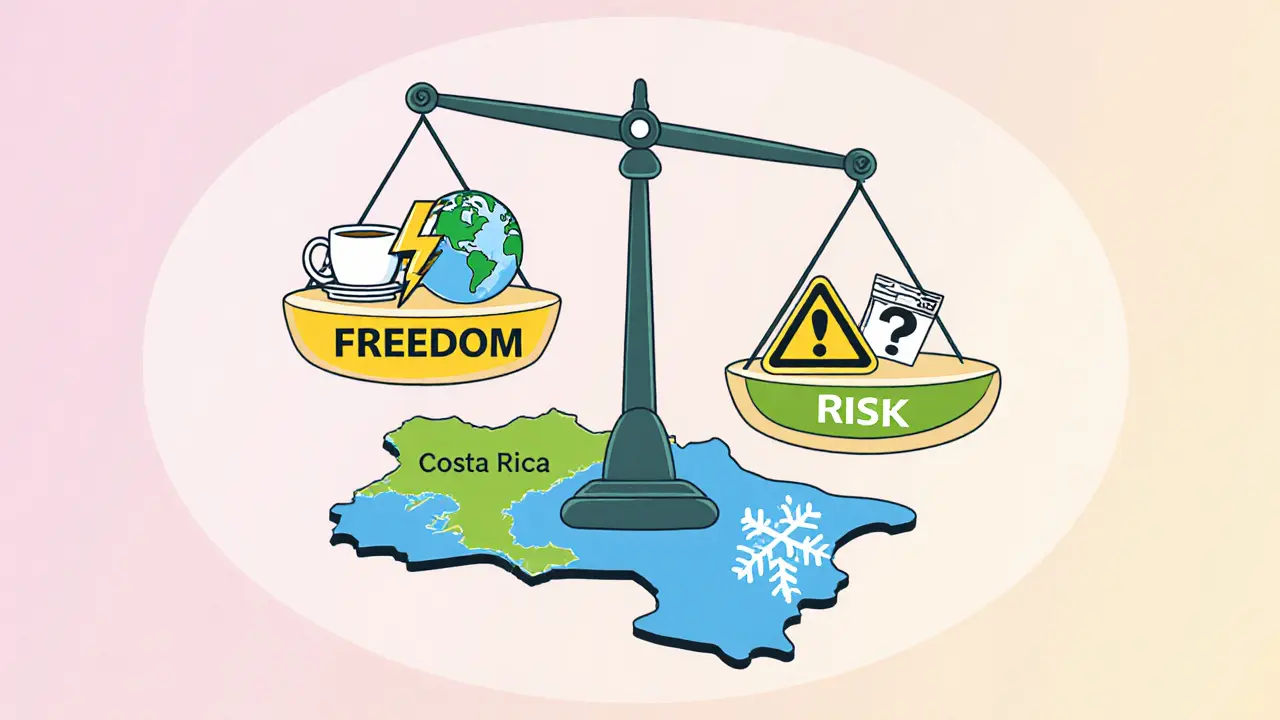
Why Costa Rica Still Wins
Despite the risks, Costa Rica keeps pulling in crypto businesses - and for good reason.- Political stability: Unlike neighbors with sudden policy flips, Costa Rica has had peaceful democratic transitions for decades.
- Infrastructure: Reliable internet, modern co-working spaces, and English-speaking talent make it easy to run a tech business.
- Tax advantages: No capital gains tax on foreign-sourced income. Low corporate tax rates. No wealth tax.
- Speed: Company registration takes 3-5 days. Bank account setup? That’s the bottleneck - but even that’s faster than in Panama or Uruguay.
What Should You Do?
If you’re thinking of launching a crypto business in Costa Rica:- Register your company with the National Registry. Get a legal address. Open a corporate bank account.
- Prepare for SUGEF registration. Build your AML/KYC system now - don’t wait for the law to pass.
- Consult a local lawyer who’s worked with crypto clients. Don’t rely on templates from other countries.
- Assume the gray area will shrink. Build compliance into your model from day one.
- Keep all records. Every transaction. Every client ID. Every communication. You’ll need them.
What’s Next?
Bill 22.837 still needs two more debates and presidential approval. That could take months - or even a year. But once it’s law, Costa Rica will no longer be a true gray zone. It’ll be a lightly regulated space - still open, still easy, but with clear rules you must follow. The future isn’t prohibition. It’s oversight. And the businesses that prepare now will be the ones that survive.Is cryptocurrency legal in Costa Rica?
Yes, but not as legal tender. You can use Bitcoin, Ethereum, and other cryptocurrencies for private transactions without breaking the law. However, the government doesn’t recognize them as money, and no official system supports them. Businesses can operate, but they do so without legal protection or clear guidelines.
Do I need a license to run a crypto exchange in Costa Rica?
Not yet - but you will soon. As of July 2025, a new bill requires all Virtual Asset Service Providers (VASPs) to register with SUGEF. Registration isn’t a license to operate - it’s a compliance requirement to prevent money laundering. If you’re running an exchange, wallet, or custody service, you must register once the law passes.
Can I open a bank account for my crypto business in Costa Rica?
It’s possible, but difficult. Many banks avoid crypto businesses due to regulatory uncertainty. Those that do work with them require extensive documentation: business plans, proof of foreign income, personal guarantees, and detailed AML procedures. Expect delays and higher scrutiny than for traditional businesses.
Are crypto profits taxed in Costa Rica?
There’s no official guidance, but most crypto businesses treat gains as business income and pay corporate taxes. Foreign-sourced income isn’t taxed. However, the tax authority hasn’t ruled on whether crypto trading is capital gains or business revenue. This uncertainty means you could face back taxes if the government changes its stance later.
Why are so many crypto startups choosing Costa Rica?
Because it’s one of the cheapest and fastest places in Latin America to set up. No minimum capital, no local director requirement, no special crypto license fees, and low corporate taxes. Combined with political stability and good internet infrastructure, it’s ideal for startups looking to launch quickly without heavy compliance costs - for now.
What happens if the new crypto law passes?
The gray area won’t disappear - but it will shrink. VASPs will have to register with SUGEF and follow strict AML/KYC rules. The government won’t endorse crypto, but it will demand accountability. Businesses that ignored compliance will face fines or shutdowns. Those that prepared early will keep operating with fewer surprises.
Is Costa Rica safer for crypto than Panama or Colombia?
For now, yes - but only if you’re a small startup. Panama has stricter banking rules and more enforcement. Colombia has formal licensing requirements. Costa Rica still offers lower barriers to entry. But Panama and Colombia have clearer laws. Costa Rica’s advantage is speed and cost - not legal certainty. As laws tighten, that gap will narrow.
Tatiana Rodriguez
29 11 25 / 19:27 PMOkay so imagine this: you’re sipping coconut water on a beach in Tamarindo, your laptop open to a crypto dashboard, and you just sent 5 ETH to a dude in Lisbon for a hand-carved wooden surfboard… and no one’s coming to arrest you. That’s Costa Rica. No law says you can’t. No law says you can. It’s like the government shrugged and said, ‘Do your thing, just don’t make it messy.’ And honestly? That’s the most beautiful form of libertarianism I’ve ever seen. People think regulation = safety. But sometimes silence is the ultimate freedom. Until it’s not. And it’s not gonna last forever.
But let’s be real - the second someone gets hacked, or a crypto casino gets flagged for money laundering, the whole house of cards comes down. And suddenly, the ‘gray area’ becomes a crime scene. The bill isn’t about control - it’s about damage control. SUGEF doesn’t want to ban crypto. They just don’t want to be blamed when it blows up in their faces.
I’ve talked to founders who moved here from Ukraine and Nigeria. They didn’t come for the beaches. They came because in their home countries, the banks wouldn’t even return their emails. Here? You get a company registered in 72 hours. No background checks. No ‘prove you’re not a terrorist’ forms. Just paperwork and a prayer. And that’s the magic. Not the tech. Not the blockchain. The sheer, unadulterated *speed*.
But here’s the twist - the people who thrive here aren’t the ones trying to ‘disrupt finance.’ They’re the ones who treat this like a summer rental. Rent the infrastructure, run the business, cash out before the law catches up. It’s not a home. It’s a launchpad. And that’s why the tax question is so terrifying. No one knows if your crypto profits are business income or personal gains. So you pay taxes like a corporation… but if the IRS or the Costa Rican tax authority decides later it’s personal? You owe back taxes, penalties, interest, and maybe a new passport.
And don’t get me started on banks. Some will work with you if you bring them a business plan thicker than War and Peace. Personal guarantees? Check. Proof of foreign revenue? Check. Notarized letters from your grandma saying you’re not laundering drugs? Not yet… but it’s coming. The banks are terrified. And they’re making it expensive to be brave.
But still. I’d rather be in this gray zone than in a country where you need a license to breathe. At least here, you can move. You can build. You can experiment. And if you’re smart? You build your exit strategy before the cameras turn on.
ashi chopra
29 11 25 / 23:57 PMThis is so beautifully written. I’m from India and honestly, I’ve been watching this with awe. The fact that Costa Rica lets people operate without drowning them in red tape… it’s rare. I wish we had even a fraction of this openness. Not everyone here is a criminal. Not every crypto business is a scam. Sometimes, silence is just space - space to grow, to learn, to fail safely. I hope they keep it that way a little longer.
Darlene Johnson
30 11 25 / 02:34 AMOf course they’re not regulating it. The government is in on it. This is a front for the CIA’s crypto laundering ops. You think they let startups set up shop here for ‘low cost’? Nah. They’re using these ‘GameFi platforms’ to move black money through NFTs and ‘token sales’ while pretending to be ‘innovative.’ The ‘registration’? That’s just so they can track everyone. They’re building a digital surveillance state under the guise of ‘anti-money laundering.’ Wake up. This isn’t freedom. It’s control with a smile.
Ivanna Faith
1 12 25 / 05:20 AMSo… no license? But you gotta register? So it’s like… a registration license? 🤔 I’m confused. Also why are people so shocked? Of course they’re gonna regulate it. Everything becomes regulated eventually. Even love. 💔
Akash Kumar Yadav
2 12 25 / 04:30 AMCosta Rica? Pfft. India has 1.4 billion people and we don’t need some tiny country to show us how to do crypto. We have our own blockchain initiatives. We have our own tech. Why are we even talking about this? It’s just another Western fantasy. You think your ‘gray area’ is genius? We’ve been running crypto exchanges in Mumbai since 2017 with zero regulation - and no one’s crying. We don’t need your SUGEF. We don’t need your ‘AML.’ We have discipline. You have chaos.
alex bolduin
2 12 25 / 19:37 PMThere’s something poetic about a country that doesn’t try to own your money. The law doesn’t say you can’t use Bitcoin - so you do. It’s not rebellion. It’s just… living. Like breathing. No permit needed. The government isn’t stopping you. It’s just watching. And maybe that’s the most honest form of governance. Not control. Not permission. Just presence. Letting things happen. Letting people figure it out. The problem isn’t the gray area. The problem is we’re scared of gray. We want black and white. But life? Life is gray. And crypto? It’s the most human thing we’ve built yet - messy, unregulated, alive.
Vidyut Arcot
4 12 25 / 13:20 PMFor anyone thinking of starting here - don’t wait for the law to pass. Start building your compliance stack today. KYC? Do it. Transaction logs? Keep them. Lawyer? Hire one who’s actually worked with crypto, not just corporate law. This isn’t a gamble. It’s a marathon. The gray area is shrinking, but the window is still open. Walk through it now - not when it’s a door slamming shut. You’ve got time. Use it wisely.
Jay Weldy
5 12 25 / 16:40 PMI love this. Not because it’s easy - but because it’s real. People are building, creating, trying. Not waiting for permission. That’s the spirit of innovation. Even if it’s messy. Even if it’s risky. Even if the banks are scared. This is what happens when you let people be creative without a rulebook. And yeah, it’ll get regulated. But for now? Let them breathe. Let them build. Let them fail. That’s how the future gets made.
Melinda Kiss
5 12 25 / 18:03 PMThank you for writing this so clearly. I’ve been researching this for months and this is the first time I felt like I understood the real stakes. The tax uncertainty is terrifying, but the fact that you can register a company in 3 days? That’s revolutionary. I’m considering moving my startup here. I’ll be following your advice - build compliance now, assume the gray will vanish, and document everything. Thank you for the clarity. 🙏
Greer Dauphin
7 12 25 / 04:58 AMWait so if I trade crypto with my buddy for a surfboard, the government doesn't care? But if I do it on an app? Then I gotta register? That's like saying it's fine to sell lemonade on the sidewalk but if you open a stand you need 17 permits. What kind of logic is this? 😅
Bhoomika Agarwal
7 12 25 / 12:57 PMCosta Rica? More like Crypto-Rica. The land of ‘oops we didn’t think this through’ and ‘we’ll fix it when someone gets hacked.’ These startups aren’t innovators - they’re legal tourists. They show up, cash in, vanish. Meanwhile, real people here get stuck with the mess when the banks freeze accounts or the tax department starts asking questions. It’s not freedom. It’s exploitation dressed up as entrepreneurship.
Katherine Alva
8 12 25 / 03:01 AMIt’s interesting how we equate regulation with safety - but sometimes, the absence of rules lets humanity find its own balance. Like how people used to trade goods without contracts. We didn’t need laws to be honest. We needed trust. Maybe crypto is asking us to rebuild that. Not with government oversight - but with better tech, better transparency, better community. The law might catch up… but maybe the spirit of this will outlast it.
Nelia Mcquiston
8 12 25 / 13:02 PMThe more I read about this, the more I think Costa Rica isn’t a loophole - it’s a mirror. We’re all trying to figure out how to live with decentralized systems. Governments don’t know what to do. Banks are terrified. People are experimenting. And this tiny country? It’s just letting it happen. Maybe that’s the real lesson here: not how to regulate crypto… but how to live with uncertainty. And maybe that’s the hardest thing of all.
Mark Stoehr
10 12 25 / 09:52 AMEveryone’s acting like this is some kind of paradise. It’s not. It’s a lawless free-for-all. You think these ‘startups’ are legit? Half of them are shell companies run by Russians and Nigerians. And the ‘bank accounts’? They’re all fake. This isn’t innovation. It’s a money laundering playground. And when it collapses? Costa Rica will be the one left holding the bag. And you know what? They deserve it for being so naive.
Reggie Herbert
11 12 25 / 09:35 AMLet’s be clear: SUGEF registration isn’t compliance. It’s surveillance. VASP = Virtual Asset Surveillance Platform. They’re not trying to protect the system. They’re trying to control it. This isn’t about AML. It’s about centralization. The moment you force KYC on crypto, you kill its core value proposition: anonymity. This bill isn’t progress. It’s the beginning of the end.
Murray Dejarnette
13 12 25 / 05:47 AMOkay but like… if you’re running a crypto casino and you register with SUGEF… are you basically saying ‘Hey government, I’m a gambling addict with a wallet’? Like… why would you volunteer for that? You’re literally giving them your entire transaction history. And then they say ‘we’re not approving you’? So you’re paying for the privilege of being watched? That’s not regulation. That’s extortion with a spreadsheet.
Sarah Locke
14 12 25 / 16:23 PMTo every founder reading this: You are not just building a business. You’re building a movement. This isn’t about tax loopholes or bank accounts. It’s about proving that innovation doesn’t need permission. That freedom isn’t granted - it’s claimed. So yes, register. Yes, comply. Yes, document everything. But don’t forget why you started. You didn’t come here to follow rules. You came here to rewrite them. Keep going. We’re watching. And we’re rooting for you.
Mani Kumar
15 12 25 / 17:54 PMCosta Rica’s model is unsustainable. No capital requirement? No local directors? This isn’t entrepreneurship - it’s regulatory arbitrage. Real businesses need structure. Real economies need rules. This is a temporary anomaly. It will collapse. And when it does, the world will laugh at those who thought silence was strategy.
Philip Mirchin
17 12 25 / 10:59 AMAs someone who’s lived in both the US and India, I’ve seen how heavy regulation kills innovation. Costa Rica isn’t perfect - but it’s got something rare: space. Space to try. Space to fail. Space to learn. I’ve seen startups here turn $500 into $50k in 6 months. Not because they’re geniuses. Because they weren’t blocked. That’s worth more than any license. Keep the door open. Even if it’s just a crack.