BRICK Slippage Calculator
Estimate how much value you'd lose when selling BRICK tokens based on current market conditions
Current Market Conditions
Based on December 2025 data from the article
Estimated Loss
Current Value
$0.00
Slippage Loss
$0.00
Value After Sale
$0.00
Effective Price
$0.000000
BrickCoin (BRICK) isn’t a project. It’s not a platform. It’s not even really a coin in the way Bitcoin or Ethereum are coins. It’s a meme. A digital lottery ticket wrapped in a green brick avatar, trading on Solana with less than $10,000 in total value. If you’ve seen posts on Twitter saying “BRICK to the moon!” or Telegram groups promising 10x returns, you’re seeing the marketing. What’s underneath is something far less exciting-and far riskier.
What BrickCoin actually is
BrickCoin (BRICK) is a token built on the Solana blockchain. It launched in December 2024, created by an anonymous developer known only as ‘a1lon9’. The whole thing started with a single tweet showing a pile of green bricks, like a child’s toy chest, with the caption “brick by brick.” That’s it. No whitepaper. No team. No roadmap. No utility. Just a meme.
There are 1 billion BRICK tokens in total. About 994 million are already in circulation. At a price of around $0.000008, that means you can buy millions of tokens for just a few dollars. That’s the hook. It feels like you’re getting something for almost nothing. But here’s the catch: value isn’t about how many tokens you own. It’s about what they’re worth when you try to sell them.
The numbers don’t lie
As of December 5, 2025, BrickCoin’s market cap hovers between $6,800 and $9,600. That’s less than the cost of a decent smartphone. For comparison, Dogecoin has a market cap of over $13 billion. Even smaller Solana meme coins like WIF are worth over $1 billion.
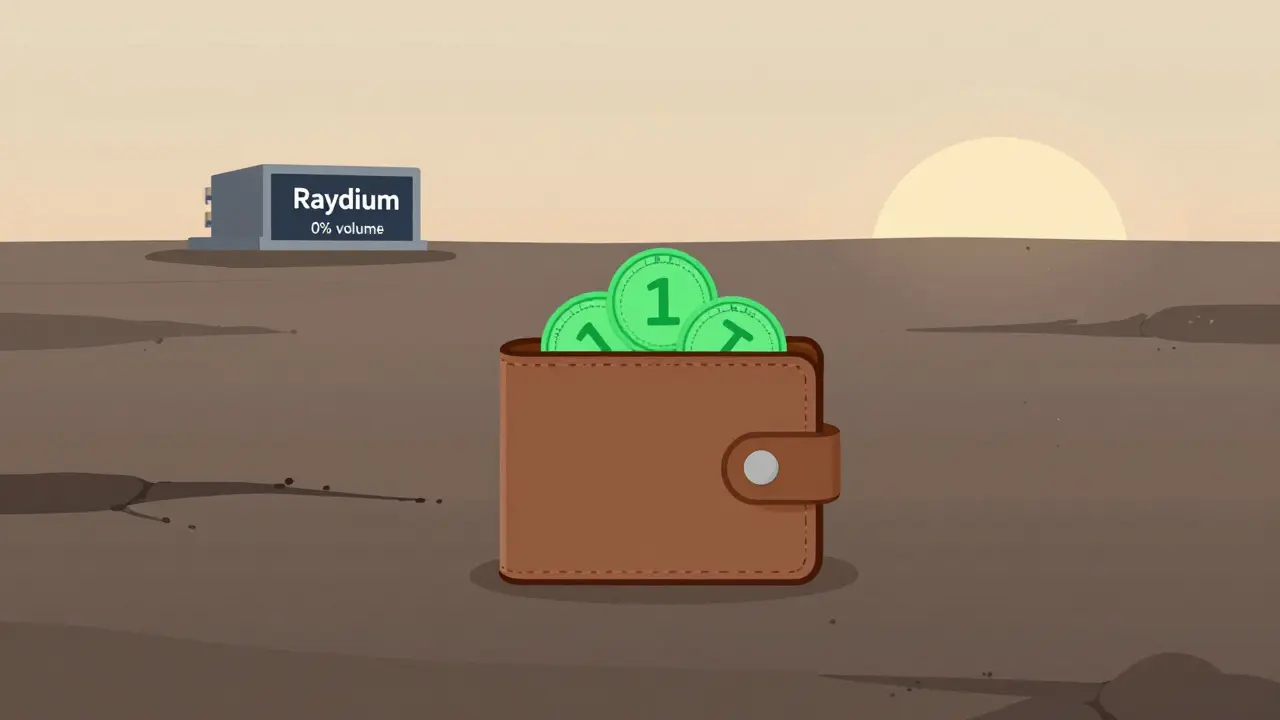
Trading volume? Forget it. On some exchanges, BRICK trades $0 in 24 hours. On others, it’s around $33. That’s not a market. That’s a whisper. If you try to sell 100 million BRICK tokens, you won’t find buyers. The order book disappears. Slippage eats 50%, 80%, even 90% of your position. People on Reddit and Twitter are posting screenshots of failed sells. One user said it took him three days to dump 100 million BRICK-and he lost most of his money in the process.
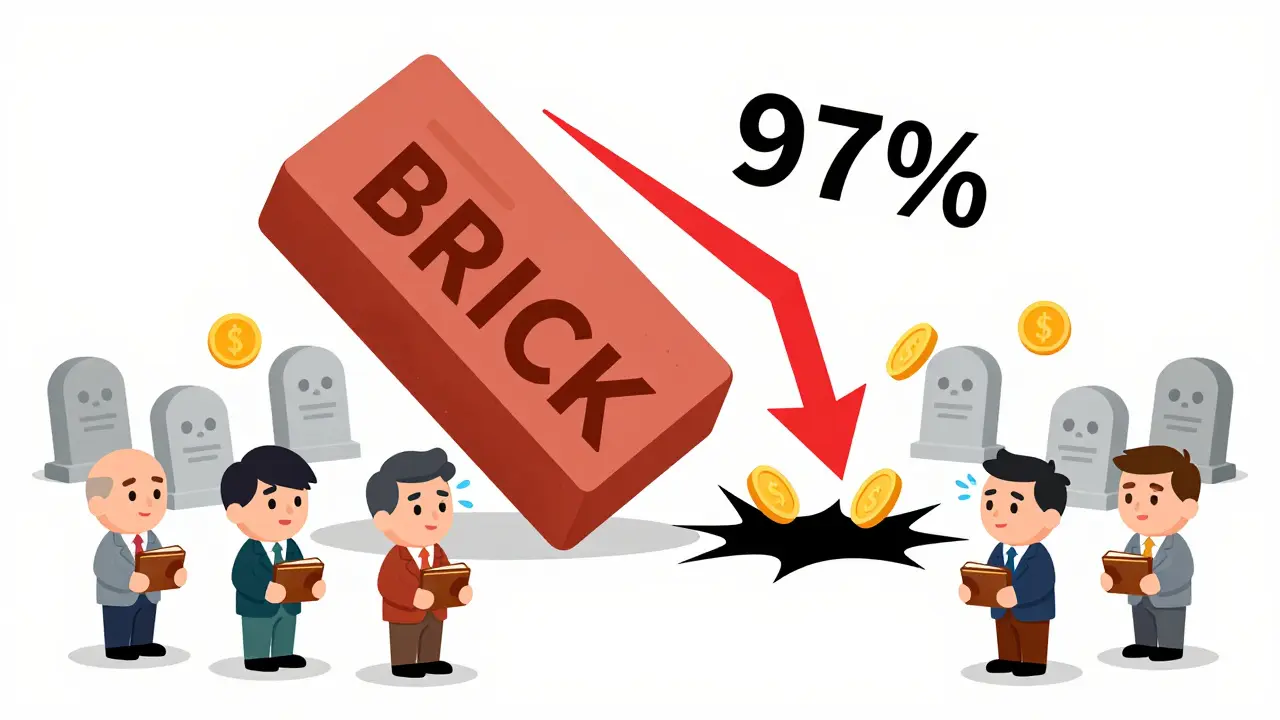
The all-time high was $0.0003017 in September 2025. Today, it’s down over 97%. That’s not a correction. That’s a collapse. And there’s no sign of recovery.
Why people still buy it
Why does anyone still trade BRICK? Because of hope. And FOMO.
There are about 2,500 wallets holding BRICK. Most of them have less than $10 worth. A handful of wallets-just 10-hold over 70% of all tokens. That’s called centralization. And it’s a red flag. Those big holders can dump their coins anytime. When they do, the price crashes. And because liquidity is so low, there’s nothing to stop it.
Signal groups and VIP clubs push BRICK hard. They promise “10x” gains. They post fake charts. They hype it as the “next WIF.” But here’s the truth: those same groups were pushing 1,200 other Solana meme coins in 2025. Almost all of them are dead now. Only 3% of new meme coins on Solana survive past 90 days with any real volume.
People who win? They bought at $0.000005, held 100 million tokens, and sold at $0.000010. They made $5. They call it a win. But they didn’t invest. They gambled. And they got lucky.
How to buy BrickCoin (if you really want to)
If you still want to try, here’s how it works:
- Get a Solana wallet like Phantom or Solflare. You need this to hold BRICK.
- Buy SOL (Solana’s native coin) on an exchange like Kraken or Binance.
- Transfer SOL to your wallet.
- Go to a decentralized exchange like Raydium or Jupiter.
- Swap SOL for BRICK. Set your slippage tolerance to 5-10%. If you don’t, your trade will fail.
That’s it. No KYC. No verification. Just a wallet, some SOL, and a lot of risk.
Transaction fees on Solana are cheap-about $0.00025 per swap. But that doesn’t matter if you can’t sell later.
Who’s behind BrickCoin?
No one knows. The creator disappeared after the first tweet. There’s no team website. No GitHub. No Discord server with developers. No updates since December 2024. That’s normal for meme coins-but it’s not normal for something that wants to be taken seriously.
Experts call it a “pump-and-dump setup.” Dr. Sarah Chen from MIT Blockchain Lab said BRICK is “classic infrastructure targeting inexperienced retail investors.” Binance Research called it “speculative excess.” CoinGecko gave it a 2.6 out of 10. Michael van de Poppe from Material Indicators said tokens under $10,000 market cap have “near-impossible odds” of surviving.
And he’s right. Chainalysis found that 78% of meme coins under $10,000 die within 90 days. BrickCoin is six months old. It’s already lost 95% of its peak value. The writing is on the wall.
Is BrickCoin worth it?
If you’re looking for an investment? No. It’s not. There’s no utility. No adoption. No growth. Just noise.
If you’re looking for a $5 gamble? Maybe. Some people treat BRICK like a scratch-off lottery ticket. They buy a few million tokens, watch the chart, and laugh when it moves. They don’t expect to get rich. They just want to see if it’ll pop.
But here’s the reality: even that kind of fun comes with pain. Over 78% of negative reviews on exchanges mention “impossible to sell.” One user wrote: “Tried to sell my BRICK and the slippage ate 80% of my position.” Another said: “Took three days to dump it. Lost everything.”
And if you’re thinking, “What if it goes viral?”-that’s a gamble on a gamble. The Solana meme coin space has over 1,200 new tokens in 2025. Only three made it past $100,000 daily volume. BRICK isn’t even close. It’s one of the lowest-ranked coins on CoinMarketCap (#8802). It’s not going viral. It’s fading.
What happens next?
BrickCoin’s future is already written. Delphi Digital predicts 92% of tokens like BRICK will become completely illiquid within 12 months. The biggest risk? Exchange delisting. If Kraken or Gate.io removes BRICK, there’s nowhere to trade. No liquidity. No buyers. Just dead tokens in your wallet.
Wendy O from Bloomberg Crypto put it simply: “Tokens with sub-$10,000 market caps and no utility have effectively zero chance of surviving the next market cycle.”
BrickCoin doesn’t need to be a scam to be worthless. It just needs to be forgotten.
It’s not the next big thing. It’s the last thing before the crash.
Chris Mitchell
6 12 25 / 23:21 PMBrickCoin isn't a coin. It's a mood. A collective sigh from people who think luck is a strategy.
Nothing to fix. Nothing to build. Just a digital slot machine with a green brick logo.
Martin Hansen
8 12 25 / 06:42 AMOh wow. Another ‘I bought 100 million tokens and now I’m broke’ sob story. You people are the reason crypto has a bad name.
Did you also cry when your Monopoly money didn’t buy you a yacht? Pathetic.
Scott Sơn
9 12 25 / 07:40 AMBRICK isn’t dead - it’s in witness protection.
Its last words were ‘I believed in the dream’ as it got buried under 994 million other tokens nobody asked for.
Imagine your life’s savings wrapped in a Lego brick and tossed into a dumpster fire while someone screams ‘10x or GTFO!’
That’s not investing. That’s performance art for the ADHD generation.
And the worst part? The devs probably bought a yacht with the liquidity and are sipping mai tais in Bali right now.
Meanwhile, you’re staring at your wallet wondering why your 50 million BRICK is worth less than your last Starbucks receipt.
It’s beautiful. In a tragic, Kafkaesque, ‘I paid $3 for this and now I’m spiritually hollow’ kind of way.
BrickCoin is the cryptocurrency equivalent of a haunted toy from a 90s garage sale.
It doesn’t need utility. It needs a therapist.
And maybe a funeral.
Rest in peace, BRICK. You were the meme we all needed… and the one we deserved.
Frank Cronin
9 12 25 / 23:22 PMWow. Someone actually wrote a 2,000-word obituary for a meme coin that’s worth less than a burrito.
What’s next? A TED Talk on why your pet rock failed to disrupt the real estate market?
You people treat crypto like a bingo game and then act shocked when you lose.
There’s no ‘truth’ here. Just consequences for people who don’t read the fine print.
And yes - if you bought BRICK, you’re the problem.
Not the devs. Not Solana. You.
Go back to your NFT monkey pajamas.
Stanley Wong
11 12 25 / 09:28 AMI get why people buy BRICK it’s not about the money it’s about the feeling of being part of something even if it’s just a glitch in the system
you know like when you see a weird meme and you laugh even though you don’t get it
it’s the same with BRICK it’s not an investment it’s a shared moment of absurdity
and yeah maybe you lose money but you also get to be part of this weird internet culture
people say it’s stupid but isn’t all of crypto stupid at this point
we’re all just trying to find meaning in a world that doesn’t make sense
and if a green brick can give you five minutes of hope that’s not nothing
maybe the real scam is believing that anything in this space is ever going to be rational
BRICK is just the mirror holding up our own madness
and i’m not saying it’s smart i’m just saying it’s human
miriam gionfriddo
11 12 25 / 12:06 PMOMG I JUST SOLD MY BRICK AND THE SLIPPAGE ATE 92% OF MY PORTFOLIO I WAS CRYING IN THE BATHROOM I THOUGHT I WAS A GENIUS BUT I WAS JUST A SLOPPY GAMBLED AND NOW I HAVE 75 MILLION BRICK THAT ARE WORTH LESS THAN MY PHONE CASE I HATE THIS I HATE MYSELF I HATE SOLANA I HATE THE DEV I HATE EVERYTHING
Kenneth Ljungström
13 12 25 / 05:26 AMHey everyone - just wanted to say I appreciate the honesty in this post.
It’s easy to get caught up in the hype but this is a good reminder to ask: why am I doing this?
If you’re buying BRICK for fun, cool. Spend what you’re okay losing.
If you’re hoping to retire on it… maybe take a step back.
There’s room in crypto for both serious builders and silly memes.
Just don’t confuse the two.
And if you’re feeling down after a loss - reach out. We’ve all been there.
💙
Brooke Schmalbach
15 12 25 / 00:25 AMBrickCoin’s market cap is lower than the cost of a decent coffee maker.
Yet somehow you still think it’s a viable asset class?
Let me guess - you also believed in the ‘Bitcoin will be worth $1 million’ hype in 2017 and bought at $15,000?
You’re not a visionary. You’re a victim of cognitive dissonance.
There’s no ‘if it goes viral’ - it won’t.
It’s not even on the radar of any serious exchange anymore.
And no, your 100 million tokens aren’t ‘a lot’ - they’re a graveyard.
Stop romanticizing failure.
It’s not a story. It’s a statistic.
Cristal Consulting
16 12 25 / 17:15 PMSome of you are so angry. But remember - no one forced you to buy it.
And no one’s stopping you from walking away.
It’s okay to admit you got caught up.
It’s not weakness. It’s awareness.
Next time? Set a hard limit. $5. One trade.
Then walk away.
You’ll sleep better.
And honestly? You’ll thank yourself later.
You got this. 💪
Tom Van bergen
18 12 25 / 07:19 AMWho says it has to have utility
Who says it has to be rational
Who says anything in crypto ever was
BRICK is the purest form of crypto
It’s just vibes
And if you need a whitepaper to feel safe
you were never meant to be here in the first place
Sandra Lee Beagan
18 12 25 / 18:29 PMAs someone who grew up in a household where ‘investing’ meant buying a new pair of boots for winter - I find this both hilarious and heartbreaking.
BrickCoin feels like the digital version of those Canadian lottery tickets you buy at the gas station because it’s $2 and you’re bored.
It’s not about the return.
It’s about the ritual.
And honestly? That’s okay.
As long as you know you’re not playing the market.
You’re playing the story.
And stories? They’re free.
But wallets? Not so much.
Just keep your eyes open.
And maybe don’t tell your grandma.